

Most of the time, a car AC not cold comes down to one of three things: low refrigerant from a leak, weak airflow across the condenser, or a compressor that isn’t engaging. Run the quick checks below first. If your vents still blow warm, or you notice grinding, oily residue, or an overheating engine, stop troubleshooting and get the system tested by a professional.
TL;DR:
- Checking the compressor clutch engagement and airflow across the condenser can identify most causes of warm air at idle.
- A rapid cycling of the compressor clutch typically indicates a low refrigerant charge needing professional evaluation.
- Symptoms like warm air at idle but cool while driving usually point to airflow issues with the condenser or fan, not refrigerant leaks.
- Do not attempt refrigerant recovery, recharge, or stop-leak additives yourself, as these can cause more damage and are best handled by professionals.
- Proper diagnosis involves pressure testing and leak detection, with repairs costing from simple recharge to condenser or compressor replacement, backed by warranties.
Table of Contents
- Fix Car AC Not Cold: A Step-by-Step Diagnostic Checklist
- Which DIY Checks Are Safe, and Where Should You Stop?
- Why Is My Car AC Warm at Idle But Cold While Driving?
- When Should You Stop Troubleshooting and Call a Shop?
- What Does It Typically Cost to Fix Car AC Problems?
- How Can You Prevent AC Problems Before They Start?
- How We Diagnose Car AC Problems at Express Lube & Car Care
- Fast Diagnosis Beats Guessing Every Time
- Get Your AC Diagnosed Right the First Time
- Sources
- FAQ
Fix Car AC Not Cold: A Step-by-Step Diagnostic Checklist
Before you assume the worst, spend ten minutes running through this sequence. It won’t fix a refrigerant leak, but it will tell you a lot about where the problem lives.
- Set the controls correctly. Put the system on MAX A/C, turn on recirculate, set the fan to its highest speed, and close the windows. This removes outside-air variables before you measure anything.
- Measure the center vent temperature. Hold a thermometer at the center vent for a minute with the engine at a steady idle, then again while driving. A healthy system usually pushes air well below outside ambient temperature.
- Check the cabin air filter. A clogged filter starves the blower and can make a fully functional AC feel weak. Compare airflow strength across all vents, not just the center one.
- Look through the front grille. Leaves, bugs, and road debris pack into the condenser fins and block the airflow the system needs to shed heat.
- Watch the condenser fan. With the engine running and the AC on, the fan (or fans) in front of the radiator should spin. If it’s silent or intermittent, that’s a strong lead.
- Watch the compressor. Look at the compressor clutch (or listen for the click of an electric compressor) to confirm it’s engaging when the AC is switched on.
- Check the fuse and swap the relay. Pull the AC fuse and inspect it, then swap in an identical relay from elsewhere in the fuse box to rule out a bad relay cheaply.
- Look for oily residue. Oily film or wet spots near the service ports, hose fittings, or condenser almost always point to a refrigerant leak, since refrigerant carries compressor oil with it as it escapes.
Pro Tip: Do this checklist twice, once at idle in your driveway and once after ten minutes of highway driving. Symptoms that appear only at idle almost always point to airflow, not refrigerant.
For a longer walkthrough with photos of what each failure point looks like, our step-by-step AC diagnostic guide covers the same checks in more depth.
Which DIY Checks Are Safe, and Where Should You Stop?
The checklist above is safe because none of it touches the pressurized side of the system. That’s the line you don’t want to cross on your own.
- Vent temperature checks, fan observation, and clutch engagement are all fine to do yourself with the hood open and the engine running.
- Fuse pulls and relay swaps are low-risk, low-cost tests that a lot of shops start with before anything more invasive.
- Skip refrigerant recovery, evacuation, or any at-home recharge kit. A do-it-yourself R-134a top-off skips the vacuum step that pulls out air and moisture, so it often looks like a fix for a week or two, then fails again.
- Stay away from stop-leak additives. They frequently clog small passages like the orifice tube or expansion valve, turning a simple leak repair into a much bigger job.
Pro Tip: If the compressor clutch is cycling on and off rapidly rather than staying engaged, that short-cycling is a classic low-charge symptom. Get it checked before the compressor burns itself out.
Our DIY car AC guide has more detail on which fixes are genuinely safe to attempt at home.
Why Is My Car AC Warm at Idle But Cold While Driving?
The pattern your AC follows tells you almost as much as a gauge reading would. Match your symptom to the likely cause before you call the shop, and you’ll get a faster, more accurate diagnosis.
| Symptom pattern | Likely cause |
|---|---|
| Cold while driving, warm at idle | Weak condenser airflow or a failed condenser fan |
| Cool, but never actually cold | Low refrigerant charge, blocked condenser, or weak compressor output |
| Strong airflow, but no cooling at all | Compressor not running, a pressure-related shutdown, or a blend-door mixing fault |
| One side cold, other side warm (dual-zone) | Blend door actuator problem on the warm side |
That first row is one of the most common complaints shops hear, and it’s almost always airflow related rather than a refrigerant problem, since highway speed forces air through the condenser that the fan alone can’t move at idle. The blend-door pattern deserves special mention: it can mimic a dead AC system entirely, but the compressor and refrigerant charge might be perfectly fine, while a stuck actuator is quietly mixing in heat behind the dash.
When Should You Stop Troubleshooting and Call a Shop?
Certain signs mean the checklist has done its job, and it’s time to hand the problem to a technician with the right tools.
Call a shop if you notice any of the following:
- The compressor never engages, even briefly, when the AC is switched on.
- You hear grinding, squealing, or a new noise when the AC compressor should be running.
- Oily residue shows up near hoses, fittings, or the condenser.
- Engine temperature climbs when the AC is running, which can point to a bigger cooling-system issue.
- The system tests completely empty, meaning there’s a leak somewhere that a simple recharge won’t solve.
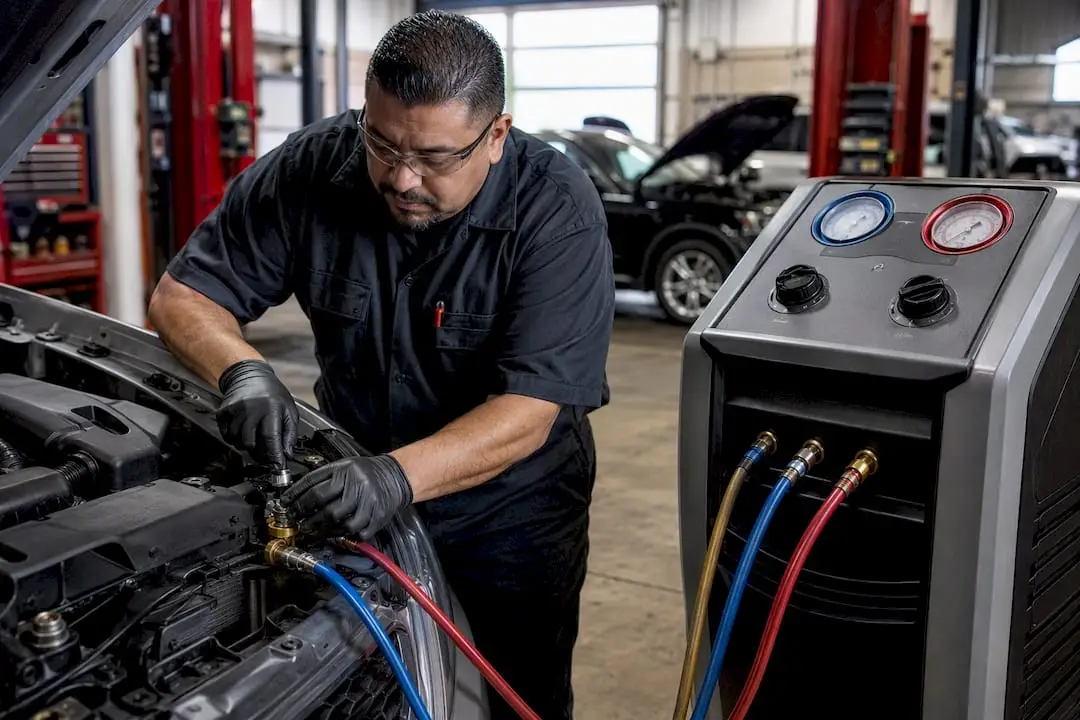
Once a vehicle is on the lift, the diagnostic process follows a fairly standard order: connect manifold gauges to read system pressures, run electronic leak detection or check for UV dye traces, evacuate the system under vacuum to remove air and moisture, repair the leak or replace the failed part, then recharge with the correct refrigerant weighed to the manufacturer’s spec. A post-repair leak check confirms the fix actually held.
Refrigerant loss is the single biggest reason cars end up in the shop for AC work, accounting for roughly 60% of AC repairs industry-wide. That’s exactly why a proper evacuation and recharge by weight beats a quick top-off. A top-off adds refrigerant without removing the moisture and air already trapped inside, so the fresh charge starts degrading almost immediately.
What Does It Typically Cost to Fix Car AC Problems?
Repair costs vary a lot depending on which part failed and what refrigerant your vehicle uses, so treat these as general ranges rather than a quote.
- Evacuate and recharge with a leak test is usually the least expensive repair path, though the price shifts depending on whether your car runs older R-134a or newer R-1234yf refrigerant, since R-1234yf costs more per pound.
- Condenser replacement is a moderate job. It sits at the front of the car and is reasonably accessible, which keeps labor time down compared to parts buried deeper in the dash.
- Compressor replacement takes longer and costs more, partly because a failed compressor often means metal debris circulated through the system, which forces a full flush and usually a new receiver-drier or accumulator to protect the new compressor.
- Evaporator replacement is the most labor-intensive repair on this list, since the evaporator sits deep inside the dashboard and often requires partial disassembly to reach.
Before approving any repair, ask what’s covered afterward. Express Lube & Car Care backs qualifying repairs with a 24-month/24,000-mile warranty, so you’re not paying twice if something related fails soon after.
How Can You Prevent AC Problems Before They Start?
A little routine maintenance goes a long way toward keeping cold air flowing when you need it most.
- Replace the cabin air filter on the schedule your owner’s manual recommends, since a clogged filter chokes airflow even when everything else is working.
- Keep the front grille and condenser clear of leaves, bugs, and road grime that build up over a season of driving. A quick check when you wipe down the dashboard or clean the interior is a good reminder to glance at the grille too.
- Run the AC for a few minutes even in cooler months. It keeps the seals lubricated and the compressor from sitting idle long enough to develop problems.
- Add an AC pressure check to your spring service visit, ideally alongside a full digital vehicle inspection so any early leak shows up before it becomes a bigger repair.
How We Diagnose Car AC Problems at Express Lube & Car Care
When you bring a car in for AC that won’t cool, our ASE-certified technicians follow the same logical order every time: airflow and cabin filter check, compressor engagement test, then a full pressure test with electronic leak detection before anything gets opened up. You get a digital vehicle inspection with photos, so you can actually see what we found instead of taking our word for it.
Diagnosing AC problems by pattern, not by guesswork, is what keeps repair bills from spiraling. A car that’s cool at idle but never cold and a car that blows warm at idle but cold on the highway need completely different fixes, and treating them the same way wastes your money.
Walk-ins are welcome, or you can schedule ahead. Either way, bring any history of past AC work if you have it. It saves diagnostic time.
Fast Diagnosis Beats Guessing Every Time
Most advice about car AC treats every warm-air complaint the same way: check the refrigerant, add more if it’s low, done. That’s backwards. Airflow problems, electrical faults, and blend-door failures show up constantly, and none of them get fixed by refrigerant. A shop that jumps straight to a recharge without confirming the cause is gambling with your money.
The pattern of your symptoms is the most underrated diagnostic tool you have. Warm at idle but cold on the highway tells a completely different story than cool but never quite cold. Most drivers describe the second one to a shop and get charged for a recharge that doesn’t hold, because the real problem was a weak compressor or a blocked condenser the whole time.
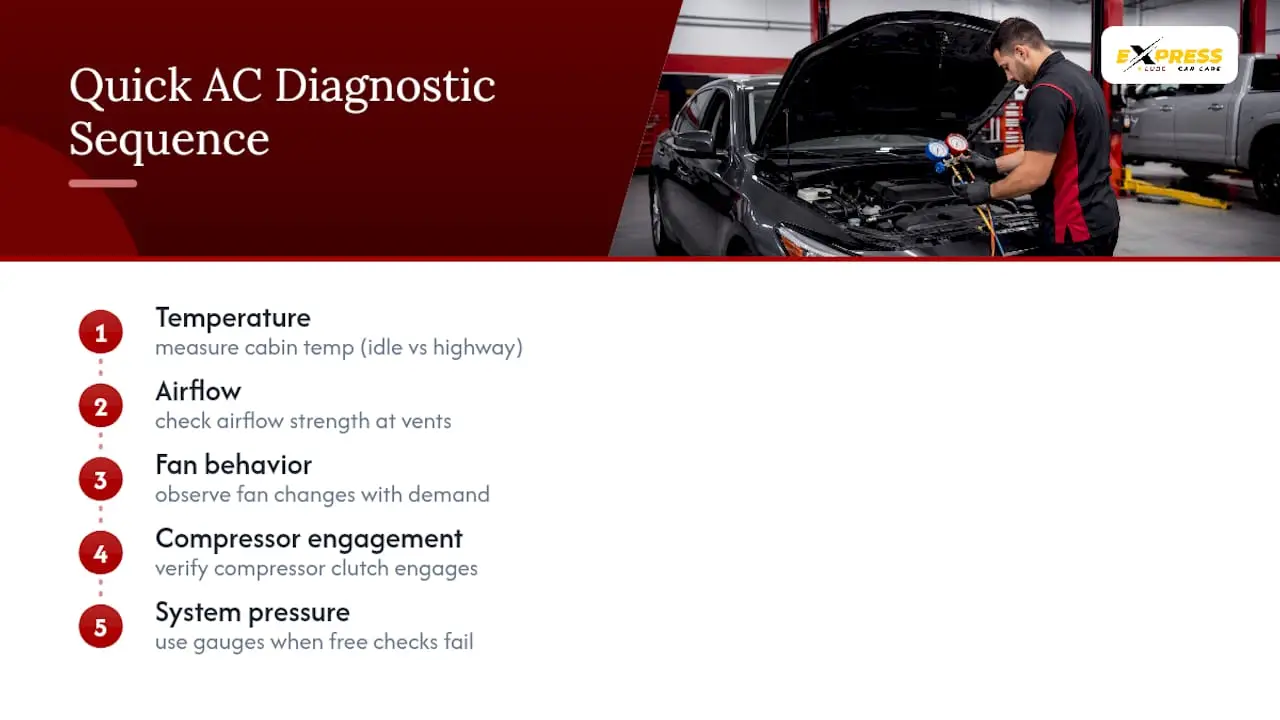
Prioritize the free checks first: temperature, airflow, fan behavior, compressor engagement. They cost nothing and point you toward the right repair instead of the first one that comes to mind. When those checks run out of answers, that’s the moment to bring in equipment that reads actual system pressure, not another guess.
Get Your AC Diagnosed Right the First Time
Express Lube & Car Care gives you something a quick top-off never will: a real diagnosis before any repair, backed by ASE-certified technicians and a digital vehicle inspection with photos so you can see exactly what’s failing.

No appointment needed. Walk in for an AC diagnostic, or schedule online if you’d rather lock in a time. Every qualifying repair carries our 24-month/24,000-mile warranty, and if the cost catches you off guard, ask about financing options before you leave. Call (817) 284-8478 to talk through your symptoms with the shop directly, or stop by if you’re near Richland Hills and want it looked at today.
Sources
For more detail beyond this guide, AutoZone’s diagnostic walkthrough and KBB’s repair diagnostics guide cover common failure points in depth. On our site, see the full AC diagnostic checklist or check our digital vehicle inspection process.
- Car AC Not Working? Complete Diagnosis and Repair Guide (2026)
- Fixing Your Car’s Air Conditioning: Symptoms, Quick Checks, and Real Repair Costs
- Automotive AC Repair Diagnostics Guide
- Car AC Not Working? How to Fix Common Air Conditioning …
FAQ
Why Is My Car AC Running but Not Cooling?
The compressor is turning on, but something downstream is failing, usually low refrigerant, a blocked condenser, or weak airflow across the condenser fins.
How Do You Make Car AC Cold Again?
Start with the free checks: cabin filter, condenser airflow, and compressor engagement. If those check out and it’s still warm, the system likely needs professional leak detection and a recharge by weight.
How Can You Tell If Refrigerant Is Low in a Car AC?
Warm air with normal airflow, a compressor clutch that cycles rapidly on and off, or oily residue near hose fittings all point to low refrigerant, though a pressure gauge test is the only way to confirm it.
Why Is My AC Cool but Not Cold?
This usually means a partial refrigerant leak, a partially blocked condenser, or a compressor that’s losing efficiency rather than failing outright, all of which a shop can pinpoint with a pressure test.
Is It Safe to Recharge My Own Car AC?
A DIY recharge kit can offer a short-term fix, but it skips the vacuum step that removes trapped air and moisture, so problems often return within weeks and can mask a leak that needs real repair.