
A truck coolant flush is a full-system service that drains all old coolant, runs multiple cleaning cycles with distilled water or an approved flush solution, and refills the system with fresh OEM-compatible coolant at the correct glycol-to-water ratio and SCA (Supplemental Coolant Additive) level. It is not a top-off. It is not a partial drain. It is a complete reset of your truck’s cooling chemistry. Three situations call for immediate action:
- Your truck is running hotter than normal under everyday load, even with adequate coolant level.
- The coolant in the reservoir looks rusty, milky, brown, or has an oily film on the surface.
- Different coolant types have been mixed, or the service history is unknown.
If any of those describe your truck right now, skip to the signs and red-flag sections below. If you want the full picture first, read on. An ASE-certified technician at Express Lube & Car Care can also run an SCA test and visual inspection to tell you exactly where your system stands.
Table of Contents
- What does engine coolant actually do in a truck?
- What is a truck coolant flush, step by step?
- Coolant flush vs. drain-and-fill: which one does your truck need?
- What are the signs your truck needs a coolant flush?
- How often should you flush your truck’s coolant?
- What are the long-term benefits of regular coolant flushes?
- How much does a truck coolant flush cost, and how long does it take?
- Should you DIY a coolant flush or take it to a shop?
- When a flush is not enough: red flags that point to bigger problems
- Safety rules and proper disposal of used coolant
- Why ASE certification matters and what Express Lube & Car Care does differently
- Key Takeaways
- The case for treating coolant maintenance as seriously as oil changes
- Professional coolant flush service at Express Lube & Car Care
- Useful sources and further reading
- FAQ
What does engine coolant actually do in a truck?
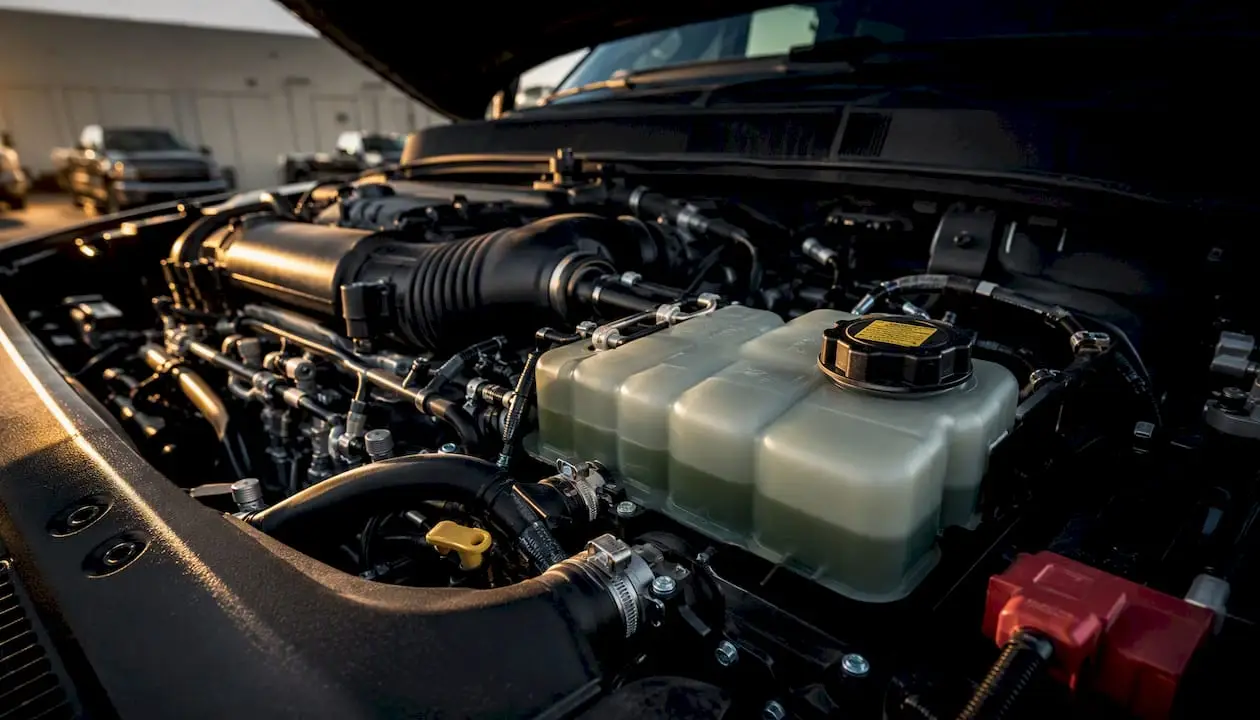
Coolant does three jobs at once, and most truck owners only think about one of them. Yes, it keeps the engine from overheating. But it also raises the boiling point of the fluid so it stays liquid under high-load conditions, lowers the freeze point so cold starts do not crack the block, and carries a package of corrosion inhibitors that protect every metal surface the fluid touches.

A proper 50/50 mix of ethylene glycol and distilled water is the standard starting point. That ratio affects both freeze and boil protection, and a refractometer or hydrometer is the right tool to verify it. Going too heavy on glycol actually reduces heat transfer. Going too light on it leaves you exposed to freeze damage.
The inhibitor side of the equation is where most truck owners get into trouble. Inhibitors deplete over time. Once they are gone, the coolant turns acidic and starts attacking the system from the inside out. The components at risk include:
- Radiator tubes and fins
- Water pump seals and impeller
- Head gasket surfaces
- Oil cooler passages
- Thermostat housing
Pro Tip: For heavy-duty diesel trucks, check SCA concentration at every oil change using test strips or a refractometer. Depleted SCAs are invisible to the naked eye but show up immediately on a strip test, and catching them early costs almost nothing compared to what they prevent.

What is a truck coolant flush, step by step?
A proper coolant flush process for trucks is not a single drain-and-fill. It is a series of fill, run, and drain cycles designed to push old fluid and contaminants completely out of the system. Here is how it works:
- Let the engine cool fully. Never open a hot cooling system. Wait at least two hours after shutdown. Pressure inside a hot system can cause serious burns.
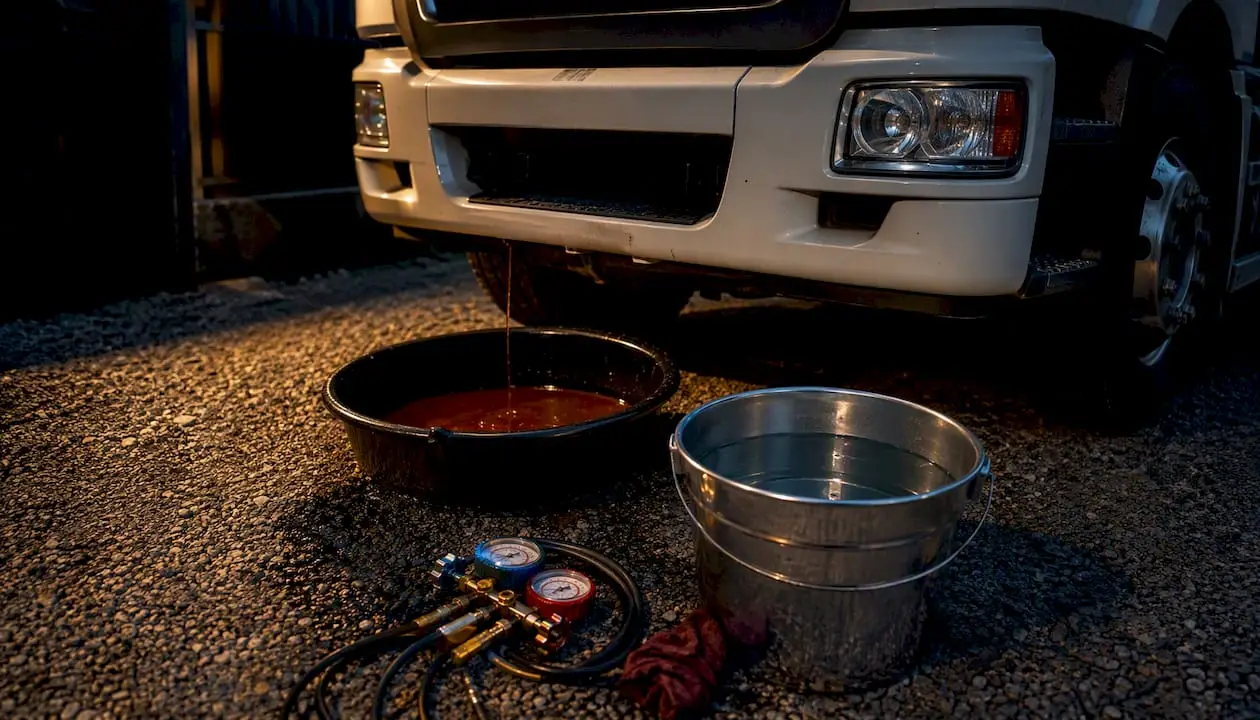
- Drain the old coolant. Open the radiator drain valve and remove the block drain plug if accessible. Capture all fluid in a large-capacity drain pan rated for the system volume.
- Close the drains and fill with distilled water. Tap water contains minerals and chlorine that
and reduce heat transfer. Distilled water only.
- Add an approved flush solution if contamination is present. Follow the product’s instructions for concentration and run time.
- Run the engine to operating temperature. This opens the thermostat and circulates the flush solution through the entire system, including the heater core and oil cooler passages.
- Let it cool, then drain again. Repeat the distilled-water fill-run-drain cycle until the drained fluid runs completely clear. This often takes three or more cycles.
- Refill with OEM-spec coolant. Use a premixed 50/50 product or mix concentrate with distilled water to the correct ratio. Add SCA if required by the engine manufacturer.
- Bleed the system. Air pockets cause localized overheating even when the temperature gauge reads normal. Run the engine with the cap off, squeeze the upper hose to burp air, and top off as needed.
- Pressure test and inspect for leaks. Check all hose connections, the radiator cap, and the overflow reservoir before calling the job done.
Tools you will need: a large drain pan, distilled water (plan on several gallons for a heavy-duty truck), OEM-compatible coolant, a funnel, gloves, eye protection, SCA test strips or a refractometer, and a clean container for used coolant disposal.

Coolant flush vs. drain-and-fill: which one does your truck need?
These two services are not interchangeable, and choosing the wrong one can leave contamination behind.
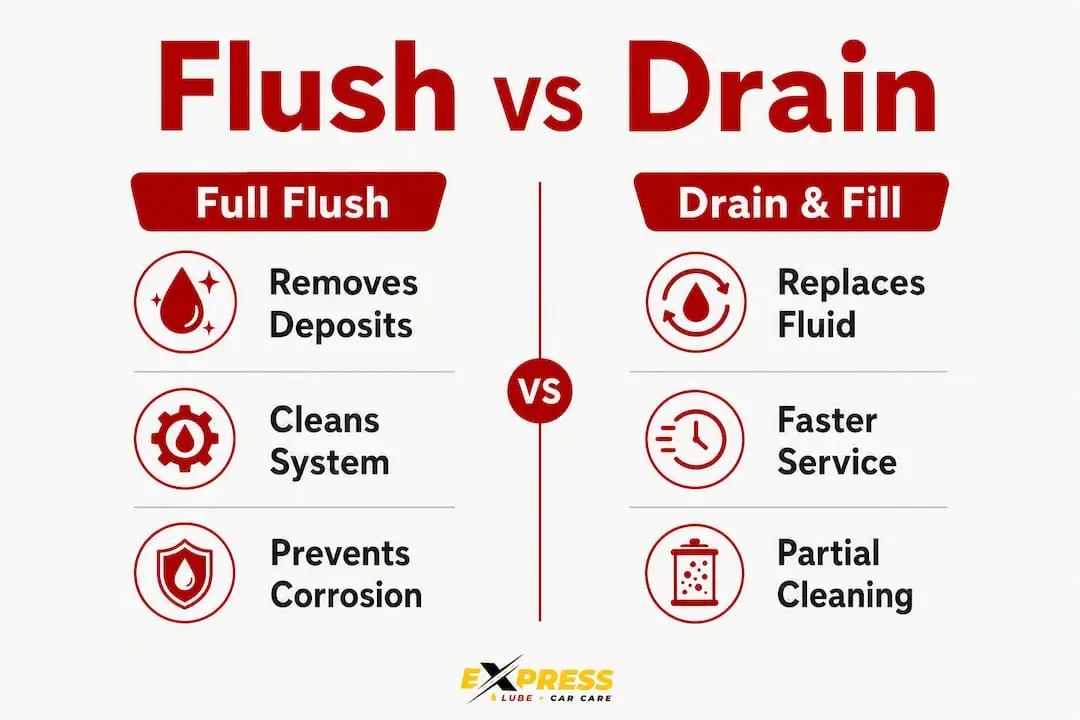
A drain-and-fill removes the coolant from the radiator and sometimes the block, then refills with fresh fluid. It is faster and cheaper, but it leaves residual old coolant in the heater core, water pump passages, and engine galleries. If your coolant is still in good condition and you are just hitting a scheduled interval with no contamination, a drain-and-fill can be appropriate.
A full flush uses multiple fill-run-drain cycles with distilled water and, when needed, a cleaning agent. It removes deposits, neutralizes acids, and clears the entire circuit. When rust, sludge, oil contamination, or mixed coolant chemistries are present, a flush is the only option that actually solves the problem.
| Criteria | Full flush | Drain-and-fill |
|---|---|---|
| Removes deposits and scale | Yes | Partial |
| Addresses contamination | Yes | No |
| Clears mixed coolant chemistries | Yes | No |
| Time required | A few hours | a few hours |
| Recommended when… | Rust, sludge, oil film, mixed types, or overheating present | Routine interval, clean coolant, no contamination |
If you are unsure which your truck needs, a quick SCA strip test and visual inspection will usually answer the question in under five minutes.
What are the signs your truck needs a coolant flush?
Some of these you can spot yourself at a cold engine. Others show up while you are driving.
- Overheating under normal load. If the temperature gauge climbs higher than usual on a route you drive every week, the coolant may have lost its heat-transfer efficiency.
- Discolored coolant. Healthy coolant is bright green, orange, or yellow depending on the type. Brown, rusty, or muddy-looking fluid means inhibitors are depleted and corrosion is already happening.
- Milky or creamy coolant. This is a red flag for oil contamination, not just a flush issue. More on that below.
- Oily film on the reservoir cap or overflow tank surface. Even a thin sheen points to oil or fuel mixing into the coolant circuit.
- Visible sludge or particles. Flakes or grit in the reservoir mean corrosion byproducts are circulating through your system.
- Sweet or burning smell from the engine bay. Glycol has a distinctive sweet odor when it burns off or leaks onto hot surfaces.
- Steam from the engine bay or excessive pressure at the cap. These indicate the system is running hotter than it should.
For a quick cold-engine check: look at the reservoir color, pull the radiator cap and check the underside for oily residue, and run an SCA or pH strip if you have one. Mixing different coolant types is also an immediate flush trigger, since incompatible chemistries can neutralize inhibitors and form gels that clog passages.
Urgency guide: Milky coolant, oily film, or persistent overheating require a same-day shop visit. Discoloration or a known service gap can usually be scheduled within the week, but do not let it slide.
How often should you flush your truck’s coolant?
Interval depends almost entirely on the coolant chemistry in your system. Here is the standard guidance for heavy-duty trucks:
| Coolant type | Typical flush interval | SCA testing |
|---|---|---|
| Conventional green (silicate-based) | Every 2 years | At every oil change |
| ELC / NOAT (Extended Life Coolant) | Every 4–5 years | At every oil change |
| OAT (Organic Acid Technology) | 5 years | Periodic strip test |
These are general benchmarks. Your OEM maintenance schedule takes priority, and operating conditions matter. Trucks running in extreme heat, hauling heavy loads consistently, or sitting idle for long periods may need more frequent service.
For owner-operators and fleet managers, a practical monitoring schedule looks like this:
- Every oil change: Run an SCA strip test. Check coolant color and level visually.
- Every 6 months: Verify freeze/boil protection with a refractometer.
- At each scheduled PM: Inspect hoses, the radiator cap, and the overflow tank for signs of contamination.
- At the OEM-specified interval: Perform a full flush and refill with fresh coolant and SCA as needed.
The coolant system role in heavy truck engines is complex enough that skipping these checkpoints often costs far more than the test strips themselves.
What are the long-term benefits of regular coolant flushes?
Scheduled coolant maintenance is one of the highest-return preventive services you can do for a truck. Here is what it actually protects:
- Prevents internal corrosion in the radiator, engine block, and head gasket surfaces
- Maintains heat-transfer efficiency so the engine runs at the designed operating temperature
- Protects the water pump by keeping inhibitor levels high enough to prevent seal and impeller erosion
- Extends thermostat life by preventing scale buildup that causes it to stick open or closed
- Reduces overheating risk on long hauls or in high-ambient-temperature conditions
- Extends radiator and engine life by stopping the slow erosion that builds up over years of neglected coolant
Cooling-system neglect can trigger cascading internal damage, including eroded passages, stuck thermostats, and water-pump failure, with repair bills starting around $3,000 or far higher for engine rebuilds. A coolant flush costs a fraction of major repair costs. For fleets and owner-operators, the real value is uptime: a truck that is not in the shop is a truck that is earning.
How much does a truck coolant flush cost, and how long does it take?
Cost and time both vary based on the truck’s size, the coolant type, and whether any related parts need replacement.
Typical cost ranges:
- Light-duty pickup truck: roughly $100–$200 for a professional flush
- Heavy-duty or diesel truck: higher, depending on coolant volume, SCA requirements, and shop labor rates
- Factors that increase cost: contamination requiring a chemical cleaner, SCA replacement, worn hoses or a failing thermostat discovered during service, or follow-on repairs like an oil cooler or head gasket
Time estimates:
- DIY: plan on several hours for a proper multi-cycle flush, especially if you are running three or more fill-run-drain cycles
- Professional shop: a few hours for a standard flush; longer if contamination is severe or parts need replacement
A coolant flush for Class 8 trucks is described as a high-return maintenance job that costs a fraction of radiator or engine replacement. The time investment is real, but so is the protection it buys.
Should you DIY a coolant flush or take it to a shop?
Honest answer: it depends on your setup. Here is a practical decision checklist.
Consider DIY if you:
- Have mechanical experience and are comfortable with cooling-system work
- Can source distilled water in the volume needed (multiple gallons for a heavy-duty truck)
- Have a proper drain pan, refractometer, and SCA test strips
- Know how to bleed the system correctly and have time to run multiple cycles
- Have access to a legal coolant disposal facility or a shop that accepts used coolant
Go to a professional shop if:
- You are not sure which coolant type is in the system or whether types have been mixed
- The coolant shows signs of oil or fuel contamination
- You do not have the tools to pressure test or bleed the system properly
- The truck has been overheating and you need a diagnosis, not just a flush
The most common DIY mistakes are using tap water, mixing incompatible coolant chemistries, and skipping the bleed procedure. Tap water leaves mineral scale. Mixed chemistries can gel and clog passages. A missed air pocket produces localized overheating that looks like a thermostat problem and can damage a head gasket before you figure out the real cause.
What to expect at a professional shop: An ASE-certified technician will inspect the system before starting, run an SCA and pH test, perform a pressure test to check for existing leaks, complete the multi-cycle flush, refill with the correct OEM-spec coolant, bleed the system, and document the service. At Express Lube & Car Care, that process includes a digital vehicle inspection with photos, so you can see exactly what the tech found. Walk-ins are welcome, or you can schedule an appointment.
When a flush is not enough: red flags that point to bigger problems
A flush is a maintenance service. It is not a repair. If any of these are present, the flush alone will not fix the underlying problem.
- Milky or creamy coolant points to oil contamination from a failed oil cooler or head gasket. A simple flush is insufficient in this case. The source of contamination must be diagnosed and repaired first.
- Strong fuel smell in the coolant suggests injector cup failure (common on some diesel engines) or a cracked component allowing fuel into the cooling circuit.
- Persistent overheating after a flush means the cooling system has a mechanical problem: a stuck thermostat, a failing water pump, a clogged radiator, or a compromised head gasket.
- Very low pH or completely depleted SCAs after a recent service may indicate an internal leak that is diluting the inhibitor package.
- Visible metal flakes or heavy sludge in the reservoir means significant internal erosion has already occurred.
If you see any of these, stop driving the truck and get it to a shop. The correct next steps are a professional pressure test, a compression test or leak-down test, and a technician diagnosis before any chemical cleaning is attempted. Flushing a system with active oil contamination just spreads the problem.
Safety rules and proper disposal of used coolant
Short and non-negotiable:
- Never open a hot radiator. Wait at least two hours after shutdown. A pressurized hot system can spray scalding fluid instantly.
- Wear gloves and eye protection throughout the entire process.
- Contain all spills immediately. Ethylene glycol is toxic to animals and has a sweet smell that attracts pets.
- Do not pour used coolant down a drain or on the ground. It is classified as a hazardous waste in the U.S.
- Use a sealed container to transport used coolant to a local hazardous-waste facility or an automotive shop that accepts it for recycling. Many service shops, including Express Lube & Car Care, handle proper coolant disposal as part of the service.
Federal and state environmental regulations prohibit improper coolant disposal. Most auto parts stores and service centers in the U.S. accept used coolant at no charge.
Why ASE certification matters and what Express Lube & Car Care does differently
Not every shop approaches a coolant service the same way. When you are choosing where to bring your truck, here are the credentials and procedures worth asking about:
- ASE certification confirms the technician has passed standardized testing on cooling-system diagnosis and service
- Documented SCA and pH testing before and after the flush, not just a visual check
- Pressure testing to identify existing leaks before they become post-service complaints
- Photo-backed digital inspection so you see what the tech sees, not just a verbal summary
- OEM-compatible coolant matched to your specific engine, not a generic off-the-shelf product
At Express Lube & Car Care, every coolant service is performed by ASE-certified technicians and backed by a 24-month/24,000-mile warranty. The service includes SCA and pH testing, a pressure and leak check, and a digital vehicle inspection with photos. Walk-ins are welcome, or you can book an appointment. Transparent pricing and honest communication are standard, not optional.
For a deeper look at what a coolant flush service covers, the Express Lube & Car Care blog walks through the shop-side process in detail.
Key Takeaways
A truck coolant flush is a full-system cleaning and refill that restores corrosion protection and heat transfer, and skipping it risks repair bills starting around $3,000 or far higher for engine rebuilds.
| Point | Details |
|---|---|
| Know the three triggers | Act immediately if you see overheating, milky or rusty coolant, or evidence of mixed coolant types. |
| Follow interval by coolant type | Conventional green coolant typically requires service more frequently; Extended Life Coolants and NOAT types have longer recommended intervals. Testing SCA concentration regularly at oil changes is advised. |
| Flush beats drain-and-fill for contamination | A drain-and-fill leaves residual old fluid; only a full flush clears deposits, scale, and mixed chemistries. |
| DIY has real failure points | Tap water, skipped bleeding, and mixed chemistries are the top DIY mistakes and can cause lasting damage. |
| Express Lube & Car Care | ASE-certified techs, SCA/pH testing, pressure checks, and a 24-month/24,000-mile warranty on every service. |
The case for treating coolant maintenance as seriously as oil changes
We see it regularly: a truck comes in with an overheating complaint, and the coolant is brown, the SCA is gone, and the water pump is on its way out. The owner had no idea because the coolant level looked fine at a glance. That is the trap. Coolant level and coolant condition are two completely different things, and the level can look perfect while the inhibitors are completely depleted.
The conventional wisdom is to flush coolant on a schedule often cited as every couple of years or moderate mileage. That guidance is fine as a floor, but the real maintenance task is monitoring SCA concentration at every oil change and adjusting interval decisions based on test results. Operating conditions can greatly affect how often service is best performed.
One thing we consistently recommend: do not wait for a symptom. By the time the gauge climbs or the coolant turns brown, the corrosion has already started. A five-minute strip test at your next oil change costs almost nothing and gives you a real answer. Schedule it as a habit, not a reaction.
Professional coolant flush service at Express Lube & Car Care
Skipping a coolant flush to save time is one of the more expensive decisions a truck owner can make. The repair costs from cooling-system neglect start around $3,000 or far higher for engine rebuilds. A professional flush at Express Lube & Car Care is the straightforward alternative.
Every coolant service at Express Lube & Car Care includes ASE-certified technician oversight, SCA and pH testing, a pressure and leak check, OEM-compatible coolant, and a digital inspection with photos. The work is backed by a 24-month/24,000-mile warranty, so you leave knowing the job was done right and covered. Current service specials are available online, and car care financing is an option if you are bundling maintenance services. No appointment needed. Walk in, or book online, and get your truck’s cooling system back where it belongs.
Useful sources and further reading
- Flushing and Refilling Heavy-Duty Truck Coolant Systems — Procedures and tips for heavy-duty truck cooling service
- Coolant System Maintenance: It’s a Question of Balance — Chevron Lubricants technical guide on glycol ratios and measurement tools
- Preventive Maintenance for a Complex Cooling System — Work Truck Online on SCA testing, coolant types, and PM processes
- Coolant Maintenance Best Practices — Chevron Lubricants on oil contamination diagnosis and flush decisions
- What Happens When You Mix Coolants? — Valvoline Global on chemistry incompatibility and inhibitor neutralization
- What Is Engine Coolant: Guide to Car Health and Maintenance — Express Lube & Car Care on coolant chemistry and function
- A Complete Guide to Your Vehicle’s Fluid Flush Service — Express Lube & Car Care on scheduling multiple fluid services
- What Does a Water Pump Do in Truck Engines? — Partner resource on water-pump function and failure modes
FAQ
Are coolant flushes really necessary for trucks?
Yes. Coolant inhibitors deplete over time, and once they are gone the fluid turns acidic and corrodes the radiator, water pump, and head gasket surfaces. A flush restores protection and prevents failures that can cost $3,000 or far higher for engine rebuilds.
What does a truck coolant flush typically cost?
For a light-duty pickup, expect roughly $100–$200 for a professional flush. Heavy-duty and diesel trucks run higher depending on coolant volume, SCA requirements, and whether worn parts like hoses or a thermostat need replacement at the same time.
How long does a full coolant flush take?
A proper flush takes a few hours because it requires multiple fill-run-drain cycles to clear the system completely. DIY jobs often take longer. Severe contamination or follow-on repairs extend the time further.
Can I drive my truck right after a coolant flush?
Yes, once the system has been properly bled and refilled. The key is confirming there are no air pockets and no leaks before returning to normal operation. A short test drive with a check for leaks and a temperature-gauge review is standard practice after any coolant service.
How do I know if I need a flush or just a top-off?
If the coolant is clean, correctly colored, and at the right concentration, a top-off may be all that is needed. If it is discolored, rusty, milky, or the SCA level is low, a full flush is the right call. An SCA strip test at Express Lube & Car Care during your next oil change will give you a definitive answer in minutes.