

A timing belt is a toothed, reinforced rubber belt that synchronizes the rotation of your engine’s crankshaft and camshaft, keeping valves and pistons moving in precise coordination. If it breaks in an interference engine, the result is often catastrophic engine damage — bent valves, damaged pistons, and repair bills that can exceed the value of the car. The short version: check your owner’s manual for the replacement interval, and if you’re near it or seeing symptoms, book a shop inspection before the belt decides for you.
Key Takeaways
A timing belt is a safety-critical engine component: follow your manufacturer’s replacement interval, replace related parts at the same time, and use an ASE-certified technician to avoid a repair bill that dwarfs the cost of scheduled maintenance.
| Point | Details |
|---|---|
| What a timing belt does | Synchronizes crankshaft and camshaft so valves and pistons move without colliding. |
| Interference engine risk | A snapped belt in an interference engine causes bent valves, damaged pistons, or total engine loss. |
| Replacement interval | Manufacturer replacement intervals vary; always follow your owner’s manual. |
| Full service includes | Belt, tensioner, idlers, water pump, and seals — replacing all together avoids repeat labor costs. |
| Express Lube & Car Care | ASE-certified timing-belt service in Richland Hills, backed by a 24-month/24,000-mile warranty. |
Table of Contents
- What is a timing belt and how does it work?
- Timing belt vs. timing chain: which does your car have?
- What are the signs a timing belt is wearing out?
- What happens when a timing belt breaks?
- When should you replace a timing belt, and what’s included?
- How much does timing-belt replacement cost?
- How to inspect a timing belt and when to call a pro
- Why an ASE-certified technician matters for this job
- How timing-belt materials affect how long the belt lasts
- Our take on the one mistake we see most often
- Timing-belt service at Express Lube & Car Care in Richland Hills
- Sources
- FAQ
What is a timing belt and how does it work?
Think of the timing belt as the conductor of your engine’s orchestra. Every moving part has a cue, and the belt makes sure nothing plays out of turn.
Here’s what the belt connects and controls:
- Crankshaft — converts piston movement into rotational power
- Camshaft(s) — controls when intake and exhaust valves open and close
- Tensioner and idler pulleys — keep the belt at the correct tension and path
- Water pump — on many engines, the timing belt drives the coolant pump directly
The sequence works like this:
- The crankshaft rotates as pistons fire.
- The timing belt transmits that rotation to the camshaft.
- The camshaft opens and closes valves at precisely the right moment relative to each piston’s position.
- The tensioner maintains the correct belt tension throughout.
The word “timing” is the key. Valves must open and close at exact moments so they don’t occupy the same space as a rising piston. The belt keeps that rhythm locked in. Even a small slip — one or two teeth on the belt — can throw the whole sequence off, causing misfires, lost power, or worse.
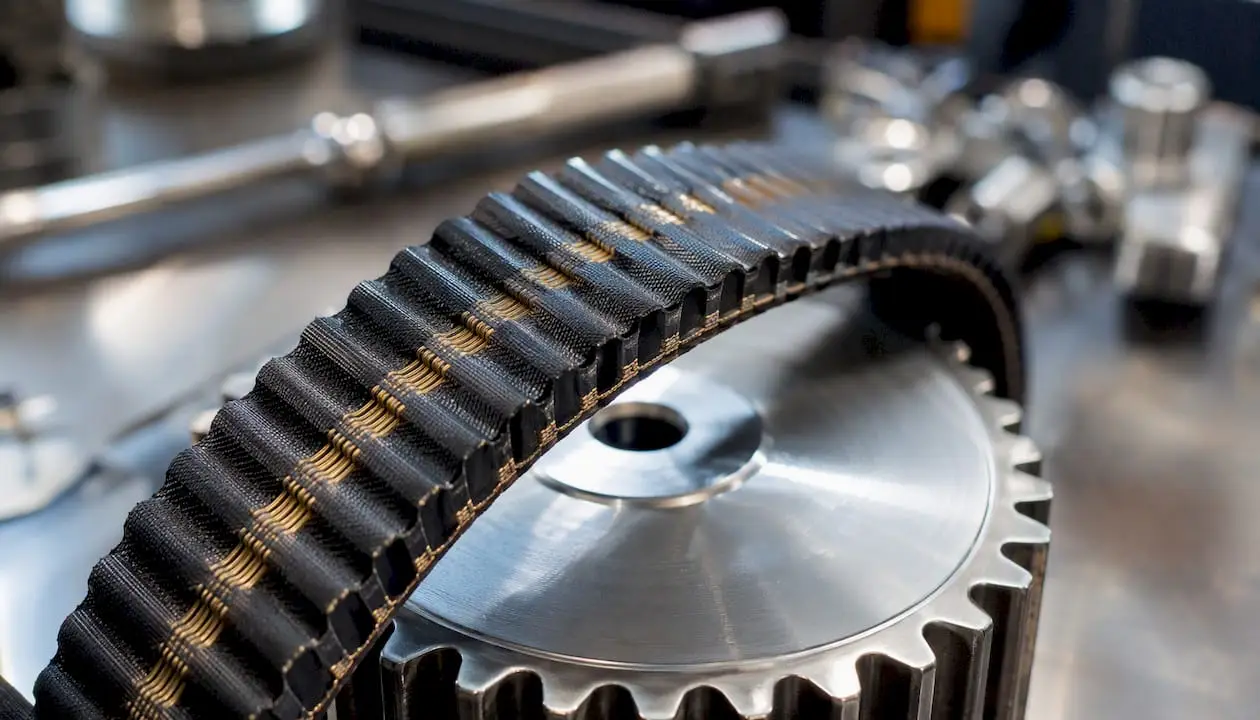
Modern timing belts are made from synthetic rubbers such as neoprene, polyurethane, or highly saturated nitrile, reinforced with high-tensile cords made from Kevlar, polyester, or fiberglass. Those cords limit stretch and give the belt its strength, but the rubber compound still degrades over time from heat, oil exposure, and simple age.
Timing belt vs. timing chain: which does your car have?
Both do the same job. The difference is in how long they last and what they cost to maintain.
| Feature | Timing Belt | Timing Chain |
|---|---|---|
| Material | Reinforced rubber | Metal links |
| Noise level | Quieter | Slightly louder |
| Typical lifespan | Scheduled replacement required | Often designed to last engine life |
| Routine maintenance | Yes — periodic replacement | Less frequent, but inspection still needed |
| Replacement cost | Lower per service | Higher if replacement becomes necessary |
| Common on | Many older and entry-level engines | Many modern and higher-end engines |
Timing chains tend to be more durable) and can be engineered to last the life of the engine, while belts are quieter and cheaper to manufacture, which is why many automakers have historically used them. The tradeoff is that belts require proactive, scheduled replacement — skip it, and you’re gambling with your engine.
Manufacturers choose between belts and chains based on cost, noise targets, and how the engine fits in the engine bay. Many newer vehicles have shifted toward chains, but belts remain common across a wide range of models still on the road today.
Pro Tip: Don’t assume — check your owner’s manual or the service sticker inside your driver’s door jamb to confirm whether your engine uses a belt or a chain. A quick VIN lookup on your manufacturer’s website can also confirm this.
What are the signs a timing belt is wearing out?
Here’s the uncomfortable truth: timing belts often give little to no warning before they fail. That said, there are symptoms worth knowing.
Common signs your timing belt may be in trouble:
- Ticking or clicking noise from the engine, especially on startup
- Rough idling or the engine shaking at a stop
- Misfires or hesitation during acceleration
- Oil contamination around the timing cover (a leaking cam seal can soak the belt)
- Difficulty starting the engine or extended cranking
- Loss of power that comes on gradually
The problem with relying on symptoms alone is that a belt can look and sound fine right up until it snaps. Cracks and fraying often develop on the inner tooth surface where you can’t easily see them. Oil contamination is particularly dangerous because it accelerates rubber degradation without any obvious noise.
These symptoms also overlap with other engine issues — a tune-up diagnosis can help rule out spark plugs, ignition coils, or sensors before assuming the belt is the culprit.
Pro Tip: Treat your manufacturer’s mileage and age interval as the real replacement trigger, not symptoms. By the time you hear something wrong, the belt may already be compromised.
What happens when a timing belt breaks?
The answer depends entirely on whether your engine is an interference or non-interference design.
Non-interference engine: The pistons and valves are designed with enough clearance that they never occupy the same space. If the belt snaps, the engine simply stops. No internal damage — you’re stranded, but the engine is salvageable.
Interference engine: The pistons and valves share the same cylinder space, relying on precise timing to avoid contact. When the belt breaks, that coordination disappears instantly.
In an interference engine, a snapped timing belt allows pistons and valves to collide at high speed. The result is typically bent valves, damaged pistons, a cracked cylinder head, or all three. Repair costs can run into the thousands — and in severe cases, the engine is a total loss. Edmunds confirms that driving with a failing belt in an interference engine risks exactly this outcome.
Many drivers don’t know which type of engine they have until something goes wrong. Checking your vehicle’s spec sheet or asking a technician before you hit the replacement interval is worth the five-minute conversation — because it changes the stakes considerably.
When should you replace a timing belt, and what’s included?
Manufacturer replacement intervals vary, with typical intervals recommended to ensure timely replacement and prevent engine damage. Kelley Blue Book recommends following your owner’s manual or a manufacturer service bulletin rather than any generic rule of thumb, since intervals differ meaningfully from one engine to the next.
A full timing-belt service typically includes more than just the belt itself. Here’s what reputable shops replace at the same time:
- Timing belt
- Tensioner pulley
- Idler pulley(s)
- Water pump (when belt-driven)
- Front crankshaft seal
- Camshaft seal(s)
Why replace all of these together? Because the water pump and tensioners sit behind the same timing cover the technician has to remove anyway. The labor to access them is already paid for. Replacing a tensioner that fails six months later means tearing everything apart again — and paying for that labor twice.
The logical order for a full service:
- Drain coolant and remove the timing cover.
- Remove the old belt, tensioner, idlers, and water pump.
- Install new components, torque to factory spec.
- Refill coolant, reinstall covers, and verify timing marks.
- Road test and recheck tension.
Following your car maintenance checklist and scheduling this service before the interval hits is far cheaper than dealing with the aftermath of a snapped belt.
How much does timing-belt replacement cost?
Labor is where most of the cost lives. The belt itself is relatively inexpensive — it’s the hours of disassembly and reassembly that drive the price.
Kelley Blue Book’s consumer estimates indicate that timing-belt replacement costs vary widely depending on vehicle and job complexity, with more intricate repairs costing significantly more.
Factors that affect your final price:
- Engine layout — a transversely mounted four-cylinder is generally more accessible than a longitudinally mounted V6 or V8
- Parts included — belt only vs. full kit (tensioner, idlers, water pump, seals)
- Vehicle make and model — European and luxury vehicles often carry higher labor rates and parts costs
- Shop labor rate — varies by region and certification level
When you get a quote, ask for a written estimate that breaks out parts and labor hours separately. Ask whether the water pump and tensioners are included, and confirm what warranty covers the work. A shop that can’t answer those questions clearly is worth walking away from.
How to inspect a timing belt and when to call a pro
There are a few things you can check yourself — safely — before deciding whether to book a service.
- Check the service sticker on your driver’s door jamb or under the hood for any recorded timing-belt replacement date and mileage.
- Consult your owner’s manual for the manufacturer’s recommended interval.
- Look for oil contamination around the timing cover or valve cover gasket area — oil leaks onto the belt accelerate wear.
- Listen for ticking or clicking on a cold start, which can indicate a worn tensioner or belt.
- Note any rough idle or misfires and cross-reference with the symptoms listed above.
What you should not do: never inspect the timing cover area on a running or hot engine. Never attempt to remove or adjust the belt without the correct tensioning tools and training. Correct belt tension is critical — too loose and the belt can skip teeth; too tight and it strains the bearings on the tensioner and camshaft.
If your engine suddenly loses power, makes a loud bang, or fails to restart, stop driving immediately. Have the vehicle towed. Continuing to crank an engine with a broken timing belt in an interference design can compound the damage significantly.
Why an ASE-certified technician matters for this job
Timing-belt replacement is not a job where “close enough” works. Factory torque specs and tensioning procedures exist for a reason, and deviating from them — even slightly — can cause the belt to skip teeth or wear unevenly.
Before you book a timing-belt service, here are the questions worth asking:
- What brand of belt and kit are you using?
- Does the quote include the tensioner, idlers, and water pump?
- How many labor hours are you estimating?
- What warranty covers parts and labor?
- Do you provide a digital inspection with photos before and after?
Pro Tip: A shop that offers a 24-month/24,000-mile warranty on timing-belt work is putting real confidence behind the job. That warranty signals they’re using quality parts and following proper installation procedures — not cutting corners on a job that can’t afford them.
ASE certification means the technician has passed standardized testing in engine repair and maintenance. It’s not a guarantee of perfection, but it’s a meaningful baseline — especially for a job where incorrect tensioning or a missed seal can undo the whole service within months.
How timing-belt materials affect how long the belt lasts
Not all timing belts are built the same, and the difference in construction has a direct impact on lifespan.
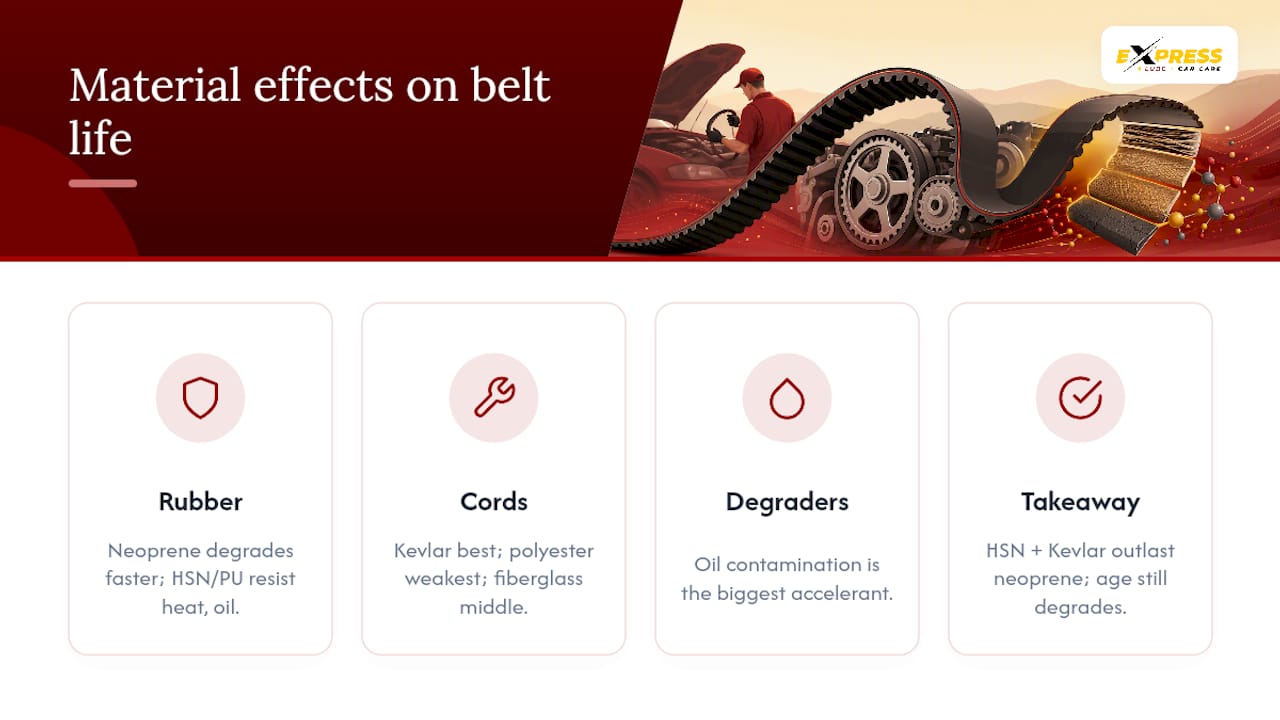
Older belts used neoprene rubber, which was reliable but degraded faster under heat and oil exposure. Most modern belts use highly saturated nitrile (HSN) or polyurethane compounds, which resist heat, oil, and ozone significantly better. The reinforcement cords — Kevlar, polyester, or fiberglass — are embedded in the rubber to prevent stretching under load.
Kevlar-reinforced belts tend to hold their tension longer and resist elongation better than polyester-reinforced versions, which is why they’re common in performance and higher-mileage applications. Fiberglass cords offer a middle ground: good dimensional stability with lower cost.
What degrades a belt faster than normal? Oil contamination is the biggest accelerant — a leaking cam seal can cut belt life dramatically. Coolant exposure has a similar effect. Heat cycling from short trips (the engine never fully warms up) also stresses the rubber compound over time.
The practical takeaway: a belt made with HSN rubber and Kevlar cords will generally outlast an older neoprene belt under the same conditions, but no material eliminates the need for scheduled replacement. Age and heat cycles degrade even the best compounds eventually.
Our take on the one mistake we see most often
We see a pattern at the shop that’s worth naming directly. Drivers come in after a timing-belt failure — sometimes towed in — and the first thing they say is, “I knew I was past due, but it was running fine.” That’s the trap. A timing belt doesn’t limp along and give you a week to prepare. It runs fine, and then it doesn’t.
The second most common mistake is approving a belt-only replacement to save money, then coming back six months later because the water pump failed. The pump was already showing wear; it just wasn’t the thing that broke first. Replacing the belt without the pump is a false economy when the labor to access both is identical.
The question we hear most often: “Do I really need to replace the water pump too?” The answer is almost always yes — and any shop worth trusting will explain why rather than just tell you to spend more.
Timing-belt service at Express Lube & Car Care in Richland Hills
When your timing belt is due, you want the job done right the first time — with the right parts, the right tools, and a warranty that actually means something. At Express Lube & Car Care, our ASE-certified technicians handle timing-belt replacement with a full-service approach: belt, tensioner, idlers, water pump, and seals replaced together so you’re not back on the lift in six months.
Every timing-belt service comes backed by our 24-month/24,000-mile warranty, and we provide a digital vehicle inspection with photos so you can see exactly what was done. No appointment needed — walk in, or book online. If you’re near your interval or noticing any of the symptoms above, don’t wait on this one.
Sources
The sources below were used to build this article. For technical specifications specific to your vehicle, your owner’s manual and manufacturer service bulletins are always the most authoritative reference.
- What Is a Timing Belt? – Edmunds
- How timing belt replacement works | HowStuffWorks
- What Is Timing Belt Replacement? – Kelley Blue Book
- What Is a Timing Belt, and What Does It Do? – AutoZone
FAQ
How much does timing-belt replacement cost?
Most U.S.
How do you know if a timing belt needs changing?
The most reliable trigger is your manufacturer’s mileage or age interval, found in your owner’s manual. Symptoms like ticking noises, rough idling, misfires, or oil around the timing cover can indicate wear, but belts often fail without warning, so interval-based replacement is the safer approach.
Can I drive a car with a bad timing belt?
No. If you suspect your timing belt is failing, stop driving and have the vehicle inspected or towed. In an interference engine, continuing to drive risks a catastrophic failure that can destroy the engine entirely — a repair that costs far more than a scheduled belt replacement.
What parts should be replaced with the timing belt?
A complete service typically includes the tensioner pulley, idler pulley(s), water pump (if belt-driven), and front crankshaft and camshaft seals. Replacing these together makes sense because they share the same labor access, and a failed tensioner or water pump shortly after a belt job means paying for that disassembly all over again.
Does my car have a timing belt or a timing chain?
Check your owner’s manual or the service sticker inside your driver’s door jamb. Many modern engines use timing chains, which are designed to last the engine’s life, while older and many current entry-level engines still use belts that require scheduled replacement.