

R-134a and R-1234yf are two different car A/C refrigerants, and you can’t swap one for the other. R-134a has a global warming potential (GWP) of 1,430, while R-1234yf has a GWP of 4, according to the EPA. R-1234yf is also mildly flammable, needs its own oil, fittings and service equipment, and cools about as well as R-134a when the system is designed for it. Which one your car takes is set by the manufacturer, and the label under your hood tells you.
We work on A/C systems of both kinds here in Richland Hills, so this guide is written the way we’d explain it across the service counter: what’s different, what’s the same, and what it means for your repair bill.
TL;DR
- R-1234yf has a far lower GWP than R-134a (4 vs. 1,430), but it is mildly flammable (ASHRAE A2L), so it comes with its own safety design and handling rules.
- The two are not interchangeable. Chemours says not to use R-134a in an R-1234yf system, and there is no approved U.S. retrofit going the other way.
- Check the under-hood A/C label or your owner’s manual to see what your car needs. Don’t guess by model year.
- R-1234yf service costs more partly because it takes dedicated equipment and a certified technician.
- If your A/C is blowing warm, get it diagnosed before anyone adds refrigerant. Low refrigerant means there is a leak somewhere.
Table of Contents
- What is the difference between R-134a and R-1234yf?
- Why did automakers move to R-1234yf?
- Is R-1234yf safe if it’s flammable?
- Does R-1234yf cool as well as R-134a?
- Can you convert R-134a to R-1234yf, or use R-134a in a newer car?
- How do you know which refrigerant your car uses?
- Can you use your R-134a gauges on an R-1234yf system?
- Why does R-1234yf service cost more?
- What to do when your A/C blows warm
- Our perspective: diagnose first, then match the refrigerant
- Need A/C service in Richland Hills?
- Buying a used car? Ask about the A/C refrigerant
- FAQs about R-134a and R-1234yf
- Sources
What is the difference between R-134a and R-1234yf?
Both are refrigerants that carry heat out of your cabin. They differ in the places that matter to a repair shop and to your wallet.
| R-134a | R-1234yf | |
|---|---|---|
| Global warming potential | 1,430 | 4 |
| Flammability | Not flammable | Mildly flammable (A2L) |
| Service fittings | Standard right-handed threads | Unique left-handed threads |
| Compressor oil | Oil specified for R-134a systems | New, specific A/C compressor oils |
| Service equipment | R-134a equipment | R-1234yf-rated equipment only |
| Used in new vehicles | Restricted by EPA rule in newly manufactured vehicles | Used in all 2025 U.S. vehicles |
The GWP figures come from the EPA’s page on acceptable refrigerants. The fitting and equipment details come from the Opteon YF shop owner’s guide. The oil requirement is spelled out in a NHTSA-filed service bulletin, which says R-1234yf systems need new, specific compressor oils.
Why did automakers move to R-1234yf?
The short answer is climate impact. Under the Technology Transitions Program of the AIM Act, the EPA prohibits refrigerants with a GWP of 150 or greater, such as R-134a, in newly manufactured light-duty vehicles, medium-duty passenger vehicles and heavy-duty pickup trucks. R-1234yf fits under that limit comfortably.
There is a fair counterpoint. Researchers at the International Council on Clean Transportation found that R-1234yf has higher upstream production emissions than R-134a. Even so, they concluded its lifecycle climate benefit is substantial because the GWP is so much lower, and that matters most when refrigerant leaks out of aging systems.
For you as an owner, the policy debate doesn’t change much. What changes is the equipment, the parts and the rules around your car’s A/C.
Is R-1234yf safe if it’s flammable?
It is classed as mildly flammable (ASHRAE A2L), and the EPA says it can be used safely under specified use conditions. Those conditions are built into the car. R-1234yf systems have to meet SAE J639 safety requirements, including warning labels, high-pressure cutoff switches, pressure-relief devices and unique fittings.
In plain terms, the engineers designed the system around the refrigerant’s properties. That is exactly why dropping a different refrigerant into it is a bad idea. The safety design was built for one specific product.
The EPA is also clear that hydrocarbon refrigerants such as propane are not approved for motor vehicle A/C because of their flammability and safety risks. If a can on a shelf promises a cheap fix with a “natural” refrigerant, that is the product to avoid.
Does R-1234yf cool as well as R-134a?
In a car engineered for it, yes, close enough that most drivers never notice. Opteon, the refrigerant’s manufacturer, says R-1234yf can deliver similar cooling to an R-134a baseline system with an internal heat exchanger and optimized operating conditions.
The fine print matters. An ICCT analysis describes R-1234yf as a near drop-in replacement that needs an internal heat exchanger or other redesign to make up for lower cooling capacity. Put simply, the system around the refrigerant was tuned for it. A bench study on a system not redesigned for the new refrigerant will show a gap, and that is not what you get in a factory R-1234yf car.
What does affect how cold your vents blow in a Texas summer is the condition of the system: leaks, a weak compressor, a clogged condenser or a failed fan. Refrigerant type is rarely the reason.
Can you convert R-134a to R-1234yf, or use R-134a in a newer car?
No to both, and here is why.
R-134a in an R-1234yf system. Chemours says not to do it and notes there is no approved U.S. retrofit for R-134a. Mixing refrigerants hurts system performance and safety. It is also illegal under the Clean Air Act to use R-134a in a vehicle designed for R-1234yf, with civil penalties of up to $45,268 per non-compliant vehicle or engine, according to the same guide.
R-1234yf in an older R-134a car. Your older car’s compressor oil, seals, fittings and safety hardware were all designed around R-134a. We’d treat any conversion as something to avoid, and a reputable shop will tell you the same. Stay with what the label says.
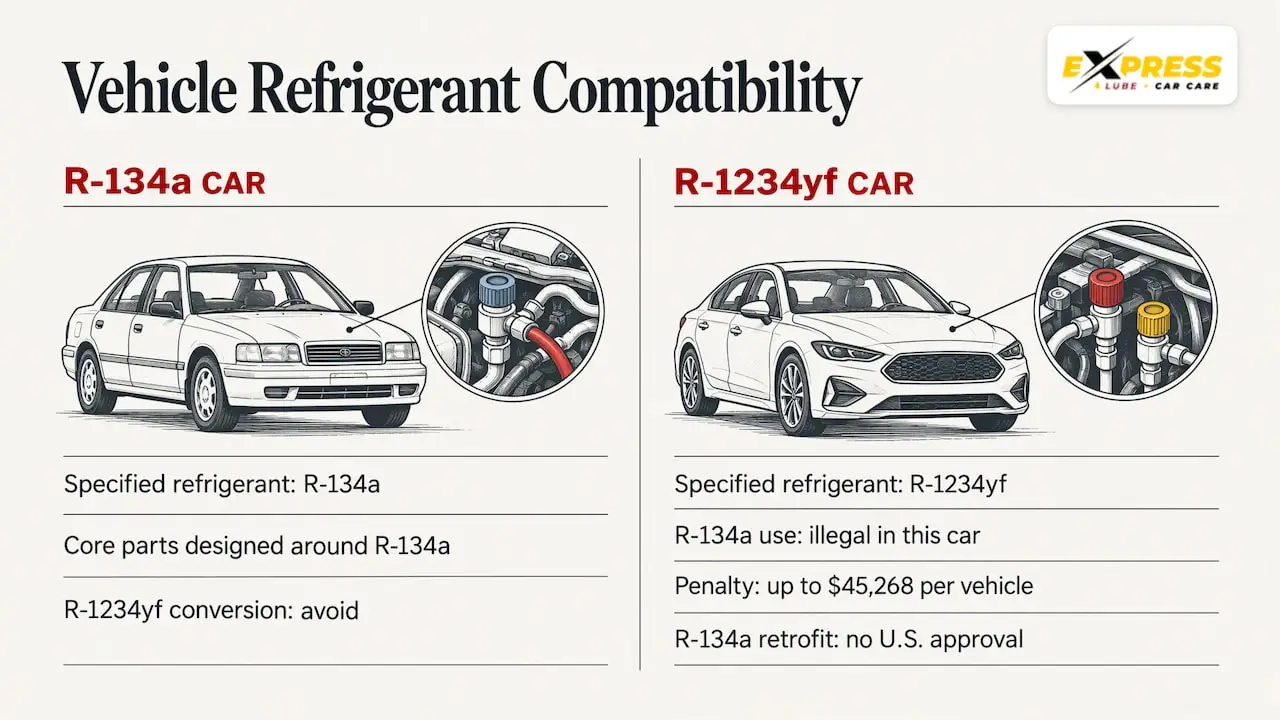
There is one more practical problem with mixing. Industry manufacturers warn that recovery machines can’t handle refrigerant blends, which can lead to equipment failure and Clean Air Act violations. A contaminated system is a headache for any shop that touches it afterward.
How do you know which refrigerant your car uses?
Don’t go by model year alone. Opteon reports that 100% of vehicles made for U.S. sale in 2025 use R-1234yf, and that over 125 million cars on U.S. roads use it. That still leaves many years where the answer depends on the make, model and build. Here is how to check:
- Look under the hood. Most cars have a label near the radiator support or on the underside of the hood that names the refrigerant and the charge amount.
- Check the owner’s manual. The A/C or specifications section lists the refrigerant type.
- Look at the service ports. R-1234yf systems use unique left-handed threaded fittings, while R-134a uses standard right-handed threads. That is by design, to prevent cross-contamination.
- Call us with your VIN. If the label is gone or painted over, we can help you confirm it before any work starts.
This is especially worth doing if you have a European vehicle, a recent import or a truck that changed refrigerants partway through a generation. Two trucks that look identical can need different refrigerants.
Can you use your R-134a gauges on an R-1234yf system?
No. Because the fittings are different on purpose, R-134a couplers won’t connect, and the guide says to use only equipment rated for R-1234yf. Adapters that defeat the fitting design are the wrong answer, since that design is a safeguard.
This is one reason a quick “top-off” at home isn’t as simple as the can suggests. Even where it is legal to buy a small can, you can’t tell how much refrigerant is missing without the right gauges, and low refrigerant points to a leak that the can won’t fix.
Why does R-1234yf service cost more?
A few reasons stack up, and they have more to do with the work than with a markup:
- Dedicated equipment. R-1234yf service requires R-1234yf-rated recovery and charging equipment. A shop can’t use its old R-134a machine.
- Certified technicians. EPA Section 609 certification is required for anyone who services motor vehicle A/C for compensation. It also affects who can buy bulk refrigerant: certification is not required to buy under 2 lbs. of Opteon YF in 12- or 28-oz cans, but it is required for a 10- or 25-lb cylinder, per the Opteon guide.
- A specialized system. Chemours itself calls this the most significant change to the mobile A/C industry since the R-12 phase-out in the 1990s.
We don’t publish a flat A/C price because the real cost depends on what is wrong. A recharge on a sealed, healthy system is a different job from replacing a leaking condenser or a failed compressor. You’ll get an actual quote after diagnosis, not a guess over the phone.

What to do when your A/C blows warm
Whether your car uses R-134a or R-1234yf, the process is the same, and it starts with finding out why.
- Notice the symptoms. Is the air cool but weak, warm all the time, or cold only while driving? Does the compressor clutch click on and off rapidly? Do you hear noise when the A/C starts?
- Get a diagnosis first. A technician checks system pressure, looks for leaks, and tests the compressor, fans and controls. Our step-by-step guide to diagnosing car A/C problems walks through what that looks like.
- Repair the cause. Typical findings are a leaking hose, seal or condenser, a worn compressor, or an electrical fault.
- Evacuate and recharge to spec. The system is recharged with the refrigerant on your label, in the amount the manufacturer lists, using the proper oil.
A warning for budget-minded drivers: refrigerant that leaked out has to have gone somewhere. Recharging without finding the leak usually means doing it again, and with R-1234yf that costs more each time.
Texas heat is hard on A/C systems, and the cooling system and A/C share the front of the car. If your engine runs warm when the A/C is on, have the radiator and fans checked too. Our heating and cooling repair page explains how the two connect.
Our perspective: diagnose first, then match the refrigerant
We see the refrigerant question from a few angles. Drivers from Richland Hills, North Richland Hills, Hurst and Bedford come in with a can-of-refrigerant story, or with a car they bought used and don’t know what it takes. The common thread is that the refrigerant is rarely the real problem. The leak, the compressor or the electrical fault is.

So we do three things in this order. We confirm what the manufacturer specifies for your car. We inspect the system and show you what we find, including photos through our digital vehicle inspection, so you decide with real information. Then we repair what’s wrong, using R-1234yf-rated equipment and ASE-certified technicians on the systems that need them.
We would rather tell you your system doesn’t need a recharge than sell you one. Repairs that qualify are backed by our 24-month/24,000-mile warranty. Qualifying is the key word: we’ll explain what is and isn’t covered before you approve work.
— Express Lube & Car Care
Need A/C service in Richland Hills?
Walk-ins are welcome, or you can book ahead. We handle A/C diagnosis and repair for R-134a and R-1234yf systems at our single shop at 7932 Glenview Drive, Richland Hills, TX 76180. See our auto A/C repair page for what the service includes, or browse all our services.
If a bigger A/C repair is on the table, eligible customers may explore financing through third-party providers such as Koalafi, Snap Finance, American First Finance and Synchrony, subject to provider approval and terms. It is not an in-house payment plan, and approval isn’t guaranteed. Call us at (817) 284-8478 and we’ll go over your options.
Buying a used car? Ask about the A/C refrigerant
The refrigerant type is a useful thing to know before you buy. A car with an R-1234yf system will cost more to service than one with R-134a, and a hidden leak in either can turn into a real repair bill. A pre-purchase vehicle inspection lets a technician check the A/C along with everything else before you sign.
FAQs about R-134a and R-1234yf
Are R-134a and R-1234yf pressures the same?
They are close enough that people assume the systems are interchangeable, but similar pressure doesn’t make them compatible. The oil, seals, fittings, safety devices and service equipment are all different. Use only the refrigerant and equipment that match your car’s label.
What cars use R-1234yf?
Every vehicle made for U.S. sale in 2025 uses it, along with a large number of earlier models, and Opteon counts over 125 million on U.S. roads. Because the switch happened at different times for different models, check your under-hood label or owner’s manual instead of relying on the model year.
Is it legal to put R-134a in an R-1234yf car?
No. Using R-134a in a vehicle designed for R-1234yf violates the U.S. Clean Air Act, and civil penalties can reach $45,268 per non-compliant vehicle or engine, according to Chemours. It also compromises the system’s performance and safety design.
Can I recharge my own A/C?
Small cans of R-1234yf under 2 lbs. can be bought without Section 609 certification, but that is only the purchase rule. Without proper gauges and leak detection you can’t tell how much is missing or why, and a system that has lost refrigerant has a leak. We recommend a diagnosis first, particularly on an R-1234yf system.
Why is my A/C blowing warm even after a recharge?
Usually the leak is still there, or the problem was never refrigerant at all. A failing compressor, a clogged condenser, a bad pressure switch or a blend door problem can each cause warm air. A technician can sort out which with a pressure check and leak test.
Sources
- Acceptable Refrigerants and their Impacts, US EPA
- Questions and Answers About the Safety Risks of Using Hydrocarbons in Motor Vehicle Air Conditioners, US EPA
- Opteon YF Shop Owner’s Guide, Chemours
- Opteon YF Shop Owner’s Guide (2025 edition), Opteon
- R-1234yf Refrigerant, Opteon
- Service bulletin on R-1234yf compressor oils, NHTSA
- Upstream climate impacts from production of R-134a and R-1234yf, ICCT
- Mobile air conditioning: life-cycle costs, ICCT