

When a power window stops working, the cause is usually one of five things: a blown fuse, a bad switch, a failed motor, a broken regulator, or a window lock that got switched on by accident. The pattern tells you a lot. If every window quits at once, think fuse or shared circuit. If just one quits, think that door’s switch, motor, regulator or wiring. Below is how to sort it out in a few minutes, and when to hand it to a shop.
TL;DR
- All windows dead: check the window lock button and the fuse first. One window dead: suspect its switch, motor, regulator or door-hinge wiring.
- Try the window from both its own switch and the driver’s master switch. If it works from one but not the other, the switch that fails is the likely culprit.
- Listen when you press the switch. Silence, a click, a hum and a grinding noise each point somewhere different.
- A window stuck open can be secured temporarily with tape or a plastic sheet until it is fixed. Don’t force the glass.
- Get a written estimate before any repair. We diagnose first and show you what we find before recommending parts.
Table of Contents
- What does it mean when one window fails versus all of them?
- What should you check first when a window won’t go up?
- What do the sounds tell you?
- Why is the driver window not working?
- How do you tell a bad window switch from a bad motor?
- Does each power window have its own fuse?
- How do you reset a power window?
- How do you secure a window that is stuck open?
- What does a window regulator replacement involve, and what does it cost?
- Our perspective on power window problems
- Need a hand with a window that won’t move?
- What happens during a power window diagnosis?
- How can you keep windows working longer?
- FAQ
- Sources
What does it mean when one window fails versus all of them?
This is the first clue, and it costs nothing to check. According to one auto glass company’s guide, a power window commonly stops because of a blown fuse, a faulty switch, a burned-out motor, a broken regulator, or the child safety lock. When all four windows stop, a fuse is the most likely cause because the windows usually share protection. When one stops, the problem is more likely local to that door.
There is a catch. One dead window does not prove the fault is inside the door. Shared controllers, power supplies or initialization settings can affect a single window channel, so a good diagnosis tests the circuit before anyone pulls a door panel.
The same goes for fuses on specific models. A Ford service bulletin filed with NHTSA describes some 2017 Escapes built on or before July 29, 2016 that could lose both front windows when a fuse opened after the windows were run against their stops at the same time, especially in cold weather. That is one vehicle, not a rule, but it shows why a repeat blown fuse deserves a closer look rather than just a new fuse.
What should you check first when a window won’t go up?
Work through these in order. None needs tools except possibly your owner’s manual.
- Press the window lock button on the driver’s door panel. If it is engaged, the passenger and rear switches won’t work. It is easy to bump, especially with kids or pets in the car.
- Try both controls. Operate the window from its own door switch and from the driver’s master switch.
- Listen. Turn the key to on (engine off is fine) and press the switch with the radio off and the cabin quiet.
- Check the fuse using the fuse diagram in the owner’s manual.
- Look at the glass and track. Visible dirt, rust, or ice on a cold morning can keep a healthy motor from moving the glass.
- Try the reset or relearn step if your vehicle has one-touch windows (more on that below).
If the window moves with a light helping push on the glass while someone holds the switch, stop. That is a sign the mechanism is worn, and continuing to force it can crack the glass or bend the track.
What do the sounds tell you?
A lot, as long as you treat them as clues and not verdicts. One auto glass guide says that silence when you press the switch can mean the motor is not getting a signal, while a hum or grinding suggests power reaches the motor but the mechanism is failing. Another parts retailer’s guide adds that if the motor runs but the glass does not move, the regulator may be damaged.
| What you hear | What it may mean | What to do next |
|---|---|---|
| Nothing at all, from any window | Fuse, relay, or window lock circuit | Check the lock button and fuse |
| Nothing, one window only | Switch, wiring, or motor | Try the other switch, then have the circuit tested |
| Click from the door | Switch or relay is sending a signal | Have the motor and wiring tested |
| Motor hum, glass stays put | Regulator, cable or track problem | Stop pushing; inspect the door mechanism |
| Grinding or crunching | Worn regulator, broken clip, or debris | Stop using the window and have it inspected |
| Slow, struggling movement | Dirty or dry track, weak motor, low voltage | Inspect the track and test voltage |
None of these sounds proves a specific part is bad. They narrow the search, and testing confirms it.
Why is the driver window not working?
The driver’s window has more going on than the others. It has its own switch, plus the master switch bank that controls every door. It often has one-touch auto up and down, which means a control module has to know where the glass is. The wiring also flexes every time the door opens and closes.
So a dead driver window can come from the switch, the motor, the regulator, wiring in the door-hinge area, a shared controller or power supply, or a lost initialization. The simple order is: check the lock button first, then try both controls if the window has more than one, and compare with the other windows. If the passenger windows work from the master switch but the driver’s does not, the problem is narrowed to the driver’s door. If the driver’s window works but nothing else does from the master, the master switch or its power feed is suspect.
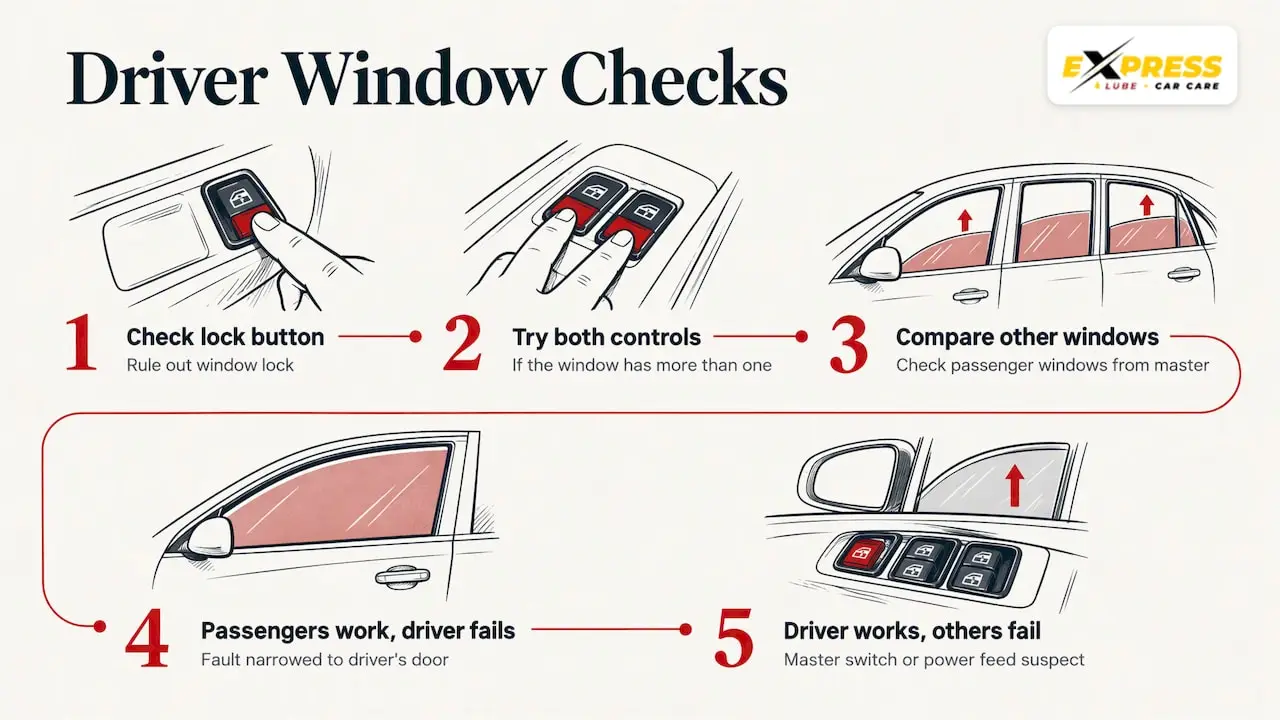
Broken wires at the door hinge are a classic cause of intermittent failure. The window works, quits, works again after a slam, then quits for good. That on-again, off-again behavior is worth mentioning to whoever diagnoses it.
How do you tell a bad window switch from a bad motor?
Start with the two-control test. According to one guide, if a window works from one control but not the other, the control that fails is likely faulty. If neither works, move on to the fuse, then consider the motor, regulator, relay or wiring.
Shops go a step further with a meter or a current clamp. As one trade publication explained, a heavy battery draw while the window does not move generally means the switch is working and the circuit is complete, which points to the motor. That is the kind of test that separates a $-sized guess from a real answer: swapping parts without testing is how a bad switch turns into a replaced motor and a still-dead window.
If you want to test at home, only do so with the battery disconnected whenever you are unplugging connectors, and don’t probe airbag-related wiring in the door. Doors on many vehicles carry side airbag circuits. If you aren’t sure what is safe to touch, that’s the moment to bring it in.
Does each power window have its own fuse?
Not usually. Power windows often share a dedicated fuse, sometimes with a relay or circuit breaker. Your owner’s manual shows where it is and what amperage it needs. Some vehicles have separate fuses for the front and rear windows, and some use a circuit breaker instead of a fuse. For example, for certain Ford models, an older repair reference lists a specified circuit breaker and, on Excursion models, fuse No. 3 in the power distribution box.
To check a fuse safely:
- Turn the ignition off and remove the key.
- Find the right fuse panel using the owner’s manual. Many cars have one inside the cabin and one under the hood.
- Pull the fuse with the puller clipped in the panel, or small pliers.
- Look at the metal strip inside. If it is broken or the plastic looks melted or dark, it is blown.
- Replace it only with the same amperage. A bigger fuse can let wiring overheat.
If a new fuse blows right away, don’t keep trying bigger or more fuses. Something is shorting or the motor is drawing too much current. That is a job for a proper electrical diagnosis.
How do you reset a power window?
There is no single reset procedure. It depends on the make, model and year, and the right steps live in your owner’s manual or the manufacturer’s service information. After a battery was disconnected or went flat, many vehicles with one-touch windows forget where the glass starts and stops, so the auto function quits even though the window still moves manually.
Two examples show how different the procedures can be:
- For certain 2019 to 2020 Mitsubishi Eclipse Cross and Outlander models, a service bulletin says some switch operations can make the auto open and close function inoperative. The fix described is to close the window fully, pull the switch up and hold it for one second, then confirm the auto function works.
- On Mercedes-Benz vehicles, a technical tips document explains that power loss can erase stored window-position data and disable automatic functions, and that normalization teaches the control unit the open and closed positions.
Don’t apply one brand’s procedure to another. If you drive a European vehicle, the relearn step can require a scan tool. We work on European vehicles regularly, and this is one of those small jobs that is much quicker with the right equipment.
How do you secure a window that is stuck open?
Safety and security first. A window stuck down is a problem when it rains, and when you park.
- Temporary cover: Tape clear plastic sheeting to the outside of the door frame with painter’s tape or a tape that won’t strip the paint. Don’t put tape across the window seal, and don’t drive at highway speed with it, because it can flap loose.
- If the glass is still in the door and just fell: Some people can raise it by hand while a helper presses the switch, then wedge it with a folded towel or a wooden block. That is only a stopgap.
- Full manual raise: A repair guide describes the full approach: remove the door panel, disconnect power to the motor, unbolt the window-to-regulator fasteners, raise the glass by hand and shim it in place with one or two wooden blocks. This involves airbag wiring and fragile clips on many vehicles, so we’d rather you don’t do it unless you are comfortable working inside a door.
If the glass is loose and rattling inside the door, it has probably come off the regulator. Leaving it in a half-open state invites more damage.
What does a window regulator replacement involve, and what does it cost?
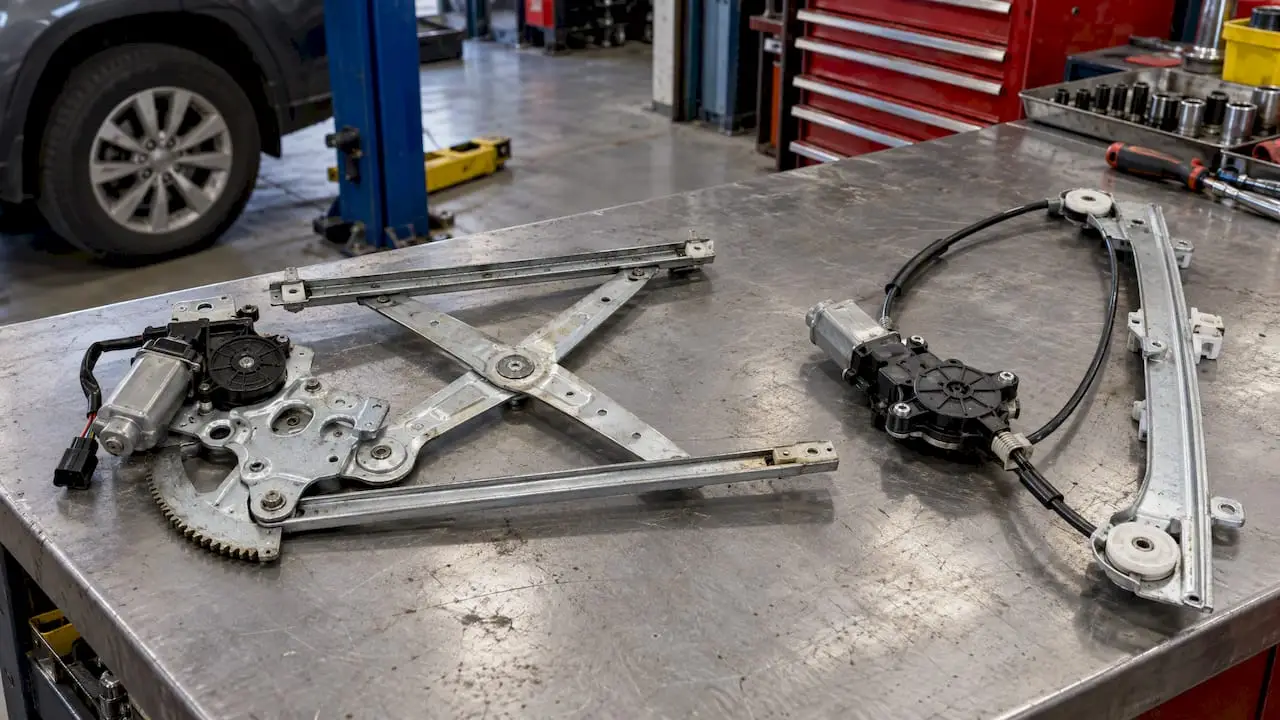
The regulator is the mechanism, either a scissor-style arm or a cable and pulley system, that lifts the glass. It often comes together with the motor as one assembly, which can affect what a repair costs. We don’t quote a price for a repair without seeing the vehicle, because the cost depends on your vehicle’s parts, whether the motor and regulator are one piece, and how much labor your door requires. A number found online may have little to do with your car, so ask for the real thing.
Whatever shop you use, Consumer Reports recommends you get a written estimate that specifies the type of parts and require the shop to get your approval before it exceeds that estimate. It also notes that paying by credit card lets you contest a charge if you are overcharged or billed for a part that wasn’t replaced. For why two estimates can differ for the same job, see our driver’s guide to why auto repair estimates vary.
Our perspective on power window problems
Most window problems we see start with a quick guess. Someone replaces a switch because the window is dead, and the window is still dead because the motor was the issue. Or the fuse is replaced three times and keeps blowing because the real fault is a chafed wire in the door hinge.
That is why we start with diagnosis. Our ASE-certified technicians test the circuit, and our digital vehicle inspections let us send you photos of what we find so you can see the same thing we see. Then we talk through the options and the written estimate before any work begins.
Windows are a safety and security item as well as a convenience. A window that won’t close leaves your vehicle open, and a window that won’t open can be a problem in a hot Texas summer parking lot. We would rather get the cause right the first time than have you back for a second visit.
Qualifying repairs are backed by our 24-month/24,000-mile warranty, and we’ll tell you up front what is covered.
Express Lube & Car Care
Need a hand with a window that won’t move?
If the quick checks above didn’t solve it, we can find out why. Electrical diagnosis, switch, motor and regulator work are part of our full range of repair services, and you can walk in without an appointment or schedule a visit. We serve drivers in Richland Hills, North Richland Hills, Hurst, Bedford and the rest of Northeast Tarrant County.

We’ll explain what we find and what it would take to repair it. Repairs that qualify are covered by our 24-month/24,000-mile warranty. Eligible customers can also look at financing through third-party providers, subject to provider approval and terms. Call us at (817) 284-8478 or stop by 7932 Glenview Drive, Richland Hills, TX 76180.
What happens during a power window diagnosis?
A proper diagnosis follows the same logic as your driveway checks, just with better tools:
- Confirm the complaint. We operate every window from every switch and note which ones fail, and how.
- Check the basics. Lock circuit, fuses, relays and breakers.
- Test power and ground at the switch and motor. This separates a bad switch from a bad motor from a wiring fault.
- Inspect the mechanism. If the motor works, we look at the regulator, the glass attachment and the track.
- Explain and estimate. You get the findings, the options and a written estimate before work starts.
We don’t make up findings or promise a timeline before we have seen the vehicle. Some windows are fixed the same day when parts are available, and sometimes a part has to be ordered. We’ll tell you which applies.
How can you keep windows working longer?
- Run them regularly. A window that sits unused in the same position for months is more likely to stick.
- Clean the tracks and seals. Dirt and grit load the motor. Wipe the channels when you wash the car and use a silicone-based lubricant that the manufacturer allows.
- Don’t force frozen windows. On the rare cold morning in North Texas, let the defroster warm the cabin and the glass before you hit the switch. The Ford bulletin above shows cold weather making an electrical problem worse.
- Don’t hold the switch at the end of travel. Running the motor against the stops strains it and the fuse.
- Mention window trouble at your next service. During a maintenance visit we can look at the door seals and operation as part of a preventive inspection, along with the other items your manufacturer’s schedule calls for.
FAQ
Why won’t my power window go up but I can hear the motor?
A motor that runs while the glass stays put usually means the mechanism is the problem, often the regulator, a cable, or the clips that hold the glass. Stop pressing the switch, because continued use can make damage worse. Have the door inspected.
Can a bad window switch affect only one window?
Yes. Each door switch controls its window, and the master switch controls them from the driver’s side. If a window works from one but not the other, the switch that fails is the likely cause. A faulty master switch can also leave several windows dead while the individual door switches still work.
Why did my windows stop working after a battery change?
On many vehicles, losing power wipes the stored window positions, and the auto up and down function stops until the system is relearned. The procedure is specific to each make and model, so check your owner’s manual, or have a shop with the right tools do it.
Is it safe to drive with a window stuck open?
Yes in most cases, if it is covered well and the glass is not loose in the door. Use a temporary cover at low speeds, don’t leave valuables in the car, and get it repaired soon. If the glass is rattling or has dropped inside the door, have it looked at before it scratches or breaks.
Sources
- Power Window Not Working: Causes, Costs & Fixes
- Front Power Windows Inoperative, Ford service bulletin (NHTSA)
- One power window does not work, The Vehicle Standard
- Window Not Working? 9 Reasons Why Window Motors and Regulators Fail
- More up than down, Vehicle Service Pros
- Power Windows, iFixit
- TSB1942A002REV, Mitsubishi (NHTSA)
- Power Window Tips, Mercedes-Benz
- 4 Causes of a Car Window That Won’t Go Up
- The how-to-get-anything-fixed guide, Consumer Reports