

Nine times out of ten, a door lock not working traces back to one of five suspects: a dead key fob battery, a blown fuse, a worn-out actuator, a cracked wire inside the door boot, or a weak vehicle battery starving the system of power. Start with the two-minute check: swap the fob battery or peek at the fuse box before you assume the worst. If neither fixes it, Express Lube & Car Care’s ASE-certified technicians in Richland Hills can pinpoint the real cause fast.
TL;DR:
- Most door lock failures are caused by a dead key fob battery, a blown fuse, or a failed actuator, which can often be fixed within a few minutes or hours.
- Testing the signal from the fob, clicking the master switch, and inspecting interior lights help pinpoint whether the issue is electrical, wiring, or mechanical.
- Broken wires inside the door boot are a common cause of intermittent lock problems, especially if issues change with door angle or movement.
- Replacing a fob battery or fuse is quick and inexpensive, but actuator or wiring repairs require more time and may involve door panel removal.
- When multiple doors fail simultaneously, or wiring damage, BCM faults, or a lack of a spare fob are suspected, professional diagnosis with proper tools is strongly recommended.
Table of Contents
- Door Lock Troubleshooting: The 2-Minute Checklist
- How Do Technicians Diagnose a Stuck or Silent Lock?
- What Causes Door Locks to Fail, and How Long Does Each Fix Take?
- When Should You Bring Your Car in for Professional Lock Repair?
- What Our Technicians See Most Often
- Get Your Locks Fixed Right the First Time
- Sources
- FAQ
Door Lock Troubleshooting: The 2-Minute Checklist
Before you assume the worst, run through this list. It takes less time than finding a parking spot at the grocery store, and it solves a surprising number of lock complaints on the spot.
- Swap the key fob battery. If you can lock the doors manually but the remote does nothing, the issue is almost always signal related rather than a mechanical failure. Try a spare fob if you have one, and hold it close to the door handle since a weak battery sometimes still works at short range.
- Test the master lock switch. Press the interior switch on the driver’s door. If the locks respond normally, your fob is the likely culprit. If nothing happens at all, the problem is probably on the vehicle side, not the remote.
- Watch your dash and interior lights. Dim lights, a slow-cranking engine, or a weak horn all point to low battery voltage rather than a lock problem specifically. Use your manual key to get in if needed.
- Check the power-lock fuse. Pop your fuse box (check both the cabin panel and under the hood) and look for a fuse with a broken filament or discolored window. A blown fuse can knock out the entire central locking circuit, and it’s a cheap, five-minute fix if that’s all it is.
- Lock up manually for now. If you’re stuck and can’t get to a shop right away, lock each door by hand and keep the vehicle in a secure spot until you can get it looked at.
Pro Tip: Keep a spare fob battery (often a CR2032) in your glovebox. It costs a couple of dollars and saves you a trip when the low-battery chirp finally catches up with you.
How Do Technicians Diagnose a Stuck or Silent Lock?
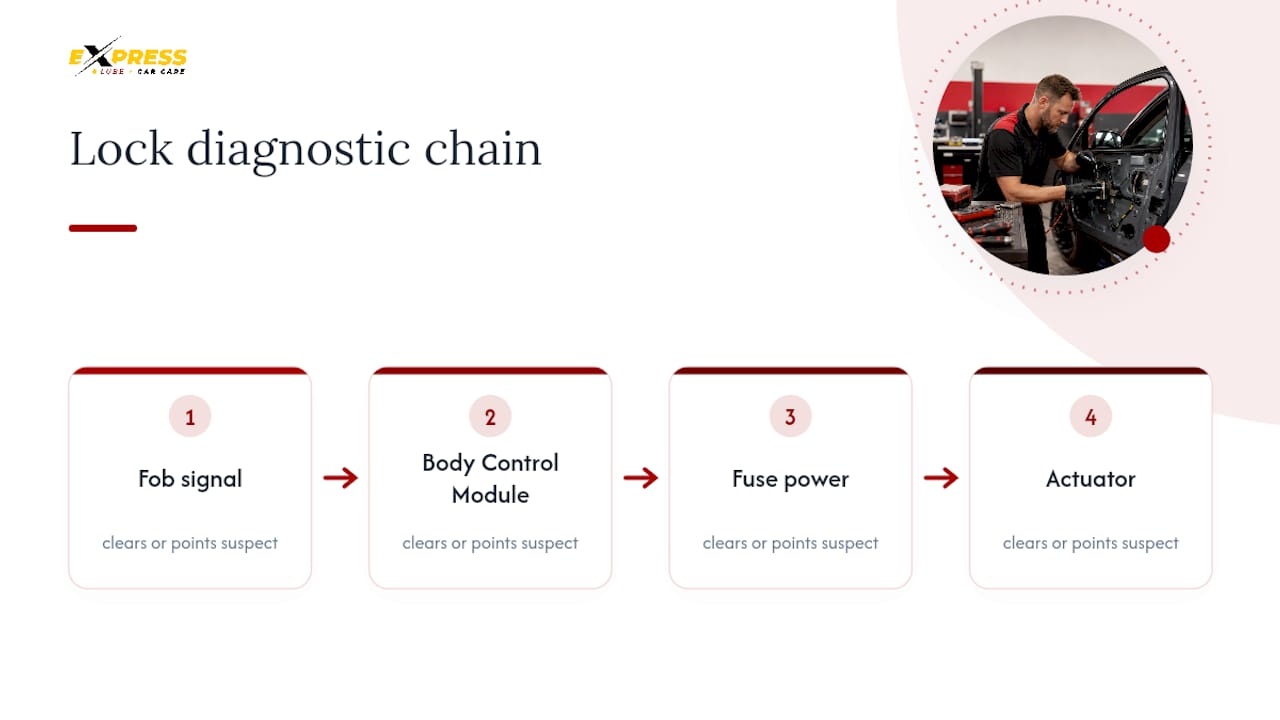
When the quick checks don’t solve it, a technician follows a logical chain: fob signal, then the body control module (BCM) that receives it, then the fuse supplying power, then the actuator that physically moves the lock. Each step either clears a suspect or points straight at it.
Step 1: Listen to each door
Have someone press the lock button while you stand outside the car with the windows down.
- A solid “thunk” means the actuator moved. The lock mechanism itself might just be sticking.
- A buzzing or clicking sound with no movement usually means the actuator is receiving power but its gears have failed internally.
- Total silence on one door but normal operation everywhere else points toward a wiring break or a dead actuator on that specific door.
- Silence on every door at once usually means a fuse, the BCM, or the fob rather than an actuator.
A whirring, grinding, or rapid “machine gun” clicking noise is one of the clearest signs you’ll get. It typically means the actuator’s internal gears have stripped and the part needs to be replaced rather than repaired.
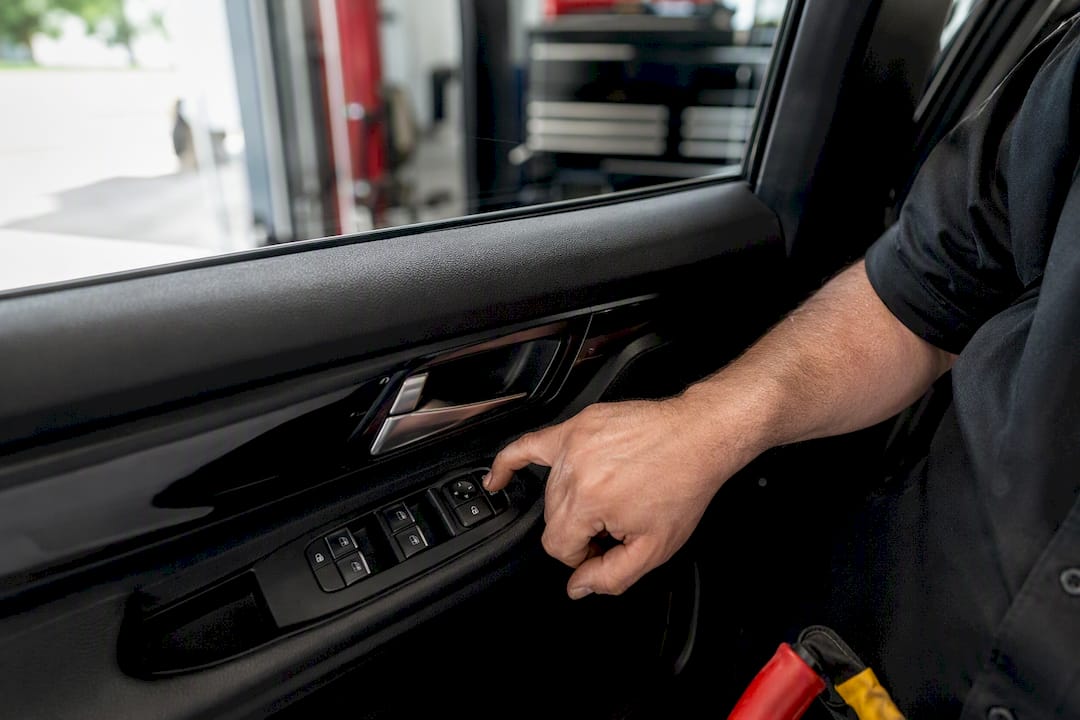
Step 2: Confirm with the master switch
If the driver’s door master switch locks every door fine but the remote doesn’t, you’re looking at a fob or receiver issue, not a wiring problem. If the master switch locks the driver’s door but not the others, the fault sits between the driver’s door module and the affected door, often in the wiring or a slave actuator.
Step 3: Run the wiggle test
Open the door and flex the rubber accordion boot that connects the door to the body while a helper cycles the lock switch. If the lock works intermittently as you flex the boot, you’ve likely found a fractured wire. This rubber section flexes every single time the door opens and closes, and after years of that motion, the copper strands inside the boot’s harness eventually snap even though the insulation looks fine from the outside. A fault that changes with door angle almost always means a broken wire inside that boot rather than a failed actuator.
Step 4: Decide what’s actually broken
- If power reaches the actuator connector (confirmed with a test light or multimeter) but the actuator doesn’t move, the actuator itself needs replacement.
- If there’s no power at the connector at all, the problem is upstream: fuse, wiring, or BCM.
- If multiple doors fail at once and the fuses check out fine, the fault often lies with a shared component like the BCM or a common ground connection rather than four separate actuators failing simultaneously, which would be an unlikely coincidence.
Pro Tip: If you’re chasing an intermittent fault, try to recreate it with the door held at different angles rather than fully open or fully closed. Broken wires inside the boot often only make contact at certain positions.
Here’s where we’ll be straight with you: probing live automotive wiring with a multimeter, and especially removing a door panel to access the actuator, carries real risk if you’re not familiar with the process. You can crack interior trim clips that don’t come cheap to replace, or short a circuit you didn’t mean to touch, so many UK drivers turn to a trusted mobile mechanic in Knutsford, Wilmslow & Crewe for convenient diagnostics and repairs at their doorstep. Repeatedly forcing a lock or trying risky shortcuts can cause damage or create a security gap, so once your diagnosis points past the fuse box, it’s usually smarter to hand it to a shop with the right electrical diagnostic tools.
What Causes Door Locks to Fail, and How Long Does Each Fix Take?
Not every lock problem takes the same amount of time or money to fix. Here’s how the common causes typically break down:
- Dead fob battery: A couple of dollars and a couple of minutes. The easiest fix on this list.
- Blown fuse: Usually under $10 in parts and a five-minute swap, assuming nothing else caused the fuse to blow in the first place.
- Failed actuator: Expect roughly one to two hours of labor per door once the panel comes off, since the actuator has to be unbolted, unplugged, and swapped, then the panel reinstalled.
- Wiring break in the door boot: This can run longer than an actuator swap because tracing an intermittent break takes time, even before the repair itself begins.
- Weak vehicle battery or BCM issue: Timing varies widely. A battery that’s too weak to supply steady voltage can mimic a dead actuator with faint clicks or partial movement, while true BCM faults usually require a scan tool and more diagnostic time.
Manual locking works as a stopgap, but keep in mind some vehicles link the power lock system to the alarm or anti-lockout logic. On some models, the BCM won’t cycle the locks at all if it thinks a key is still inside the cabin. Watch for red flags that mean it’s time to stop troubleshooting on your own: a fob that’s been through the wash, more than one system acting strange at once (locks and windows both misbehaving, for example), or any smell of burning plastic near a connector, which can indicate arcing.
When Should You Bring Your Car in for Professional Lock Repair?
Call it in once you’ve hit any of these: more than one door failing at the same time, no spare fob to test with, visible wire damage in the door boot, a suspected BCM fault, or a problem that only shows up sometimes and won’t reproduce on command. If you don’t have a multimeter or you’re not comfortable removing interior trim, that’s also a perfectly good reason to skip straight to a shop.
When you bring it to Express Lube & Car Care, our ASE-certified technicians start with a digital vehicle inspection that includes photos, so you can see exactly what’s failing before any work begins. From there, diagnosis typically includes:
- Fuse and voltage checks at the panel
- Multimeter testing directly at the actuator connector
- Door panel removal when wiring or the actuator itself needs a closer look
- Wiring repair inside the boot, actuator replacement, or a BCM scan, depending on what the testing shows
Basic diagnosis is usually quick since the chain of causes narrows fast once testing begins. Bring your key fob and spare if you have one; it saves a step. Repairs completed at our shop are backed by our 24-month/24,000-mile warranty, so you’re covered if the same issue resurfaces.
What Our Technicians See Most Often
Most of the lock complaints that come through our bay end up being a fob battery, a blown fuse, or a single failed actuator, not some exotic electrical gremlin. That’s exactly why we start there instead of jumping straight to a door-panel teardown. It saves you time and money when the fix really is that simple. When it isn’t, our digital inspection shows you the actual photos of what we found, so pricing never feels like a mystery.
Get Your Locks Fixed Right the First Time
Express Lube & Car Care gives Richland Hills drivers a faster path to a working lock than guessing your way through forum threads or paying for parts you don’t actually need. Our ASE-certified technicians handle everything from fuse and wiring diagnostics to full actuator replacement, and every repair comes with a digital vehicle inspection so you can see the exact problem in photos before you approve any work.

Repairs performed at the shop are covered by a 24-month/24,000-mile warranty, and walk-ins are always welcome if you’d rather not wait for an appointment. If a fob battery or fuse swap didn’t solve your issue, schedule an appointment online or call to get your locks working the same day whenever possible.
Sources
- Power locks not working: causes and fixes – Auto Barn
- Engineerskill
- Keyless entry troubleshooting guide – PRECISE LOCKSMITH LLC
FAQ
Why is my door lock jammed but the key fob still works?
A jammed mechanical lock usually points to a stuck actuator arm, ice or debris in the linkage, or a lock cylinder that needs lubrication rather than an electrical fault, since the fob signal is clearly reaching the door.
Why are my power door locks not working on just one door?
A single door failing almost always means a local problem: a broken wire inside that door’s rubber boot, a failed actuator on that door, or a stuck mechanical linkage, rather than a fuse or fob issue that would typically affect every door at once.
How do I unlock a stuck door manually?
Use the physical key in the driver’s door cylinder if your vehicle has one, or the interior manual door pull most cars keep as a backup; if neither works, call a shop rather than forcing the mechanism, since forcing it risks further damage.
How much does door lock actuator replacement typically cost?
Cost varies by vehicle and labor time, since actuator replacement usually runs one to two hours per door once the panel is removed; Express Lube & Car Care provides an itemized estimate with photos before any repair begins.
Can a weak car battery cause central locking to stop working?
Yes. Low system voltage can prevent actuators from getting enough current to fully cycle, which often shows up as faint clicking or partial lock movement instead of complete failure.