

Your Hyundai's oil light comes on during a lunch break run down Boulevard 26, and now you're stuck with the same question a lot of drivers ask: do you need service right now, or is this one of those old 3,000-mile habits that doesn't apply anymore?
That confusion is understandable. Modern Hyundai engines run on tighter tolerances, lighter viscosity oils, and longer factory intervals than older cars did. But Richland Hills driving isn't “normal” in the textbook sense. Short errands, school pickup lines, traffic, summer heat, and long idle time all change what your engine oil goes through.
If you searched for oil change hyundai because you want a straight answer, here it is. The right interval depends on your model, your engine, the oil spec your Hyundai requires, and how you drive every week. A good oil change protects more than lubrication alone. It supports cold starts, helps manage heat, and keeps contaminants from circulating through parts that don't tolerate neglect well.
Why Your Hyundai Needs Regular Oil Changes
A lot of Hyundai owners first think about oil when the maintenance reminder pops up. Others notice it when the engine starts sounding a little rougher at idle, or when they realize they've gone longer than planned since the last service. Either way, waiting until the engine feels “off” is not a great strategy.
Modern Hyundai engines depend on clean oil to do several jobs at once. It lubricates moving parts, carries heat away from internal components, suspends contaminants, and helps protect tight engine clearances from wear. In direct-injected and turbocharged engines, that job gets harder because oil deals with more heat and more stress than older engines did.
What clean oil is really doing
When oil breaks down, it doesn't just get darker. It can lose its ability to protect critical parts during startup, especially after your Hyundai sits overnight and then goes right into stop-and-go traffic. That matters in local driving where many trips are short and the engine doesn't always stay fully warmed up for long.
Hyundai owners who still follow the old 3,000-mile rule are usually being cautious, not careless. But factory guidance has changed, and so has oil technology. If you want a quick background on why regular service still matters even when intervals have stretched, this overview of the benefits of an oil change lays out the basics well.
Practical rule: Oil isn't just there to make the engine run. It's there to keep wear, heat, and deposits from stacking up over time.
What happens when service gets delayed
Delayed oil service usually shows up gradually, not all at once. The engine may get noisier. Idle quality may feel less smooth. Internal deposits can build faster if the oil is overloaded with moisture, fuel dilution, and combustion byproducts.
For your Hyundai, regular oil changes are cheap insurance compared with engine repair. That's especially true if you drive in traffic often, make lots of short trips, or own a turbo model that works the oil harder than a basic commuter engine.
Hyundai Oil and Interval Recommendations
Your Hyundai may be capable of long oil change intervals on paper. In Richland Hills, a lot of them do not live on paper. They live on short trips to work, school pickup lines, grocery runs, hot afternoons, and long red lights on Boulevard 26.
That difference matters.
Hyundai notes that many newer models can go farther between oil changes under normal driving, often with synthetic oil, but the shorter severe-service schedule applies sooner than many drivers expect. Hyundai's maintenance guidance for owners points out that conditions like frequent short trips, extended idling, stop-and-go driving, dusty roads, and high temperatures call for more frequent service, as shown in Hyundai's owner maintenance schedule and severe-use guidance.
Normal driving versus severe driving
In the shop, “severe” usually means ordinary local use.
If your Hyundai spends most of its time on quick errands, city streets, or heavy traffic, the oil has a harder job than it would on steady highway miles. The engine may not stay at full operating temperature long enough to burn off moisture and fuel dilution. Add summer heat and idle time, and the interval that looks fine in a brochure may be too long for how you drive.
For that reason, I usually tell local Hyundai owners to treat the owner's manual as the starting point, then adjust based on use. A commuter Elantra that sees regular highway time can often stay closer to the longer interval. A Tucson or Santa Fe that does mostly neighborhood driving and idles with the A/C blasting usually benefits from earlier service.
Oil type matters as much as mileage
Hyundai engines are picky for a reason. The correct oil is not just about synthetic versus conventional. It is also about the right viscosity and the right API or ILSAC approval for that specific engine family.
That becomes even more important on turbocharged Hyundai engines, which put more heat into the oil and tend to be less forgiving of the wrong spec. If you want a clearer breakdown of how viscosity grades and manufacturer approvals affect your engine, this guide to oil recommendations for my car explains what to check before service.
Here is the practical version. Use the exact oil grade listed for your Hyundai, and do not guess based on what another model uses.
| Hyundai Model/Engine | Recommended Oil Type | Normal Interval (Miles) | Severe Interval (Miles) |
|---|---|---|---|
| Elantra with Smartstream G2.0 Atkinson | Check owner's manual for the exact viscosity and required API or ILSAC spec | Follow Hyundai normal schedule in the manual | Use the shorter severe-service schedule in the manual |
| Sonata with engine-specific Hyundai spec | Check owner's manual for exact viscosity and API/ILSAC requirement | Follow Hyundai normal schedule in the manual | Use the shorter severe-service schedule in the manual |
| Tucson with engine-specific Hyundai spec | Check owner's manual for exact viscosity and API/ILSAC requirement | Follow Hyundai normal schedule in the manual | Use the shorter severe-service schedule in the manual |
| Santa Fe with engine-specific Hyundai spec | Check owner's manual for exact viscosity and API/ILSAC requirement | Follow Hyundai normal schedule in the manual | Use the shorter severe-service schedule in the manual |
| Smartstream G1.6 T-GDi applications | Check owner's manual for the exact Hyundai-approved oil spec | Follow Hyundai normal schedule in the manual | Use the shorter severe-service schedule in the manual |
What actually works for Richland Hills drivers
For local drivers, the best interval is the one that matches real use, not ideal use. If your Hyundai gets regular highway miles, the normal schedule may fit. If it sees mostly short-trip city driving, heat, and idle time, the severe schedule is usually the safer call.
That is the gap between generic advice and what works in town. The manual gives the framework. Your driving pattern decides which side of that framework you belong on.
Signs Your Hyundai Needs an Oil Change
Scheduled maintenance is one side of the job. The other side is paying attention to what your Hyundai is telling you between services. If the car is asking for help, don't wait just because the calendar says you still have time.
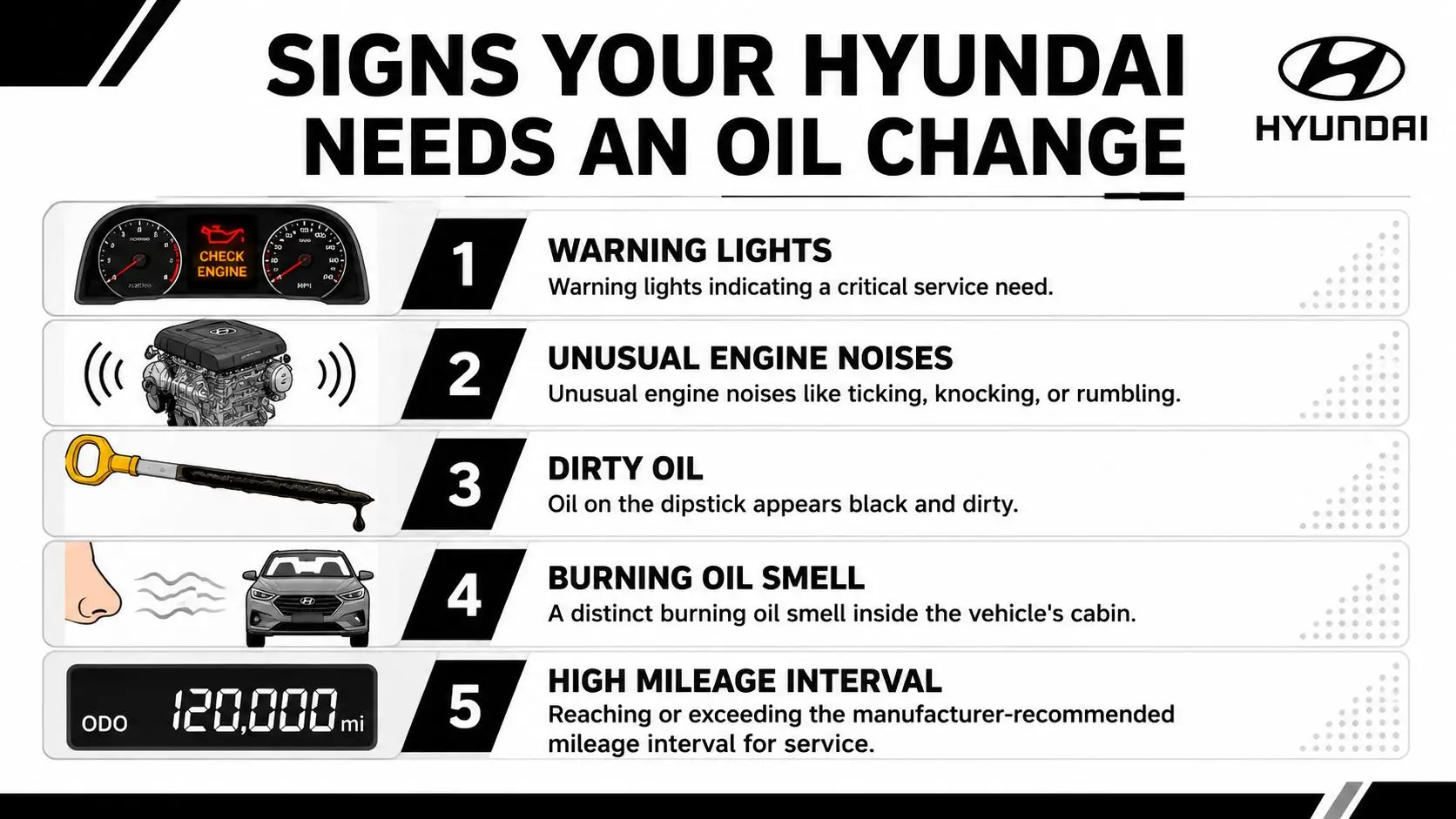
Dashboard warnings and mileage reminders
The most obvious sign is the maintenance or oil-related warning on the dash. That doesn't always mean engine damage is already happening, but it does mean you shouldn't ignore it.
Hyundai also says severe conditions such as rough or muddy roads, mountainous driving, extended idling or low-speed operation, prolonged extreme humidity or cold, or more than 50% city driving in 90°F+ weather should trigger more frequent oil changes. Hyundai adds that 4,500 to 5,000 miles may be more appropriate than 6,000 to 7,500 miles for many drivers, according to Hyundai severe driving oil guidance. For Texas drivers, that's an important reality check.
What you can see, hear, and smell
A few common clues deserve attention:
- Engine noise that wasn't there before. Ticking, knocking, or a rougher mechanical sound can mean the oil isn't protecting parts as well as it should.
- Very dark or gritty oil on the dipstick. Dark oil alone isn't the whole story, but thick, dirty oil is a sign it's carrying a heavy contaminant load.
- Burning oil smell inside the cabin. If you smell oil, don't brush it off. That can point to overheated oil, a leak, or oil contacting hot engine parts.
- Exhaust smoke or unusual odor outside the car. That can indicate oil is being burned or leaking onto hot surfaces.
- You've reached the service interval already. If your mileage says it's time, don't try to stretch it by guessing.
Don't diagnose by color alone. A better check is the full picture: reminder light, mileage, engine sound, oil condition, and how the car has been driven lately.
Why local driving makes these signs more important
Richland Hills traffic and heat don't always cause obvious symptoms early. That's why a Hyundai can need an oil change before it feels dramatically different. The car may still run fine while the oil is already past its best service life.
If your driving pattern is mostly short hops with lots of stoplights, being a little more alert to these signs can save you trouble.
DIY vs Professional Hyundai Oil Change
You pull into your driveway after a week of Richland Hills traffic, pop the hood, and figure an oil change should be a quick Saturday job. Sometimes it is. The catch is that modern Hyundai engines leave less room for small mistakes than older cars did.
Where DIY makes sense
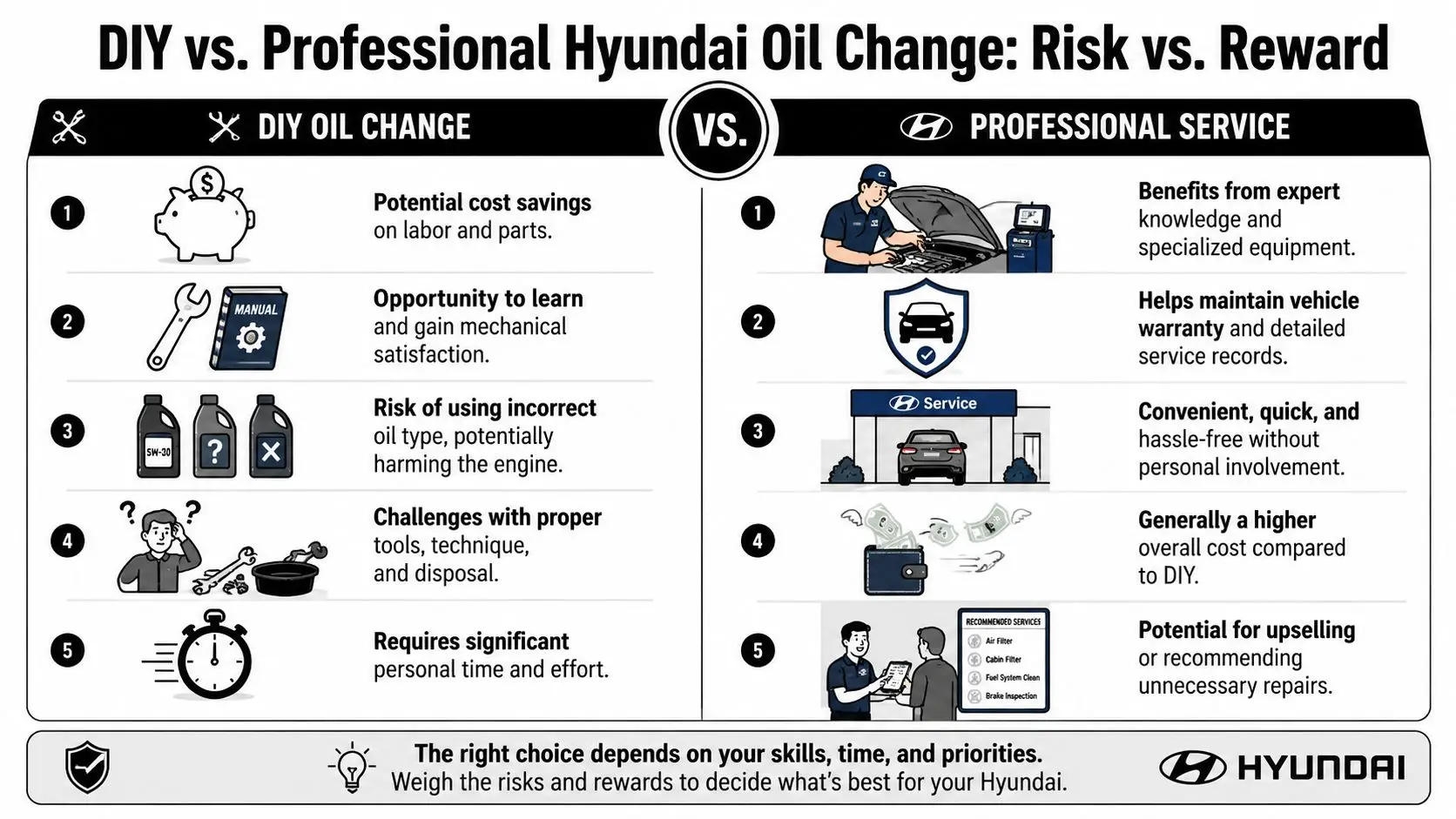
DIY can work well if you have ramps or a lift, the right socket sizes, a torque wrench, a drain pan, and a reliable way to confirm your Hyundai's exact oil spec and capacity. For some owners, the upside is real. You choose the oil and filter yourself, you get a look underneath the vehicle, and you may save some labor cost.
That said, the savings are not always as large as they look at first. Between full-synthetic oil, a quality filter, disposal time, and the chance of having to correct a mistake, the math changes fast. If you want a realistic cost breakdown, this guide on whether it's cheaper to change your own oil lays out the trade-offs clearly.
Some drivers also prefer to handle other routine maintenance at the same time, similar to broader Car Services that are bundled during a shop visit.
Where DIY usually goes wrong on a Hyundai
The problem is rarely draining the old oil. The problem is the detail work afterward.
Hyundai engines can be picky about viscosity, filter quality, washer condition, and final fill level. Get one of those wrong and you can end up with a leak, a low-oil condition, or an engine that is running on the wrong protection package for the way it is driven in North Texas heat.
Common mistakes include:
- Using oil that is close, but not correct. “Full synthetic” is not the whole spec. Your Hyundai still needs the right viscosity and service rating.
- Installing the wrong filter or double-gasketing the old one. That can cause a fast leak right after startup.
- Overtightening the drain plug. I see this often. Damaged oil pan threads turn a basic service into a repair.
- Missing the exact refill amount. Too little oil risks poor lubrication. Too much can cause foaming and other problems.
- Skipping the final leak and level check. A car can look fine on the lift and still drip once oil pressure comes up.
- Treating used oil disposal as an afterthought. It still has to be stored and dropped off properly.
Why professional service often makes more sense
For a lot of Hyundai owners in Richland Hills, professional service is the safer bet because it replaces guesswork with a repeatable process. A good technician verifies the model and engine, checks the oil spec before the bottle is opened, installs the correct filter, uses the right washer if needed, torques the plug properly, then confirms the level after the engine has run and settled.
That matters even more on newer Hyundai models, where a simple oil change is also a chance to catch small issues early. A seep at the filter housing, a worn splash shield fastener, uneven tire wear, or the start of an oil consumption concern can show up during routine service.
If you like doing your own work, that is a valid choice. If you want fewer risks, less mess, and a second set of trained eyes on your Hyundai, professional oil change service usually earns its keep.
Our Professional Oil Change Checklist
A proper Hyundai oil service should be transparent. You should know what's being checked, what parts are being replaced, and what details matter after the drain pan goes away.
What a complete service should include
Hyundai technical guidance states that if the specified viscosity is unavailable during service, 5W-30 may be used temporarily, and it emphasizes using the latest API service grade. It also notes that proper plug and washer condition, correct torque, and a new filter are essential to avoid leaks and pressure loss after service, as described in this Hyundai oil service guidance.
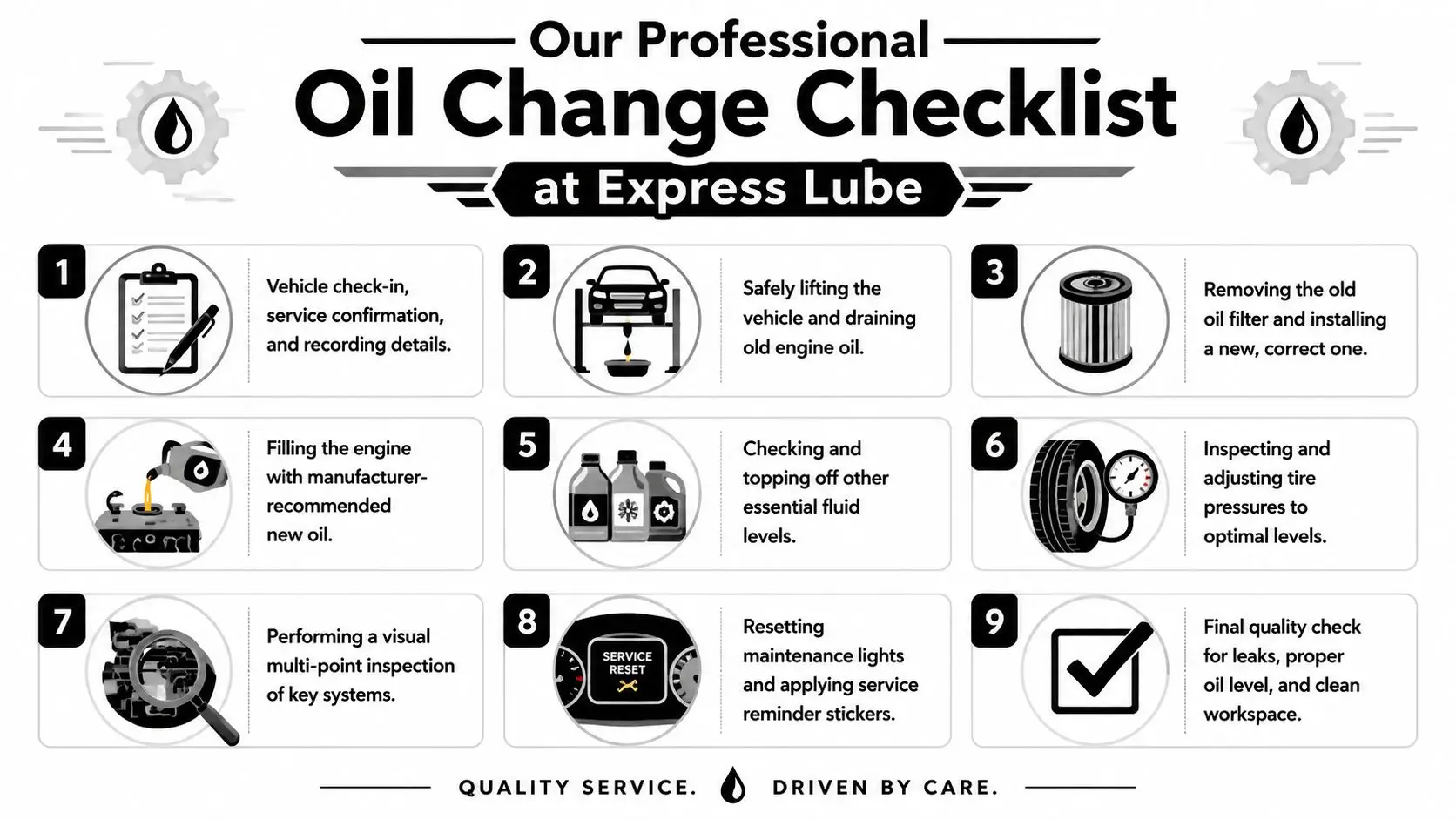
That's why a quality service checklist should look like this:
Vehicle check-in and spec verification
Confirm the Hyundai model, engine, oil specification, and any maintenance reminder concerns before work starts.Drain old oil safely
The vehicle is raised correctly, the oil is drained fully, and the technician watches for signs like metal debris or abnormal contamination.Replace the oil filter
The old filter comes off, the sealing surface is checked, and the correct new filter is installed.Inspect the drain plug and washer
This step gets skipped too often in low-quality service. Plug and washer condition matter.Refill with the correct oil
The technician uses the proper viscosity and approved specification for that engine.Run the engine and recheck the level
This confirms the filter is filled, the oil level is correct, and there are no immediate leaks.
The extras that actually help
A useful oil service usually includes a quick look beyond the crankcase.
- Fluid top-offs when appropriate
- Tire pressure check
- Visual inspection of belts, hoses, and obvious leak points
- Maintenance reminder reset if the Hyundai requires it
- Basic under-hood review for anything that needs attention soon
For drivers who like understanding service standards from outside the local market too, this overview of Car Services offers a broader look at what vehicle maintenance can include.
A lot of owners also like seeing the process before they come in. This walk-through helps show what a routine oil service looks like in practice.
One local option for this kind of service is Express Lube & Car Care, which handles oil and filter changes along with general maintenance and inspection work for everyday drivers.
Visit Express Lube in Richland Hills
You pull into a shop on your lunch break because your Hyundai is due, and you need more than a quick sticker on the windshield. You need someone to ask how you drive in Richland Hills, whether your car spends its time on short errands, school pickup lines, or daily highway miles across Northeast Tarrant County. That part matters because a Hyundai that sees stop-and-go traffic and Texas heat does not always fit the ideal schedule printed in generic maintenance advice.
A good local oil service should feel straightforward. The technician confirms the right oil for your engine, checks for early signs of leaks or wear, and tells you if your current interval still makes sense for the way you use the vehicle. That is the difference between routine service and a basic drain-and-fill.
Why local drivers choose a walk-in shop
A lot of Hyundai owners want maintenance handled without turning it into an all-day appointment. Walk-in service works well for commuters, families with multiple vehicles, and drivers who would rather take care of oil changes before they become a bigger problem.
There is also a practical trade-off. Dealer service can be a good fit for some warranty or recall work, but many drivers want a neighborhood shop for regular maintenance because it is faster, easier to fit into the week, and more personal. What matters is whether the shop follows the right process for your Hyundai, not whether the waiting room has nicer coffee.
What to expect in Richland Hills
At a neighborhood shop staffed by ASE-certified technicians, you should expect clear communication, fair pricing, and direct answers if something looks worn, leaking, or overdue. You should also expect the shop to explain whether your Hyundai falls closer to normal service or severe service based on how you drive.

That local judgment helps. A Hyundai Elantra used for short in-town trips may need a different schedule than a Santa Fe that spends most of its life on longer highway runs, even if both are well maintained. Good service advice accounts for the model, engine, mileage, and driving pattern instead of handing every owner the same answer.
Stop by when your Hyundai is due
If your Hyundai is due for service, has started sounding rougher than usual, or you just want a second opinion on the right interval, a walk-in visit is often the simplest next step. Shops like this also commonly offer rotating specials and community discounts, which can help keep maintenance on budget without putting it off.
Express Lube & Car Care is one local option for Richland Hills drivers who want routine oil service, a basic inspection, and practical recommendations based on how the vehicle is driven.
If your Hyundai is due for service, visit Express Lube & Car Care in Richland Hills for walk-in maintenance, practical recommendations, and straightforward help with the right oil change for your vehicle and driving conditions.