

You moved, updated your address, got your Georgia registration in motion, and then the surprise hits. Someone tells you the car needs an inspection, but another person says Georgia doesn't even do inspections. Both statements are partly true, and that's where people get tripped up.
From a Texas shop perspective, this confusion makes sense. A lot of drivers are used to one kind of state process and expect Georgia to work the same way. It doesn't. Georgia auto inspection rules are narrower in some ways, stricter in others, and very county-specific.
If you're new to the state, managing a company vehicle, or helping a family member register a car, the smart move is to sort out the rules before you waste a trip to a test station or the tag office. If you're also still sorting out license and registration paperwork, this guide on how to legally drive in Georgia helps fill in the non-mechanical side.
Welcome to Georgia Now Get Your Car Inspected
The first thing to know is that Georgia doesn't treat every driver in every county the same. That catches a lot of people off guard. You can live in one part of the state and never deal with emissions testing, then move into metro Atlanta and suddenly it becomes part of your annual routine.
The headache isn't the test itself. It's figuring out whether the rule even applies to their vehicle in the first place. That's especially true for anyone coming from Texas, where customers often ask whether Georgia wants a full safety inspection, an emissions test, both, or something else entirely.
Georgia's system makes a lot more sense once you separate registration rules, county rules, and vehicle type rules.
A practical way to approach it is this:
- Confirm where the vehicle is registered. Georgia's emissions requirement is tied to certain metro Atlanta counties, not the whole state.
- Confirm what you drive. Gasoline passenger vehicles are treated differently from diesel vehicles, motorcycles, RVs, and heavier commercial equipment.
- Confirm the model year. Some vehicles are exempt because they're too new or old enough to age out of the program.
- Handle the inspection before your deadline gets tight. Waiting until the last minute is how small issues become registration problems.
Drivers usually don't need a long legal explanation. They need a clean answer to one question: “Do I need to get this car tested before I can renew?” Once that's clear, the rest of the process is straightforward.
Emissions vs Safety What Georgia Actually Requires
A Texas driver usually walks into this question expecting two lanes. Safety inspection and emissions inspection. Georgia does not handle personal vehicles that way.
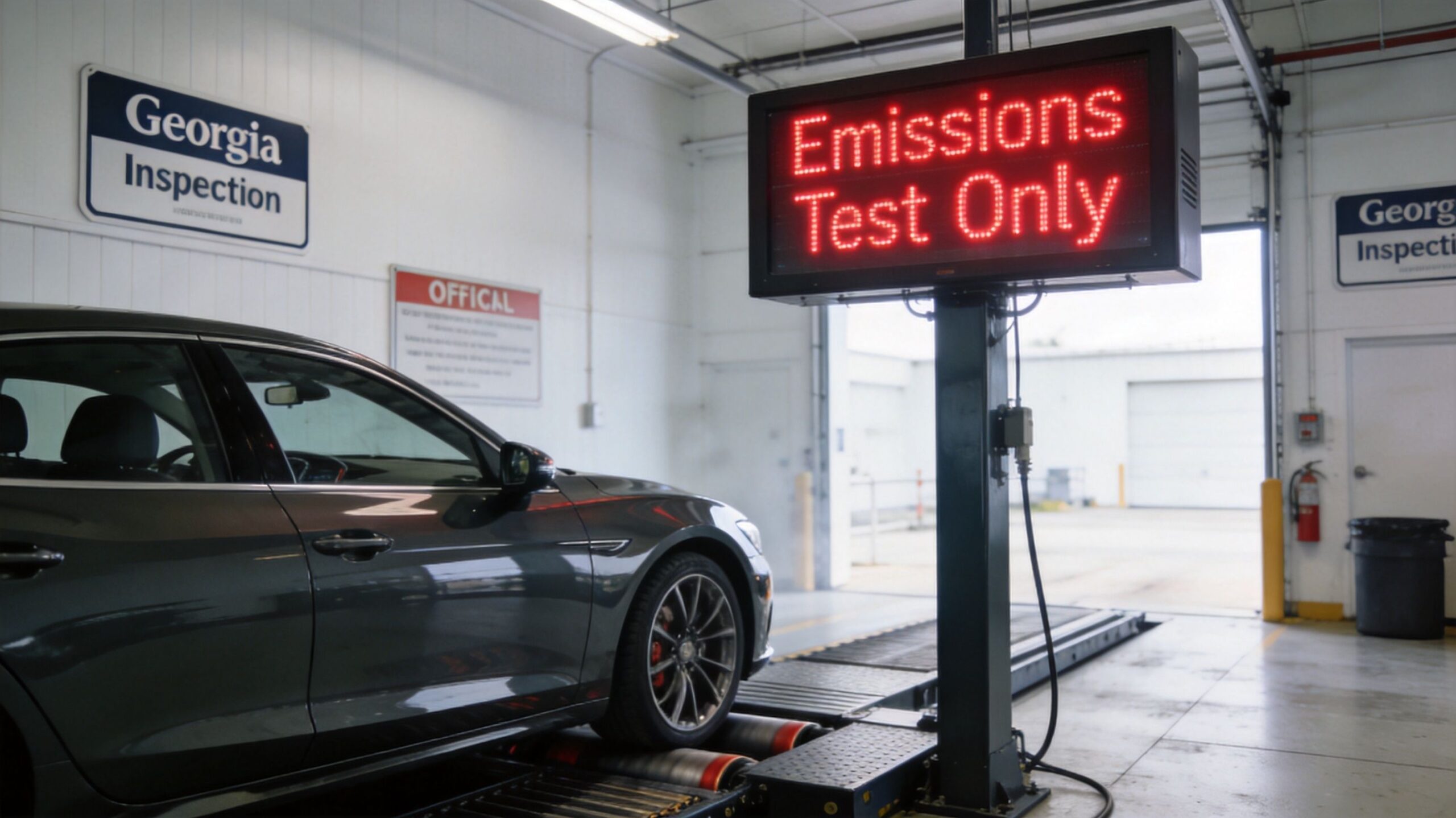
For the passenger cars and light trucks that trigger annual testing, Georgia's recurring requirement is centered on emissions, not a statewide safety check. That distinction matters because a lot of out-of-state drivers show up expecting someone to measure brake pad thickness, inspect suspension parts, and check every light on the car as part of annual renewal. For a regular personal vehicle, that is usually not the test tied to registration.
What the state is actually checking
From a technician's standpoint, Georgia is looking at whether the vehicle's emissions system is intact and reporting properly. On newer vehicles, that usually means an OBD-based check. The computer has to show the right monitors, no emissions-related fault codes, and no signs that someone has removed or bypassed required equipment.
The practical checkpoints usually include:
- OBD system readiness
- Emissions-related diagnostic trouble codes
- Check engine light status
- Catalytic converter presence and obvious tampering issues
That is a narrower test than many drivers expect.
A car can pass Georgia emissions and still need tires, brakes, or front-end work. I tell Texas customers that all the time, because they are used to a state system that puts safety items in the inspection conversation. Georgia separates those issues for ordinary passenger vehicles.
Where out-of-state drivers get tripped up
The confusion usually starts with the word “inspection.” In Texas, that word has long meant a broader roadworthiness check in many drivers' minds. In Georgia, for most personal vehicles affected by the annual program, the state is focused on air-quality compliance.
That does not mean safety stops mattering. It means the annual test for registration is not serving as your once-a-year mechanical review.
So if you just moved from Texas and your car is due for renewal, do not assume the test station is about to give you a full safety verdict on the vehicle. If your brakes are thin or your tires are worn, that may still be your problem to catch before it becomes a roadside problem.
The practical way to handle it
Treat Georgia's inspection requirement like a targeted emissions screening. Show up with a healthy battery, no check engine light, and no recent code clearing. If the vehicle has been running rough, burning fuel heavily, or showing an evap or catalyst fault, fix that first.
Also, do not use the state test as a substitute for a real service inspection. For fleets and new residents, that is one of the biggest mistakes I see. Passing emissions only tells you the vehicle met that emissions standard on test day. It does not tell you the brakes are safe, the tires are legal everywhere you operate, or the suspension is in good shape.
Georgia's rule is narrower than many drivers expect. Once you understand that, the process gets a lot easier.
Who Needs a Georgia Emissions Inspection
You just moved from Texas, renewed your Georgia registration, and figured you would need the same kind of yearly check you were used to back home. Then the questions start. Does every county require it? Does a diesel pickup count? What if the vehicle is part of a small fleet?
In Georgia, the first thing I tell people is to stop looking at the word inspection and start with the registration address. For most drivers, that answer settles the issue fast.
Start with where the vehicle is registered
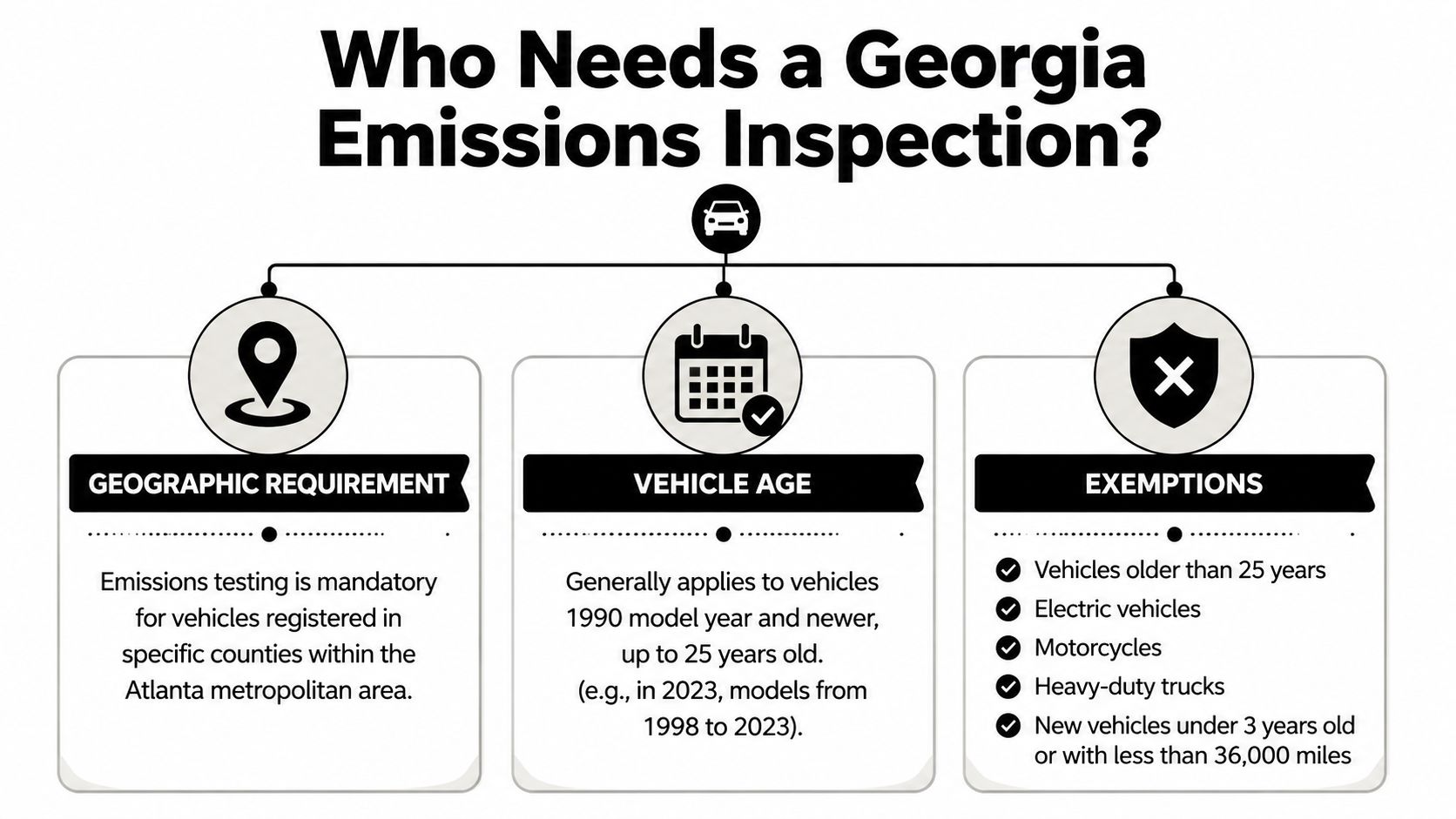
Georgia's emissions program is tied to the 13-county Atlanta area. If the vehicle is registered in Cherokee, Clayton, Cobb, Coweta, DeKalb, Douglas, Fayette, Forsyth, Fulton, Gwinnett, Henry, Paulding, or Rockdale, you may be in the program. If it is registered outside those counties, you usually are not.
That catches a lot of out-of-state drivers. I have seen people assume an Atlanta commute means they need a test, but Georgia looks at the registration county, not where you drive during the week.
Which vehicles usually need the test
For the typical owner, the rule usually hits gasoline passenger vehicles and light-duty trucks. That includes the kinds of vehicles I see every day in the shop. Sedans, SUVs, crossovers, and half-ton pickups used as personal transportation.
Some vehicles are commonly exempt from the emissions program:
- The three newest model year vehicles
- Vehicles 25 model years old or older
- Diesel vehicles
- Motorcycles
- RVs and motor homes
This is why two neighbors can get different answers even if they renew registration on the same day.
If you are new to Georgia, it also helps to separate emissions compliance from basic mechanical condition. A passing result does not replace a real once-over, so I still recommend using a car safety inspection checklist before registration time, especially if the car just came from another state.
Fleet vehicles and commercial units need a closer look
Fleet managers often get tripped up by these scenarios. A gasoline pool car registered in a covered county may fall into the normal emissions program, while a heavier truck, CDL unit, or specialty commercial vehicle can have a different inspection path altogether.
If you manage service vans, delivery trucks, or mixed-use pickups, do not assume one rule covers the whole lineup. Break it down by registration county, fuel type, model year, and how the vehicle is classified. If one of those units has an active check engine light or drivability problem, fix that before test day. For major diagnosis, trust Top Level Cars for engine work if you need a specialist resource.
Quick decision table
| Registration and vehicle status | Likely result |
|---|---|
| Registered outside the covered metro counties | Usually no Georgia emissions test |
| Gasoline passenger vehicle in a covered county | Usually subject to emissions testing |
| One of the three most recent model years | Exempt |
| 25 model years old or older | Exempt |
| Diesel vehicle, motorcycle, RV, or motor home | Exempt from the emissions program |
| Commercial truck or fleet vehicle | May need separate or additional inspection review |
If you are unsure, check four things in this order. Registration county, fuel type, model year, and vehicle class. That gives you the right answer much faster than guessing based on what your old state required.
Your Step-by-Step Guide to Getting Inspected
You move from Texas, pull into a Georgia test station, and expect the usual safety checklist. Instead, the tech plugs into the OBD port and focuses on emissions. That difference catches a lot of out-of-state drivers off guard, especially if you are used to a state that checks lights, tires, brakes, and other safety items as part of the annual process.
Find the right station first
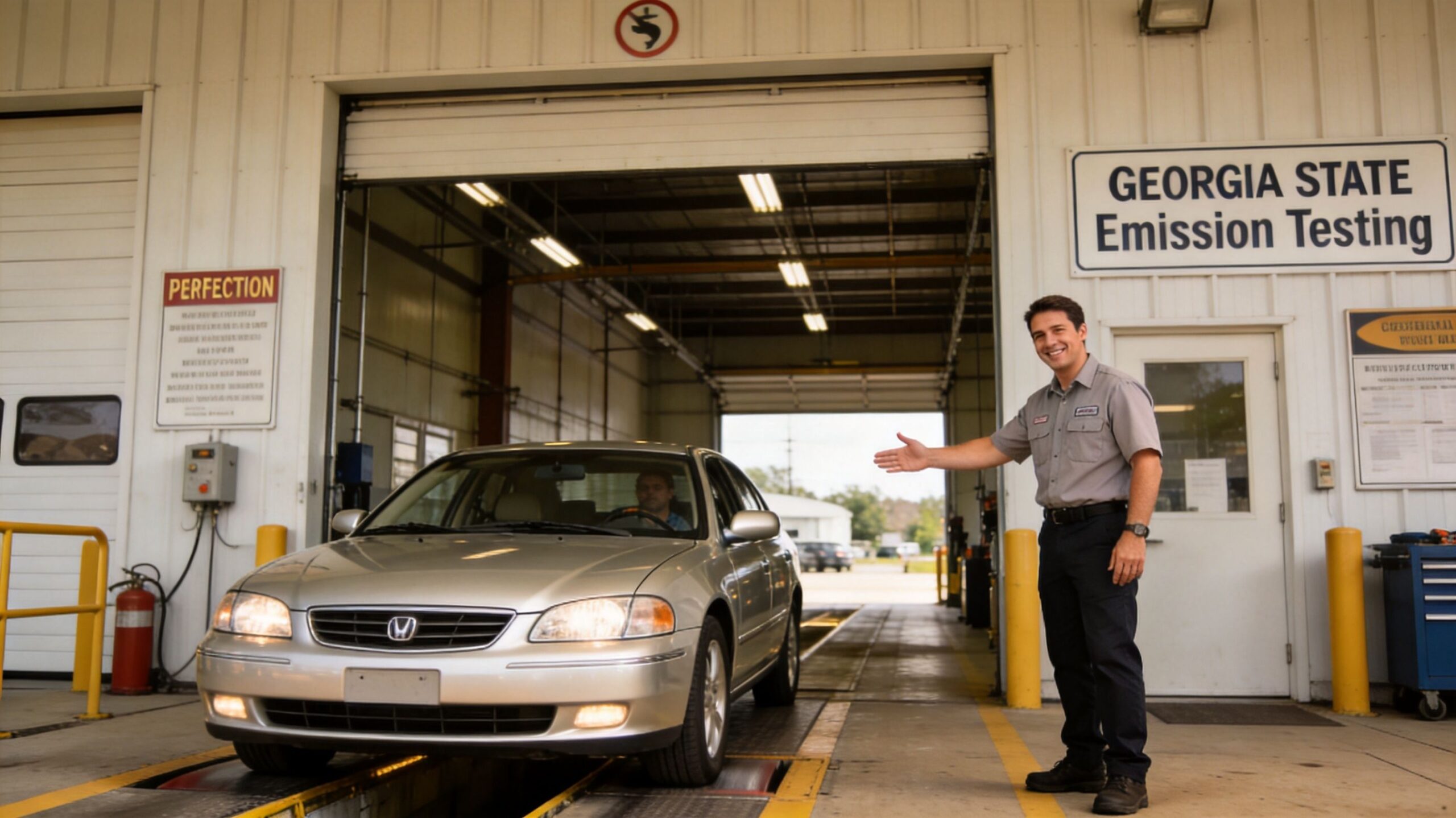
Start with a Georgia emissions testing station that is approved for the program. A general repair shop may be able to fix the car, but the actual state test needs to happen at a station set up for it.
If you are coming from a safety-inspection state, it helps to reset your expectations before you go. A general car safety inspection checklist is still useful for catching worn or unsafe items, but Georgia's routine requirement for covered personal vehicles is centered on emissions, not a full safety exam.
What to bring and what to expect
Keep the visit simple. Bring the vehicle, have your registration details available if the station asks for them, and make sure you have a payment method the location accepts.
More important than paperwork is the condition of the car that day. If it is overheating, leaking badly, struggling to stay running, or dealing with battery problems, fix that first. Test stations are set up to verify compliance, not sort out a car that can barely make it into the bay.
If the battery was disconnected recently or codes were cleared, wait until the vehicle has been driven enough for the onboard system to reset properly.
What happens during the test
For covered 1996 and newer vehicles, the station usually checks the OBD-II system and performs a visual look at emissions equipment such as the catalytic converter. In practical terms, the technician is checking whether the car's computer sees an emissions fault, whether the monitors have completed their self-tests, and whether the required hardware still appears to be in place.
That matters because a car can run fine and still fail. I see that a lot with drivers who just moved in from another state. The dash looks normal, the vehicle feels fine on the road, but one monitor is still incomplete after a recent repair or battery disconnect.
If the vehicle passes, you get a Vehicle Inspection Report showing a pass result. If it fails, the report points to the area that needs attention before you retest.
When the problem is bigger than the test lane
Some failures are straightforward, like a monitor that has not reset yet. Others point to engine performance problems, EVAP faults, catalyst issues, or wiring trouble that needs real diagnosis.
That is where repair quality matters. Throwing parts at a check engine light gets expensive fast. When the problem goes beyond a loose gas cap or an obvious sensor issue, it helps to review how a shop handles major diagnosis and why drivers often trust Top Level Cars for engine work.
Best timing for the least hassle
Do not wait until the registration deadline is breathing down your neck. Give yourself enough time to test, repair if needed, and come back without scrambling.
A practical plan looks like this:
- A few weeks before the deadline: scan for current or pending emissions codes
- After any repair: drive the vehicle normally so the monitors have time to complete
- A day or two before testing: confirm the check engine light stays off
- At the station: expect a quick emissions check, not the kind of bumper-to-bumper safety inspection many Texas drivers are used to
Common Failures and How to Pass the First Time
Most failed Georgia emissions tests come down to a short list of issues. The frustrating part is that many of them can be caught before test day with a basic scan tool and a little planning.
The check engine light is the biggest warning sign
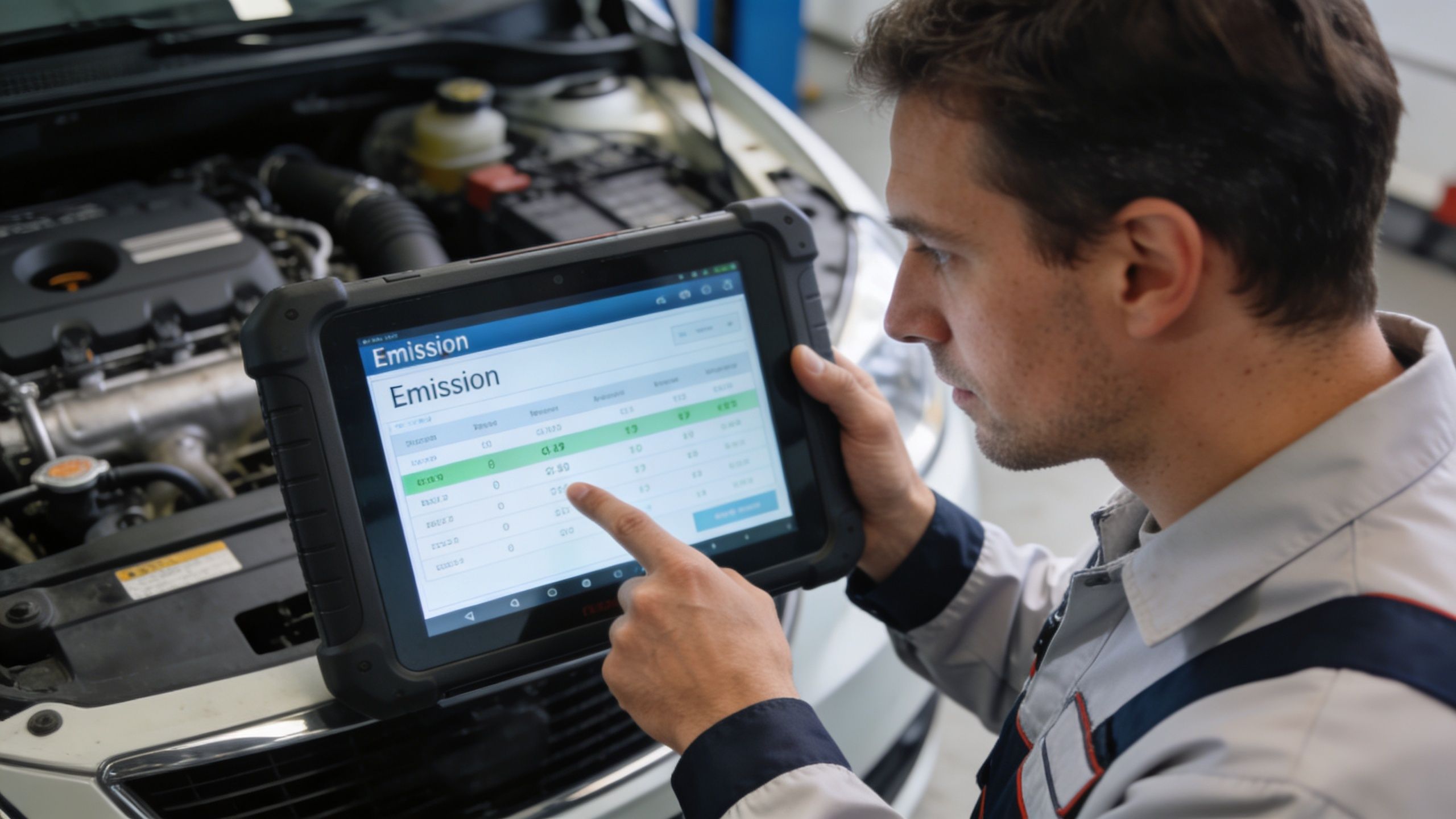
If the check engine light is on, don't hope for a lucky pass. Georgia's OBD-based process is reading the same system that turned that light on in the first place.
A passing OBD-II test requires all non-continuous monitors to be ready with no emissions-related Diagnostic Trouble Codes. Georgia Clean Air Force guidance lists common failure codes such as P0420, which means Catalyst System Efficiency Below Threshold, and P0442, which means EVAP System Leak Detected. That same guidance notes these problems are often fixable with repairs such as a new O2 sensor or gas cap (Georgia Clean Air Force before-you-test guidance).
What common codes usually mean in plain language
Here's a simple translation table for issues drivers often see:
| Code or symptom | What it usually points to | Typical next move |
|---|---|---|
| Check engine light on | Stored emissions fault | Scan codes before test day |
| P0420 | Catalytic converter efficiency problem | Diagnose converter and upstream sensor performance |
| P0442 | Small EVAP leak | Inspect gas cap and EVAP system for leaks |
| Monitor not ready | Car hasn't completed drive cycle | Drive normally before retest |
What actually helps you pass
Drivers often waste money replacing parts based only on a code description. That's not the same as diagnosis. A P0420 code, for example, can involve the catalytic converter, but a technician still needs to look at sensor behavior and engine condition before calling the converter bad.
A better pre-test routine looks like this:
- Scan before the deadline: Use a decent scan tool and check for active, pending, and permanent codes.
- Look at monitor status: Even with the light off, the car can fail if readiness monitors haven't completed.
- Check the gas cap: It sounds small because it is, but small leaks can still trigger EVAP faults.
- Don't clear codes on the way to the station: That usually resets monitors and creates a different failure.
- Inspect for obvious tampering: If the catalytic converter is missing or modified, the visual inspection can catch it.
The cheapest repair isn't always the right repair. The right repair is the one that fixes the cause and lets the monitors run clean.
What doesn't work
A few things almost never help:
- Throwing parts at the problem without confirming the fault
- Disconnecting the battery the night before
- Using fuel additives as a last-minute miracle
- Ignoring a flashing or intermittent warning light
- Waiting until registration is due and then scrambling for same-day repairs
If you want a second practical angle on preparation, this article on how to pass your vehicle inspection lines up with what technicians see every day. And if you want a broader view of inspection habits and common vehicle condition problems, this local car inspection perspective from Richland Hills is a good companion read.
Inspection Exemptions Waivers and Special Cases
Some Georgia drivers spend too much time worrying about a test they don't even need. Others assume they're exempt when they're not. The easiest fix is to separate true exemptions from post-failure options.
Vehicles commonly exempt from the emissions test
Georgia recognizes several exemptions. The key ones include:
- Newest vehicles: the three most recent model year vehicles are exempt
- Older vehicles: vehicles 25 model years or older are exempt
- Other vehicle categories: diesel vehicles, motorcycles, RVs, and motor homes are also outside the standard emissions requirement
Those rules cover a lot of edge cases, especially for classic-car owners, people with specialty vehicles, and households that just bought a newer car.
What happens after a failure
A failed result doesn't always mean you're stuck paying for another test immediately. Georgia allows a free retest within 30 days of a failure, and owners of older vehicles facing expensive emissions repairs may be eligible for a repair waiver, as noted in this Georgia vehicle inspection overview.
That matters because emissions repairs can vary widely. Sometimes the issue is minor and straightforward. Sometimes the vehicle needs more diagnostic time than the owner expected.
Don't assume a failure means the car is unregistrable forever. In some cases, the answer is repair. In others, the answer is qualifying for the proper waiver path.
Special-case judgment calls
Owners of older vehicles need to be careful not to confuse “old” with “exempt.” The exact model year still matters. If the vehicle is close to the exemption cutoff, verify before you skip the test.
For business operators, the bigger caution is not to mix up emissions exemptions with commercial inspection obligations. A unit might be exempt from the passenger emissions program and still fall under separate safety or operational requirements because of how it's used.
Georgia Inspection FAQs for Out-of-State Drivers
Does Georgia require a full annual safety inspection for my personal car
Usually, no. For personal vehicles, the common issue is emissions compliance in the covered metro counties, not a statewide annual safety inspection.
Can I use my home-state inspection to register in Georgia
Don't assume you can. Georgia's emissions requirement is tied to Georgia registration rules and county rules, so an out-of-state inspection usually isn't something to rely on for Georgia compliance. Check the local registration requirement before you head to the tag office.
What if I'm just visiting and my check engine light comes on
A Georgia visitor isn't in the same position as a newly registering Georgia resident. The smart move is to diagnose the light promptly, especially if the vehicle will soon need registration action in Georgia or if drivability changes.
I manage vehicles in more than one state. What's the biggest mistake to avoid
Treating every state like it uses one inspection model. Georgia is a good example of why fleet operators need county-specific and vehicle-specific review, not just a single company rule.
Where can I get a broader look at how inspection rules differ by market
A quick comparison piece like this article on car inspections in another state market helps show why assumptions cause trouble when you move vehicles across state lines.
If your car has a warning light on, needs a pre-inspection check, or just hasn't had a good diagnostic look in a while, Express Lube & Car Care can help you get ahead of the problem before it becomes a registration headache. The ASE-certified team handles everything from routine maintenance to deeper diagnostics, with clear recommendations, walk-in convenience, and the kind of honest service that makes interstate car ownership a lot less stressful.