

Most oil leak repairs land between $50 and $1,500, and where you fall on that range comes down entirely to which seal or gasket failed. Minor fixes like a loose oil cap or drain plug run in a lower price range that varies based on the issue and location. Moderate jobs, think valve cover or oil pan gasket, typically fall between $150 and $600. Major repairs involving the rear main seal or a head gasket can push past $500 to $1,500 or more, largely because of how much of the engine has to come apart to reach the failure point.
That widespread exists because “oil leak” isn’t one problem. It’s a symptom with a dozen possible causes, each demanding a different amount of labor.
Here’s your immediate next step:
- If oil is dripping slowly and your level holds steady between top offs, book a diagnostic. Expect to pay $75 to $150 for a shop to find the exact source.
- If you smell burning oil, see smoke, or watch your dipstick drop fast, stop driving and get the car towed.
Pro Tip: Ask upfront whether the diagnostic fee gets credited toward the repair if you move forward. Many shops do this, and it can save you $75 to $150 outright.
Key Takeaways
Oil leak repair costs in the U.S. typically range from $50 for a simple fix to $1,500 or more for a rear main seal or head gasket job, with labor access driving most of the price gap.
| Point | Details |
|---|---|
| Know your cost band | Minor fixes run $50–$250, moderate gasket jobs $150–$600, major repairs $500–$1,500+. |
| Budget for diagnosis | Expect $75–$150 for professional leak tracing, often credited toward the repair. |
| Watch for urgency signs | Smoke, burning smell, or fast oil loss means stop driving and get towed. |
| Get it in writing | Always request an itemized estimate before authorizing repair work. |
| Express Lube & Car Care | Uses ASE-certified techs, photo-backed inspections, and a 24-month/24,000-mile warranty on repairs. |
Table of Contents
- How Much Does Oil Leak Repair Cost by Type?
- What Actually Drives Your Oil Leak Repair Price?
- How Do Shops Diagnose an Oil Leak?
- Can You Still Drive With an Oil Leak?
- DIY, Independent Shop, or Dealer: How Do You Choose?
- How Express Lube & Car Care Handles Oil Leak Diagnosis
- Why Realistic Cost Bands Beat Vague Estimates
- Get Your Oil Leak Diagnosed the Right Way
- Sources
- FAQ
How Much Does Oil Leak Repair Cost by Type?
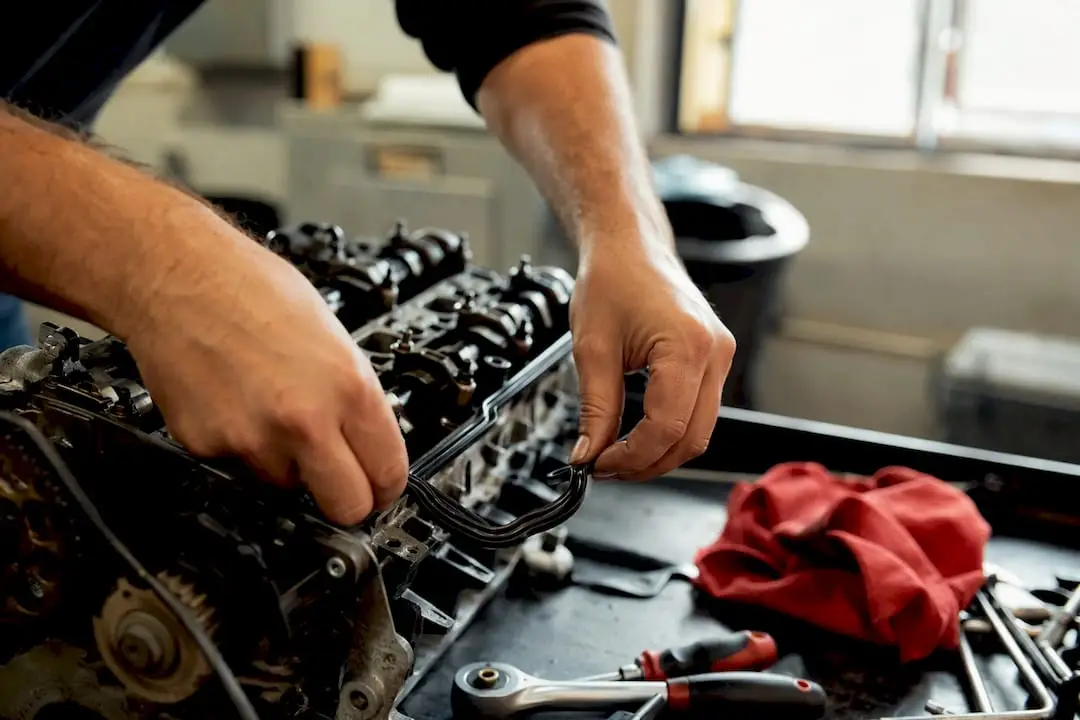
Once a technician traces the leak, the price mostly depends on how buried the failing part is. A leaking valve cover gasket sits right on top of the engine, easy to reach, quick to swap. A rear main seal hides between the engine and transmission, and reaching it can mean pulling the transmission entirely. That difference in access is the single biggest reason two “small” oil leaks can carry a $1,000 price gap.
Here’s how the most common leak sources typically break down:
These numbers come from national averages compiled by Synchrony, and your local quote can swing based on your shop’s hourly rate and your vehicle’s specific layout. A rear main seal is a great example of a repair where the part itself might cost $30, but the labor to get to it, often requiring transmission removal, is what fills out the invoice. Labor, not parts, drives the bill on nearly every deep-seal repair.
Regional labor rates matter too. A shop charging $90 an hour and one charging $160 an hour will produce very different quotes for the same 4 hour timing cover job, even using identical parts.

What Actually Drives Your Oil Leak Repair Price?
Two shops can quote wildly different numbers for the same leak, and it’s rarely because one is ripping you off. A few specific variables do most of the work:
- Labor rate times labor hours. A $50 an hour difference in shop rate, multiplied across 6 hours of timing cover work, adds $300 to your bill before a single part gets ordered.
- Vehicle complexity. Transverse-mounted engines in compact cars often have tighter access than longitudinal V6 or V8 layouts in trucks. European makes frequently carry a parts premium and sometimes require specialty tools.
- Parts choice. OEM parts cost more but match factory tolerances. Aftermarket and remanufactured options save money but vary in quality by brand.
- Diagnostic difficulty. J.D. Power’s cost guide notes that base service line items often start around $85 to $155, but a hard-to-trace leak that requires an engine bay cleaning and UV dye test adds time before any repair even begins.
Pro Tip: Spending an extra $50 to $100 on a proper dye-based diagnostic almost always saves money in the long run. It prevents shops from guessing and replacing the wrong gasket first, which is a repeat-labor bill you never wanted.
How Do Shops Diagnose an Oil Leak?
A trustworthy diagnosis follows a sequence, not a guess. Skipping steps is how misdiagnosis happens, and misdiagnosis is how a $250 gasket job turns into a $600 do over.
- Visual inspection first. The technician checks obvious spots: the oil cap, drain plug, and filter housing.
- Engine bay cleaning. Years of grime hide the actual leak point, so the bay often gets degreased before anything else happens.
- Run the engine and inspect. With the surface clean, a fresh leak becomes visible almost immediately.
- UV dye or pressure test. For stubborn leaks, dye tracing under UV light pinpoints the exact source rather than a general area.
Expect to pay $75 to $150 for this process, and expect same-day results for straightforward leaks. Dye-based tracing on a heavily soiled older engine can stretch the diagnostic into a multi-hour job, sometimes requiring you to drive the car and return the next day.
Can You Still Drive With an Oil Leak?
Sometimes, yes. Often, no. The difference comes down to how fast you’re losing oil and what that oil is touching.
Stop driving and arrange a tow if you notice smoke from the engine bay, a burning smell inside the cabin, oil visibly pooling on the exhaust manifold, or your oil level dropping noticeably within a day. Any of these signals real risk of engine seizure or fire.
If the leak is slow and your dipstick barely moves between checks, you likely have more flexibility:
- Check your oil level daily until the repair is scheduled.
- Top off with the correct oil grade if you’re below the fill line.
- Skip long highway trips and keep speeds moderate.
- Watch your oil pressure gauge for any drop, which signals the leak has gotten worse.
Delaying a known leak rarely saves money. A gasket that costs $250 today can turn into a $900 job once low oil pressure damages bearings or a seized component forces additional labor.
DIY, Independent Shop, or Dealer: How Do You Choose?
Not every leak needs a professional. If it’s a loose oil filter cap, an obviously loose drain plug, or a fitting you can see and reach without removing anything, tightening it yourself is reasonable and free. Anything involving gasket replacement, sealant application, or partial disassembly is where DIY risk climbs fast, one cracked gasket surface or over-torqued bolt and you’ve turned a simple fix into an expensive one.
When you do call a shop, run through this checklist before authorizing any work:
- Ask what the diagnostic fee is and whether it’s credited toward the repair.
- Request an itemized estimate showing labor hours separately from parts cost.
- Ask whether parts are OEM, aftermarket, or remanufactured, and what warranty covers each.
- Get a turnaround estimate in writing, not a verbal guess.
- Confirm the shop will show you photo evidence of the actual leak source before repair begins.
Pro Tip: A shop that hesitates to give you a written estimate or can’t explain labor hours in plain terms is a red flag. Reputable shops welcome the questions because they’ve already done the diagnostic work to back up their number.
How Express Lube & Car Care Handles Oil Leak Diagnosis
Our process at Express Lube & Car Care starts the same way every reliable diagnosis should: visual inspection, engine bay cleaning when grime is hiding the source, and UV dye tracing for leaks that don’t show themselves easily. If you move forward with the repair, your diagnostic fee gets credited toward the total.
- ASE-certified technicians handle every diagnosis and repair.
- Every completed repair carries a 24-month/24,000-mile warranty.
- Walk-ins are welcome alongside scheduled appointments.
| What You Get | Why It Matters |
|---|---|
| Photo-backed digital inspection | You see the actual leak source before approving work |
| Written estimate | No surprise labor charges after the job starts |
| Warranty coverage | Protection if the same leak resurfaces |
Why Realistic Cost Bands Beat Vague Estimates
Most articles on this topic hand you a single average number and call it a day. That’s not useful. A $600 “average” oil leak repair tells you nothing if your actual problem is a $90 oil cap or a $1,400 head gasket. The real value in a cost guide is teaching you which variables push your specific leak toward one end of the range or the other, access, labor rate, and part choice.
The conventional advice to “get multiple quotes” also misses something. What actually protects you isn’t quote shopping, it’s demanding a proper diagnostic before anyone touches a wrench. A shop that skips the dye trace and guesses at the gasket is the shop that costs you a second repair bill. Prioritize the diagnostic process over the sticker price of the estimate.
If you take one thing from this guide, let it be this: a slow leak you catch early and diagnose properly almost always costs less than the same leak ignored for three months.
— Express Lube & Car Care
Get Your Oil Leak Diagnosed the Right Way
Express Lube & Car Care gives you something a quick online estimate can’t: an ASE-certified technician who traces your actual leak with cleaning and UV dye before quoting a fix, so you’re never paying to replace the wrong part twice.
Every repair comes backed by our 24-month/24,000-mile warranty, and if the total runs higher than expected, our easy financing options can spread out the cost. Walk-ins are welcome, no appointment required, and your diagnostic fee gets credited toward the repair if you move forward with us. If you’ve noticed a spot on your driveway or a drop in your oil level, schedule your diagnostic appointment today and get a straight answer instead of a guess.
Sources
- How Much Does It Cost to Repair Car Oil Leaks? — Synchrony
- How Much Does It Cost To Fix A Car Oil Leak? — J.D. Power
- Oil Leaking From Car: Causes, Signs, Fixes & Cost Guide — RxMechanic
- Engineerskill
FAQ
Is an Oil Leak Expensive to Fix?
It depends entirely on the source. Minor leaks like a loose oil cap cost as little as $50, while major repairs like a head gasket or rear main seal can run $1,500 or more.
Can You Still Drive a Car With an Oil Leak?
You can often drive short distances with a slow, stable leak if you monitor your oil level daily, but you should stop immediately if you see smoke, smell burning oil, or notice your level dropping fast.
How Long Does It Take a Mechanic to Fix an Oil Leak?
Simple repairs like an oil cap or filter take under an hour, while gasket jobs typically run 1 to 4 hours, and major repairs like a timing cover or rear main seal can take a full day or more.
What Does an Oil Leak Diagnostic Usually Cost?
Most shops, including Express Lube & Car Care, charge between $75 and $150 for a full diagnostic, and many credit that fee toward your repair if you proceed with the work.