

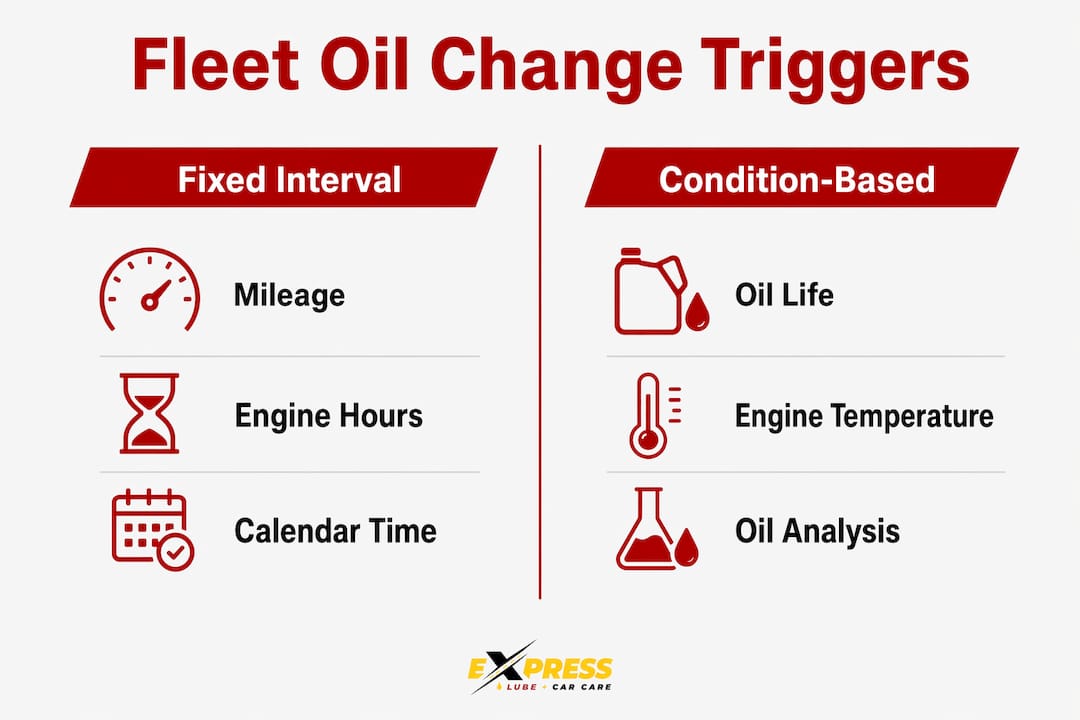
Fleet oil-change intervals should be based on the maintenance requirements for each vehicle—not a universal mileage number applied across the entire fleet. Depending on the vehicle, service timing may consider mileage, calendar time, engine hours, onboard oil-life information, operating conditions, and manufacturer requirements.
A delivery van that spends much of its day idling may accumulate engine use very differently from a vehicle covering mostly highway miles. Likewise, two vehicles with similar mileage may have different oil specifications and maintenance schedules.
The goal of a good fleet oil-change policy is to keep each vehicle within its appropriate maintenance requirements while making service predictable and easy to document.
Table of Contents
- Where Should Fleet Oil-Change Intervals Start?
- Mileage, Time & Engine Hours
- How Does Duty Cycle Affect Fleet Maintenance?
- Should Fleets Use Oil-Life Monitoring Systems?
- When Is Oil Analysis Useful?
- Does Oil Type Change the Service Interval?
- Should Every Fleet Vehicle Use the Same Interval?
- How Should Fleet Oil Changes Be Tracked?
- What Else Should Be Checked During Fleet Service?
- Fleet Maintenance in Richland Hills, TX
- Frequently Asked Questions
Where Should Fleet Oil-Change Intervals Start?
The starting point should be the maintenance information provided for the specific vehicle and engine.
Depending on the application, the manufacturer may specify service using:
- Mileage
- Calendar time
- Engine hours
- An onboard oil-life monitoring system
- Different schedules for normal and more demanding operating conditions
- Another vehicle-specific maintenance method
A fleet policy should preserve those vehicle-specific requirements rather than replacing them with one generic company-wide mileage number.

For more information about oil-change timing generally, see our guide on why oil-change intervals matter for engine maintenance.
Mileage, Time & Engine Hours
Different fleet vehicles accumulate use in different ways.
Mileage
Mileage is a common maintenance trigger because it provides a straightforward measure of vehicle use. However, odometer mileage does not capture every type of engine operation.
Calendar Time
Some manufacturer maintenance schedules include a time limit in addition to mileage. This can matter for low-mileage or seasonal vehicles that do not accumulate enough miles to reach a mileage-based service point quickly.
Engine Hours
Engine-hour tracking can be important for vehicles that spend significant time operating without accumulating many road miles.
This can include certain:
- Delivery vehicles
- Work trucks
- Utility vehicles
- Service vehicles
- Vehicles with significant idle or stationary operating time
If the manufacturer provides an engine-hour maintenance requirement, fleet managers should incorporate it into the service schedule.
The correct maintenance trigger is the one specified for that vehicle and its operating application—not whichever number is easiest to standardize across the fleet.
How Does Duty Cycle Affect Fleet Maintenance?
Duty cycle describes how a vehicle is actually used.
Fleet operating conditions can include:
- Frequent short trips
- Stop-and-go traffic
- Extended idling
- Highway operation
- Towing
- Heavy loads
- Dusty environments
- Frequent starts and stops
- High ambient temperatures
- Seasonal or intermittent operation
Some manufacturers provide different maintenance guidance for particular operating conditions. When they do, the fleet’s actual duty cycle should determine which schedule applies.
Do not assume that a vehicle requires shorter or longer oil-change intervals simply because it is used commercially. Use the manufacturer’s applicable maintenance information for that vehicle and operating condition.
Should Fleets Use Oil-Life Monitoring Systems?
If a vehicle is equipped with a manufacturer-designed oil-life monitoring system, that system may be part of the recommended maintenance strategy.
Oil-life systems can use operating information such as engine temperature, operating time, load, starts, and other parameters depending on the manufacturer.
The system should be used according to the manufacturer’s instructions.
Fleet managers should also make sure the monitor is properly reset after qualifying service so future maintenance information remains meaningful.
An oil-life monitor should not be overridden with an arbitrary extended interval unless the manufacturer provides for that maintenance strategy.
When Is Oil Analysis Useful?
Used-oil analysis can provide additional information about lubricant condition and certain engine operating characteristics.
Depending on the laboratory and application, analysis may evaluate factors such as:
- Viscosity
- Fuel dilution
- Coolant contamination
- Soot or insoluble material
- Wear metals
- Additive condition
- Other lubricant properties
Oil analysis can be particularly useful in some heavy-duty, high-use, or specialized fleet applications.
However, laboratory analysis should not automatically be used to extend an oil-change interval beyond manufacturer requirements. Any extended-drain strategy should be supported by the engine, oil, filter, operating conditions, warranty requirements, and applicable manufacturer guidance.
Does Oil Type Change the Service Interval?
The oil used in a fleet vehicle should meet the viscosity and performance specifications required by the vehicle or engine manufacturer.
Using synthetic oil does not automatically mean the vehicle can safely operate beyond its specified maintenance interval.
Likewise, using a premium filter does not by itself authorize an extended drain interval.
When selecting engine oil, consider:
- Required viscosity grade
- Required performance specification
- Manufacturer approvals where applicable
- Engine type
- Operating environment
- Maintenance and warranty requirements
If the manufacturer permits different intervals based on oil specification or operating conditions, follow that vehicle-specific guidance.
Should Every Fleet Vehicle Use the Same Oil-Change Interval?
No. A mixed fleet should not automatically use one universal oil-change interval.
A fleet may contain:
- Passenger cars
- Light-duty pickups
- Vans
- Gasoline vehicles
- Diesel vehicles
- Different model years
- Different engine designs
- Vehicles with different duty cycles
Each vehicle should have a maintenance profile based on its own requirements.
Fleet managers can still simplify administration by grouping vehicles with genuinely similar maintenance requirements, but the grouping should come from the vehicle specifications—not from forcing different vehicles into one schedule.
How Should Fleet Oil Changes Be Tracked?
Consistent recordkeeping is one of the most important parts of fleet maintenance.
For each vehicle, consider tracking:
- Vehicle identification or unit number
- VIN
- Current mileage
- Engine hours when applicable
- Date of service
- Oil specification and viscosity used
- Filter information
- Next applicable maintenance trigger
- Inspection findings
- Recommended repairs or follow-up work
Fleet-management software can help automate reminders, but even a smaller fleet benefits from consistent service records.
The objective is to know which vehicle needs service and why—before maintenance becomes overdue.
What Else Should Be Checked During Fleet Oil Service?
An oil change is also an opportunity to inspect the vehicle for developing maintenance concerns.
Depending on the vehicle and service program, a fleet inspection may include:
- Fluid levels and visible leaks
- Belts and hoses
- Battery condition
- Exterior lighting
- Brakes
- Steering and suspension components
- Filters
- Warning lights
- Other vehicle-specific maintenance items
A documented digital vehicle inspection can help fleet managers prioritize repairs and keep a record of vehicle condition over time.
Learn more about our digital vehicle inspections.
Fleet Maintenance & Oil Changes in Richland Hills, TX
Express Lube & Car Care provides fleet maintenance and repair for businesses operating vehicles in Richland Hills and surrounding Northeast Tarrant County communities.
We can help businesses organize preventive maintenance around each vehicle’s manufacturer requirements, mileage, engine hours where applicable, operating conditions, and service history.
Our digital vehicle inspections can also document maintenance and repair concerns so fleet managers can make informed decisions about vehicle priorities.
Learn more about our fleet maintenance and repair services in Richland Hills.
Frequently Asked Questions About Fleet Oil-Change Intervals
How often should fleet vehicles get an oil change?
There is no universal interval for every fleet vehicle. Follow the maintenance requirements for each vehicle, which may consider mileage, calendar time, engine hours, an oil-life monitoring system, operating conditions, or a combination of these factors.
Should fleet vehicles use mileage or engine hours for oil changes?
Use the maintenance method specified for the vehicle and application. Mileage may be appropriate for some vehicles, while engine hours can be important for vehicles with substantial idle or stationary operating time.
Does synthetic oil let fleet vehicles go longer between oil changes?
Not automatically. Synthetic oil should meet the manufacturer’s required specifications, but using synthetic oil by itself does not authorize extending service beyond the applicable maintenance interval.
Can every vehicle in a fleet use the same oil-change schedule?
Not necessarily. Different engines, model years, oil specifications, duty cycles, and manufacturer requirements can require different maintenance schedules.
Should fleet managers follow the oil-life monitor?
If the manufacturer uses an oil-life monitoring system as part of the vehicle’s maintenance strategy, follow the manufacturer’s instructions for that system and ensure it is properly reset after service.
Does idling count toward oil-change intervals?
It can matter, particularly when the manufacturer specifies maintenance based on engine hours or defines certain operating conditions differently. Fleet managers should use the applicable vehicle-specific maintenance information.
Can oil analysis be used to extend oil-change intervals?
Oil analysis can provide useful information about lubricant and engine condition, especially in certain commercial applications. It should not be used by itself to extend service beyond manufacturer requirements unless the engine manufacturer and maintenance program support that strategy.
What records should a fleet keep for oil changes?
Useful records include service date, mileage, engine hours where applicable, oil specification, filter information, inspection findings, recommendations, and the next applicable maintenance trigger.
Does Express Lube & Car Care service fleet vehicles?
Yes. Express Lube & Car Care in Richland Hills provides preventive maintenance, oil changes, digital vehicle inspections, diagnostics, and repair services for fleet vehicles.
Managing multiple vehicles? Express Lube & Car Care provides fleet maintenance and repair in Richland Hills, TX with vehicle-specific maintenance planning and documented digital inspections.