

You're driving home through Richland Hills traffic, the light turns green, you ease into the throttle, and the car hesitates for a second before it shifts. Maybe it feels a little late. Maybe there's a small shudder you've never noticed before. Most drivers try to ignore that moment and hope it doesn't happen again.
That's usually when people start searching for transmission service meaning. They want to know whether “service” means a fluid change, a flush, a repair, or the start of a very expensive conversation. The honest answer is that a real transmission service is preventative maintenance with a diagnostic purpose. It's meant to catch wear early, protect internal parts, and help you avoid turning a manageable maintenance visit into a major repair.
Why Your Transmission Needs Attention
A transmission problem rarely announces itself all at once. It usually starts with something small. A delayed shift pulling onto Highway 121. A harder-than-normal gear change in stop-and-go traffic on I-820. A faint burnt smell after a hot afternoon of errands.

That matters because the transmission isn't a background part. It's the system that transfers engine power to the wheels and manages how the vehicle moves through its gear range. When fluid breaks down, temperatures climb, or debris starts circulating, the transmission doesn't work smoothly for long.
Why this is showing up more often
This isn't just a local issue. The U.S. transmission repair market was valued at USD 37.26 billion in 2024 and is projected to reach USD 45.34 billion by 2030, while more than 284 million registered vehicles drove a record 3.28 trillion miles in 2024. More vehicles on the road and more miles driven means more wear on transmissions.
In practical terms, that means more daily drivers are reaching the point where fluid condition, filter restriction, heat, and neglected maintenance start to matter. Richland Hills drivers deal with all the usual stressors that speed that process up. Heat. Traffic. Frequent short trips. Long idle periods with the AC on full blast.
Practical rule: If your vehicle has started shifting differently, the transmission is asking for attention now, not later.
Why waiting usually costs more
Transmission damage often builds gradually. Fluid loses its protective ability, clutch material circulates in the pan, and the unit has to work harder every day. By the time the symptom becomes obvious, the repair bill is usually larger than it needed to be.
That's why a real service matters. It gives a technician a chance to inspect what's happening inside before a minor issue turns into slipping, overheating, or hard-part damage. For drivers who rely on their vehicle every day, that's the difference between planned maintenance and unplanned downtime.
What a Transmission Service Actually Means
The simplest way to understand transmission service meaning is this. It's the drivetrain version of a routine health check, not emergency surgery. You service the transmission to keep it operating correctly, verify fluid condition, inspect for wear, and replace the parts of the serviceable system that protect the unit.
A lot of customers hear “service” and assume it means someone drains fluid and pours in new fluid. That's only part of the story. A proper service is a maintenance routine that focuses on fluid, filtration, sealing surfaces, and inspection.
Why the fluid matters so much
Automatic transmission fluid does more than lubricate. It also carries heat away from components and acts as a hydraulic fluid that helps the transmission apply clutches and shift properly. When that fluid gets old, contaminated, or heat-damaged, the transmission can't do its job the way it was designed to.
That's why fresh fluid can change how a vehicle feels on the road. Smoother engagement. Better shift timing. Less slip. More consistent response when the transmission is hot.
What a service usually includes
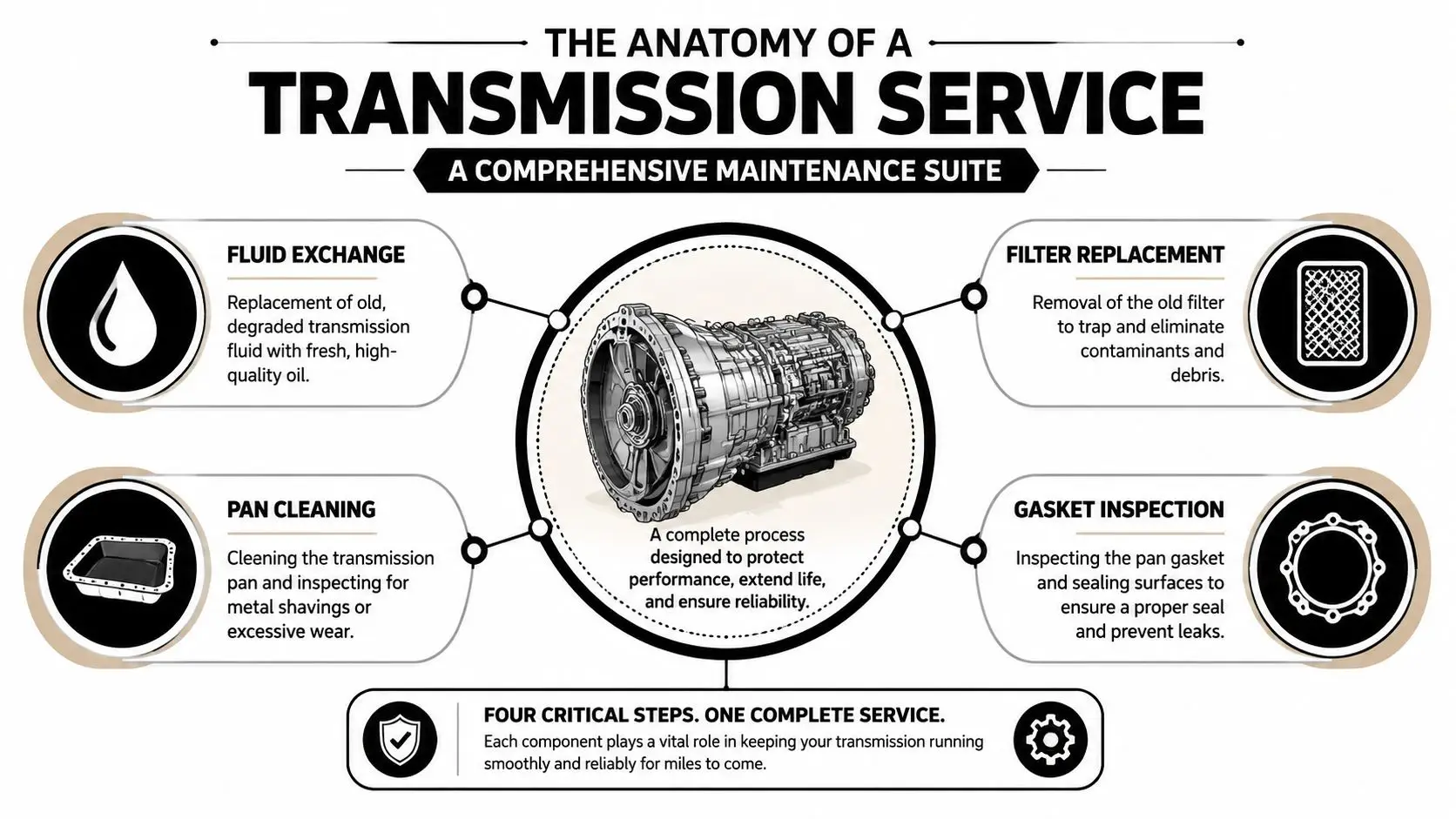
A professional transmission service typically focuses on four core jobs:
- Fluid exchange through service access: Old, worn fluid is removed as part of the service procedure.
- Filter replacement: The filter is changed if the transmission design uses a serviceable one.
- Pan cleaning and inspection: The pan and magnet are checked for clutch material or metal debris.
- Gasket renewal or inspection: The sealing surface is cleaned and the gasket is replaced or inspected based on design.
A service should tell you something about the transmission's condition, not just leave you with cleaner fluid.
What it doesn't mean
It doesn't automatically mean the transmission is failing. In many cases, it means the opposite. The owner is servicing it at the right time, before symptoms become severe.
It also doesn't mean every vehicle gets the same procedure. Transmission type, mileage, fluid condition, service history, and manufacturer design all matter. A technician should look at the vehicle's needs instead of treating every car the same way.
The Key Tasks in a Professional Transmission Service
A professional transmission service should be transparent. If a shop can't explain what it's doing, what it inspected, and what it found in the pan, that's a red flag. The details matter because a drain and fill and a real service aren't the same thing.
What a pan-drop service does
In a standard automatic transmission service, the pan is removed so the technician can access the inside of the unit's service area. That allows replacement of the filter when applicable, cleaning of the pan and magnet, inspection for debris, installation of a fresh gasket, and refill with the correct OEM-spec fluid.
Why inspection is half the value
A basic fluid swap doesn't tell you much. A pan-drop service does. The pan magnet and the sediment in the bottom of the pan show what the transmission has been dealing with.
Here's what technicians look for:
- Normal material: Fine clutch dust and light residue can be expected in many units.
- Concerning debris: Shiny flakes, larger metallic fragments, or heavy sludge can point to internal wear.
- Filter condition: A loaded filter can restrict fluid flow and hurt transmission performance.
- Leak points: The pan gasket and surrounding areas can show whether the unit has been losing fluid.
If you want a good primer on optimizing transmission filter performance, that resource does a good job explaining why filter condition matters.
What works and what doesn't
What works is matching the service to the unit, using the correct fluid, and paying attention to what the pan reveals. What doesn't work is treating every transmission like it needs the same quick procedure.
For drivers who want to understand fluid condition before scheduling service, this guide on how to check transmission fluid is a useful starting point.
The best transmission service is part maintenance and part inspection. If nobody looked for evidence of wear, the job was only half done.
Automatic Manual and CVT Service Differences
Not all transmissions need the same kind of care. One reason drivers get confused about transmission service meaning is that the term covers very different procedures depending on whether the vehicle has an automatic, a manual, or a CVT.
Transmission Service At-a-Glance
| Transmission Type | Key Service Tasks | Typical Fluid | Common Concern |
|---|---|---|---|
| Automatic | Pan removal, filter service when applicable, pan cleaning, gasket service, refill with OEM-spec fluid | Automatic transmission fluid | Heat, worn fluid, restricted filter, delayed or harsh shifts |
| Manual | Drain and refill of gear oil or manual transmission fluid, leak inspection | Gear oil or manual transmission fluid | Worn synchronizers, contaminated lubricant, difficult shifting |
| CVT | CVT fluid service with exact spec fluid, heat-related inspection, attention to cooler lines and condition | CVT-specific fluid | Fluid breakdown under heat and stop-and-go driving |
Automatic transmissions
Traditional automatics rely heavily on hydraulic pressure and fluid condition. That makes fluid quality and internal cleanliness a big part of long-term reliability. If the service includes a pan inspection, the technician gets useful information about clutch wear and debris that a simpler approach can miss.
Automatics also tend to show symptoms in ways drivers notice quickly. A delayed engagement when shifting into drive, a flare between gears, or a harsh shift when hot usually means the transmission wants attention.
Manual transmissions
Manual transmissions are mechanically simpler in this context. They don't use automatic transmission fluid in the same way an automatic does, and they usually don't involve the same type of pan-drop service. Service often centers on replacing the proper lubricant and checking for leaks or contamination.
Drivers often notice manual transmission problems through noise, notchiness, or difficulty engaging gears. The service is different, but the principle is the same. Clean, correct fluid protects moving parts.
CVTs need special attention
Misinformation often begins with statements like drivers being told their CVT has “lifetime fluid,” leading them to assume service isn't needed unless something goes wrong. That assumption gets expensive.
For North Texas drivers, that's especially relevant. Heat and repeated low-speed driving are rough on CVT fluid. If the fluid shears down or overheats, the unit can start slipping, shuddering, or failing in ways that get costly fast.
If you drive a CVT in Texas, don't let the phrase “lifetime fluid” make maintenance decisions for you.
Warning Signs and Recommended Service Intervals
When a transmission needs service, the vehicle usually gives clues. The problem is that many drivers wait until the clues become severe. By then, the options are often narrower and more expensive.

Warning signs you shouldn't ignore
Some symptoms point to fluid condition. Others suggest wear, pressure loss, or overheating. Either way, they deserve attention.
- Delayed shifting: The engine revs, but the gear change comes late.
- Harsh engagement: The transmission drops into gear harder than normal.
- Slipping under load: The vehicle feels like it falls out of gear or struggles to stay engaged.
- New noises: Whining, humming, clunking, or grinding during shifts need inspection.
- Burning smell: Heat-damaged fluid often has a burnt odor.
- Visible leaks: Red or reddish-brown fluid under the vehicle is never something to ignore.
What counts as severe driving
A lot of drivers assume they're on the “normal” maintenance schedule when they really aren't. In this area, severe service is common. Stop-and-go commuting, long idle periods, towing, repeated short trips, and summer heat all push a transmission harder.
The financial argument for staying ahead of this is straightforward. Regular transmission service at $150 to $300 per visit can total about $1,000 to $2,250 over a vehicle's life, while a full transmission replacement typically costs $4,000 to $7,000. The same source recommends service every 30,000 miles for severe conditions.
That's why many local drivers are better off using the shorter interval instead of waiting for a problem. If you want more detail on one common point of confusion, this article on how often a transmission flush makes sense helps clarify the difference between service timing and flush timing.
A quick visual can help if you're trying to recognize early symptoms and understand what technicians inspect:
Practical interval guidance
Use the manufacturer recommendation as your baseline, then adjust for real-world use. If your driving includes heavy traffic, towing, hills, or long periods in heat, the severe schedule is usually the safer call.
Waiting for a transmission to “feel bad enough” is not a maintenance plan. It's a repair plan.
Get Your Trusted Transmission Service in Richland Hills
A transmission service is a preventive check on one of the most expensive systems in your vehicle. The value isn't just in replacing old fluid. It's in inspecting the unit, catching warning signs early, and making sure the transmission is operating the way it should.
That's why the process matters. A complete service goes beyond fluid replacement and includes diagnostic steps that many drivers never see.
What to expect from a complete service
A more thorough approach should include checks like these:
- Electronic scan and code review: A technician can use scan data to look for transmission-related faults and operating issues.
- Temperature awareness: Complete transmission service can include monitoring ATF temperatures, where temperatures over 220°F cause damage, along with OBD-II checks of solenoid duty cycles.
- Physical inspection: Mounts, linkage, cooler function, leaks, and related hardware should be looked over.
- Pan and magnet inspection: Filter service and magnet cleaning help reveal the transmission's internal condition.
- Road test verification: The vehicle should be evaluated before or after service if symptoms are present.
That same source notes that a quality service with a filter change and pan magnet cleaning can reduce the risk of major transmission failure by 25 to 35% compared with neglected units. That's a strong reason to treat service as maintenance, not as an afterthought.
A practical local option
For local drivers who want a walk-in shop that handles routine maintenance and diagnostics, transmission service in Richland Hills is available through Express Lube & Car Care. The shop's ASE-certified technicians perform maintenance and repair work across common drivetrain issues, which is useful when a vehicle needs more than a simple fluid visit.
No-appointment availability matters here. Individuals typically don't start looking into transmission service because they had extra time in their week. Instead, they start because the car shifted oddly on the way to work, or because they noticed a leak in the driveway and need an answer without waiting days to get seen.
A good transmission visit should end with clarity. What was serviced, what was found, and what needs attention next.
If your car is hesitating, shifting hard, leaking fluid, or you just want a professional opinion before a small issue becomes a major repair, schedule a visit with Express Lube & Car Care. You'll get straightforward guidance, ASE-certified service, and the convenience of a neighborhood shop built for busy Richland Hills drivers.