

You’re probably here because your Mercedes did something unsettling. A warning light came on during the drive down Boulevard 26. The steering feels a little different than it did last week. Maybe the car still runs, but now you’re wondering if this is a simple service visit or the start of a very expensive repair.
That uncertainty is what makes Mercedes ownership stressful for a lot of drivers. These vehicles are refined, fast, and packed with engineering that rewards proper care. They also don’t respond well to guesswork, delayed maintenance, or bargain-bin repairs that ignore how the system is designed to work as a whole.
Your Guide to Mercedes-Benz Care in Richland Hills
Mercedes owners usually notice trouble in small ways first. A message on the dash. A rougher shift pulling into traffic. A faint oil smell after parking in the garage. Most of the time, the underlying problem isn’t just the symptom. It’s not knowing whether you can keep driving, what the fix should involve, or whether the estimate you get will make sense.

That concern is justified. Mercedes-Benz vehicles have an average annual repair cost of $908, compared with the $652 industry average, and the data also shows a 13% probability of a repair being severe, based on RepairPal’s Mercedes-Benz brand analysis. For a local driver, that matters because the wrong decision at the wrong time can turn a manageable service visit into a much larger bill.
What good Mercedes care looks like
A solid mercedes repair service approach does three things well:
- It catches issues early. Early diagnosis is where owners save the most money.
- It follows the vehicle’s service rhythm. Mercedes systems are interconnected, so skipping basics often creates bigger failures later.
- It explains trade-offs clearly. You should know when you need a factory-style repair, when an equivalent part makes sense, and when you can safely wait.
Mercedes problems rarely get cheaper by waiting. They get clearer, then more expensive.
Richland Hills drivers also deal with the practical side of ownership. You need a car that starts every day, handles heat, tolerates stop-and-go traffic, and doesn’t spend unnecessary time in a bay waiting for answers. That’s where understanding the maintenance schedule, common warning signs, and cost strategy makes a big difference.
Understanding Your Mercedes Maintenance Schedule
A lot of Mercedes owners around Richland Hills run into the same problem. The car still feels fine, so the factory reminder gets treated like a suggestion. A year later, the bill is no longer routine maintenance. It is brake fluid service, filters, worn tires, and sometimes a diagnosis that could have been avoided with better timing.
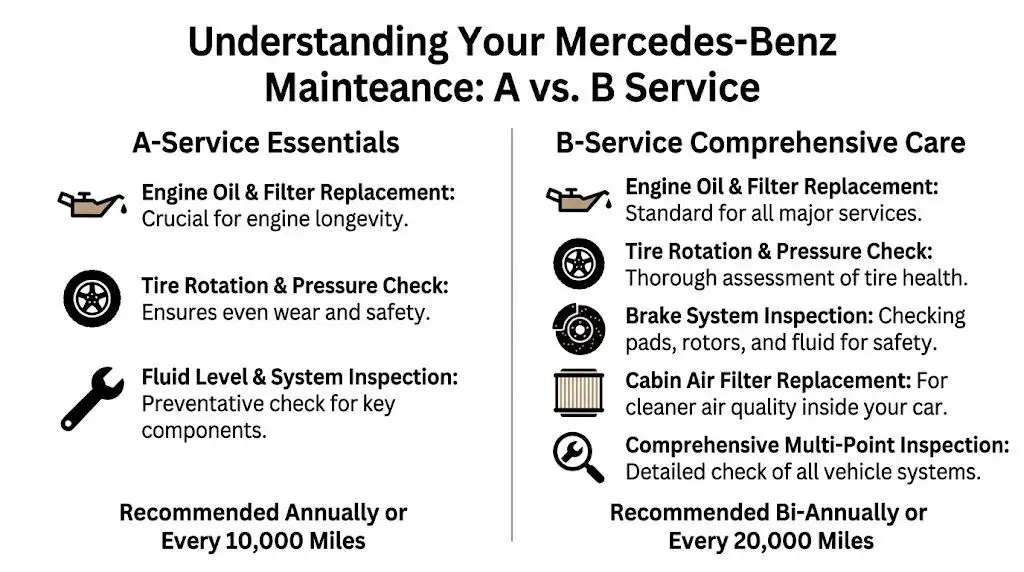
Mercedes uses a scheduled system for a reason. The factory Mercedes-Benz owner service information sets Service A at about 10,000 miles or 1 year, whichever comes first. It then recurs every 20,000 miles or 2 years. Service B follows the alternating pattern and adds a few items that protect systems owners often overlook.
What Service A includes
Service A usually covers the basics that keep wear under control:
- Synthetic motor oil replacement with the correct Mercedes-approved specification
- Oil filter replacement
- Fluid level checks and corrections
- Tire inflation check and adjustment
- Brake component inspection
- Maintenance counter reset
That may sound straightforward, but on a Mercedes, basic service quality affects long-term cost. Wrong oil, skipped inspections, or generic shortcuts can create expensive follow-up work. At an independent shop, the advantage is usually better cost clarity. You can see what is standard, what is recommended, and what can wait.
What Service B adds
Service B includes the core Service A items, plus:
- Cabin dust or combination filter replacement
- Brake fluid exchange
Brake fluid service is a good example of maintenance that saves money. Mercedes brake systems do not like moisture-contaminated fluid. Pedal feel drops off, internal corrosion starts, and parts wear faster. If your inspection also shows pad or rotor wear, it helps to understand when Mercedes brake repair becomes necessary before a routine visit turns into a larger repair order.
Why real-world driving changes the schedule
Factory intervals are the baseline, not the whole story.
In North Texas, heat, short trips, traffic, long idle time, and quick highway runs all age oil faster than ideal test conditions. Turbocharged Mercedes engines run hot, and oil that stays in service too long loses cleaning ability and film strength. I usually tell drivers to look at how the car is used, not just what the reminder says. For many local owners, shorter oil service intervals make financial sense because oil service is cheap compared with timing component wear, turbo problems, or sludge-related repairs.
That is one of the biggest dealership versus independent shop trade-offs. A dealership often sticks closely to the standard interval structure. A good independent shop can adjust recommendations to your actual driving pattern, explain why, and show you the cost difference upfront.
A practical maintenance plan
For most Mercedes owners, this approach works well:
- Use ASSYST Plus reminders as the minimum schedule
- Shorten oil intervals if the car sees heavy traffic, heat, or frequent short trips
- Inspect brakes, tires, filters, and fluid condition at every visit
- Handle small service items before they stack into one expensive appointment
Owners who stay current on maintenance usually spend less over time and deal with fewer surprise repairs. That is the return on preventive Mercedes service. It protects the car, but it also protects your budget.
Common Mercedes Issues and Warning Signs
Most Mercedes problems announce themselves before they become emergencies. The trick is recognizing the pattern early enough to act while the repair is still straightforward. If you wait until the car becomes undrivable, diagnosis is usually more expensive and your repair options narrow quickly.
Transmission behavior that shouldn’t be ignored
Mercedes transmissions usually give some notice before a major failure. Watch for these changes:
- Delayed engagement: You shift into drive or reverse and the car hesitates before moving.
- Hard shifts: Gear changes feel abrupt, especially during light acceleration.
- Surging between gears: The engine revs oddly before the next gear grabs.
- Warning messages: Transmission or drivetrain alerts deserve prompt scanning with the right diagnostic equipment.
Heat and stop-and-go traffic around Northeast Tarrant County can make these symptoms feel worse. If the transmission fluid has aged or internal wear has started, city driving exposes it faster than steady cruising.
Suspension and ride-height problems
Many Mercedes models are known for a composed, planted ride. When that changes, suspension issues often show up in obvious ways:
- One corner sits lower after parking overnight
- The ride gets harsh or bouncy
- The compressor seems to run more often than usual
- The car leans or dips during braking and turns
Drivers sometimes mistake these signs for “just old shocks.” On a Mercedes, the suspension system may involve more than a basic strut replacement. That’s why proper diagnosis matters before parts get ordered.
Oil leaks and burning smells
European engines often develop leaks at seals, covers, and gaskets as they age. Don’t ignore:
- Oil spots where you park
- A burning oil smell after driving
- Smoke from under the hood
- Low oil warnings between services
A small leak can stay small for a while. It can also spread onto belts, hoses, or hot components and create a much bigger repair plan. That’s one reason regular inspections matter so much on these vehicles.
For brake-specific warning signs like vibration, squeal, longer stopping distances, or a soft pedal, it helps to review a focused guide on Mercedes brake repair warning signs and service needs.
Electrical faults and sensor issues
Mercedes vehicles rely heavily on electronic communication between modules. When one sensor or control issue starts, the symptoms can seem unrelated.
Look for patterns like:
- Intermittent dashboard lights
- Features that work one day and fail the next
- Battery drain complaints
- Backup camera, parking assist, or infotainment glitches
- Windows, locks, or seats acting inconsistently
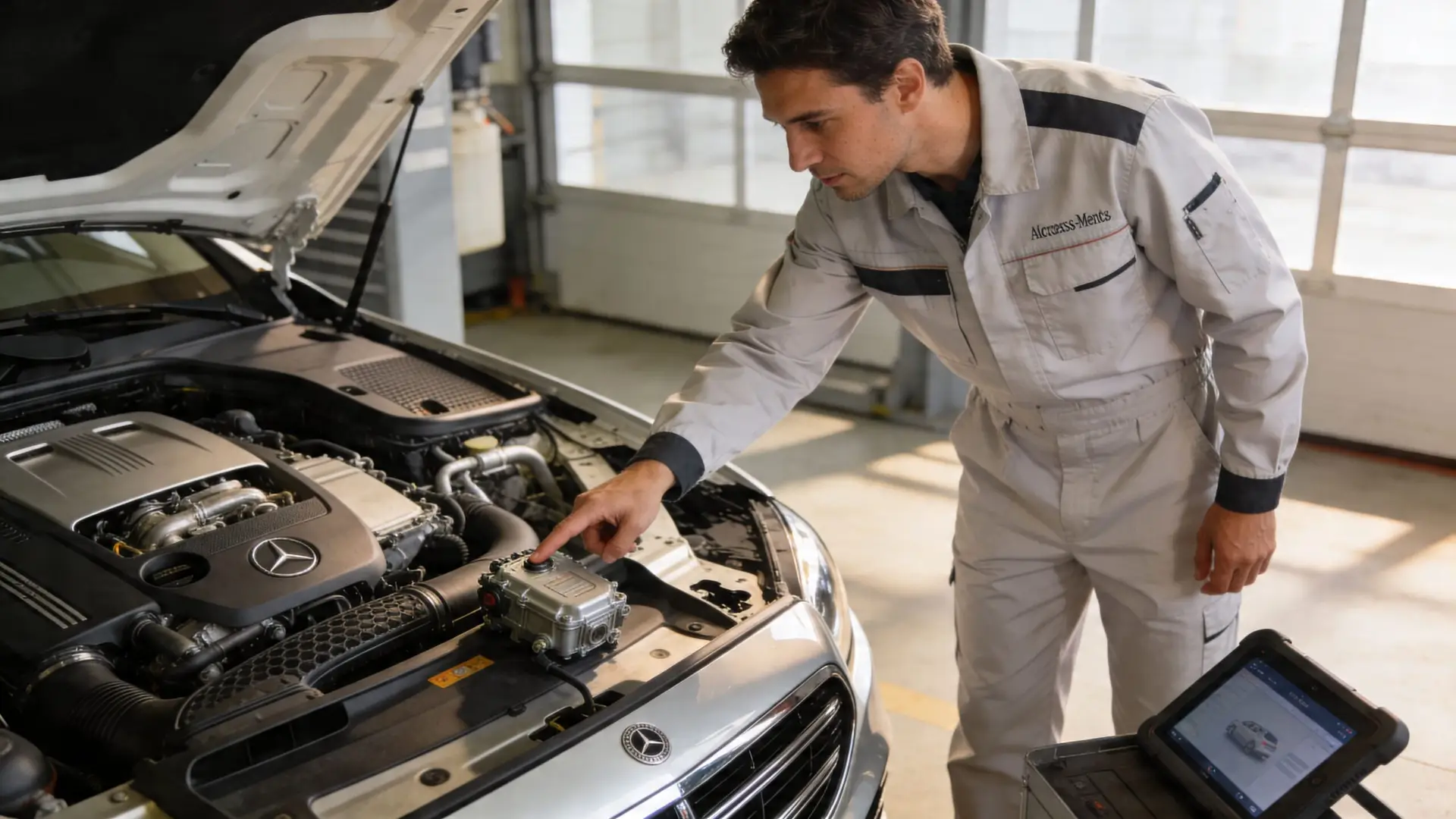
These aren’t repairs to guess at. You need a scan tool that can read manufacturer-specific faults and a technician who can separate a bad component from a wiring, communication, or voltage problem.
A short visual overview can help if you’re trying to understand how Mercedes diagnostics typically begin:
If your Mercedes feels different, sounds different, or starts showing intermittent warnings, treat that as useful information. The vehicle is giving you a window to fix something before it escalates.
Managing Repair Costs OEM vs Aftermarket Parts
Mercedes owners don’t just need repairs. They need a cost strategy. That starts with knowing where the money goes, which parts choices are smart, and why preventive maintenance usually beats reactive repair by a wide margin.
One of the biggest mistakes I see in luxury car ownership is false savings. A driver postpones a service because the car still feels fine. Then the deferred maintenance stacks up behind the scenes, and the next visit includes damage that could have been avoided. The verified guidance behind this topic makes the financial point clearly: many owners don’t realize how quickly deferred maintenance can turn a modest service into a repair worth thousands, including the common example that skipping a $200 Mercedes Service B can lead to a $5,000 problem later, as highlighted in the referenced short-form discussion on deferred maintenance costs.
OEM parts and aftermarket parts are not the same decision every time
OEM means the part comes from the original equipment manufacturer or its direct supply chain. Aftermarket means a third-party manufacturer builds a replacement part intended to match the application.
That doesn’t make aftermarket automatically bad. It means the part choice has to match the job.
| Attribute | OEM Parts | High-Quality Aftermarket Parts |
|---|---|---|
| Fit and specification | Built to original design standards | Can match original function when sourced carefully |
| Best use case | Complex systems, sensitive electronics, model-specific components | Routine wear items and selected repairs where quality is proven |
| Cost | Usually higher | Usually lower |
| Risk if chosen poorly | Lower fitment uncertainty | Greater variability between brands |
| Buyer mindset | Prioritizes factory-match consistency | Prioritizes value without sacrificing reliability |
Where spending more makes sense
Use OEM or equivalent factory-level parts when the system is especially sensitive. Think sensors, electronics, complex suspension components, or parts where software and calibration matter.
High-quality aftermarket parts can make excellent sense on selected maintenance and wear items. The key phrase is high-quality. Cheap parts that only look right on paper often fail early, fit poorly, or create repeat labor.
Preventive maintenance has real ROI
The cleanest money-saving move in Mercedes ownership is still prevention. A planned fluid service, inspection, or filter replacement is usually far less painful than paying for secondary damage after something overheats, slips, leaks, or contaminates another component.
That same mindset matters after collision work, too. If your Mercedes has been repaired after an accident, it’s worth understanding diminished value after an accident so you can evaluate the broader financial impact on the vehicle, not just the mechanical bill.
For a broader look at how service choices affect ownership costs, this local guide on auto repair cost comparison is useful context.
Why Choose Express Lube for Your Mercedes Service
A lot of Mercedes owners hesitate before taking their car anywhere other than a dealership. That hesitation is understandable. These vehicles are advanced, and nobody wants to hand a luxury car to a shop that treats it like a generic sedan.
The better question isn’t dealer or independent. It’s whether the shop has the training, diagnostic capability, and process discipline to work on Mercedes properly.
What closes the trust gap
The strongest independent shops narrow that gap with two things. ASE-certified technicians and modern diagnostic equipment. Verified guidance on this point notes that independent shops with ASE certification and modern diagnostic equipment can match dealership quality at 30 to 40 percent lower cost, which directly addresses one of the biggest trust barriers for Mercedes owners considering a non-dealer option, as summarized in the source discussion at Minh’s Auto Care Mercedes service overview.
That matters because “independent” doesn’t mean improvised. A capable shop follows a process:
- Scan the vehicle correctly
- Confirm the fault before replacing parts
- Inspect related systems
- Use quality parts
- Explain what’s urgent and what can be scheduled
Why local drivers often prefer the independent route
Dealer service works for some owners. It also often comes with more overhead, less flexibility, and a more formal process than busy drivers want.
A strong local independent shop usually fits real life better:
- Walk-in convenience: Helpful when a warning light appears on a workday.
- More direct communication: You’re more likely to get a plain-English explanation of the issue.
- Better cost control: You can discuss OEM versus equivalent-quality part options where appropriate.
- Practical prioritization: Not every recommendation needs to happen the same day.
Good Mercedes service isn’t about the logo on the building. It’s about whether the technician can diagnose the car accurately and repair it without shortcuts.
If you want to understand what credentials and equipment matter, this guide on choosing a certified Mercedes mechanic is a helpful place to start.
What works and what doesn’t
What works is a shop that respects the platform. What doesn’t work is treating a Mercedes like every other car on the road, throwing parts at warning lights, or using the cheapest available replacement to hit a lower estimate.
For Richland Hills drivers, the best value usually comes from accurate diagnosis, clear approvals, and repairs that solve the problem the first time.
What to Expect During Your Service Visit
Mercedes owners want a service visit that is clear, efficient, and worth the money they spend. If a warning light comes on during the morning drive through Richland Hills, the goal is simple. Get a correct answer, approve only the work the car needs, and avoid paying twice for the same problem.
From arrival to inspection
The visit should start with a real conversation about the symptom. A cold-start rattle, a rough idle at stoplights, or a suspension warning after hitting a pothole all point the diagnostic process in different directions. Those details save time and help prevent guesswork.
From there, the car needs more than a quick code scan. Mercedes systems are interconnected, so the fault showing on the dash is not always the failed part. A proper inspection usually includes a road test if needed, a visual check, system testing, and a review of related components that could be causing the complaint.
That step protects your budget.
Accurate diagnosis costs less than replacing parts until something works. That is one of the biggest financial advantages of working with an independent shop that takes the time to test first and explain the result.
Clear approval before repair
Before any repair starts, you should know three things. What failed, what it affects, and what it will cost to fix correctly.
A solid service process usually looks like this:
- Confirm the concern so the symptom is documented correctly
- Test the system based on the model, mileage, and complaint
- Build a repair estimate with parts, labor, and any related recommendations explained in plain language
- Get your approval before work begins
- Verify the repair after the work is done
That approval step matters, especially on a Mercedes. Some repairs have options. In certain cases, OEM parts make the most sense. In others, a high-quality aftermarket part can lower the bill without creating problems later. You should be able to ask about those choices and get a straight answer about the trade-offs.
A practical process for busy drivers
Most local drivers do not have time for a long, vague service process. They need clear updates, realistic timing, and no surprise add-ons at checkout. A good independent shop keeps the visit moving and keeps you informed if the diagnosis changes once testing begins.
At Express Lube Richland Hills, that usually means explaining the issue in plain English, documenting what we found, and separating immediate repairs from items that can be planned for later. That helps owners protect the car without turning one visit into a larger bill than necessary.
A good service visit should feel predictable. You know what the car needs, why it needs it, and what you are agreeing to before the work starts.
That is how Mercedes service stays manageable over the long run.
Frequently Asked Questions About Mercedes Repair
Will independent service void my Mercedes warranty
No. An independent shop can perform maintenance and repairs without automatically voiding your warranty, as long as the work is done properly and the correct parts and procedures are used. Keep your records. If your vehicle is still under factory coverage, documentation matters.
Should I always follow the dash reminder exactly
Use it as a guide, not as your only decision-maker. Service reminders are helpful, but driving habits, heat, idle time, and short trips all affect how hard the vehicle is working. Many owners benefit from a more proactive schedule, especially for oil service.
Are Mercedes repairs always expensive
Not always. What gets expensive is delayed diagnosis, skipped maintenance, and replacing parts without confirming the fault. Routine service and early inspection are usually far more manageable than waiting for a breakdown.
Is dealership service automatically better
No. The quality of the repair depends on the technician, the diagnostic process, and the parts strategy. A well-equipped independent shop with Mercedes experience can be an excellent option.
How do I know if a warning light is urgent
If the light is red, flashing, tied to braking, charging, overheating, or major drivability changes, stop and get advice right away. If the car still runs normally but shows a warning, schedule diagnosis soon. Waiting usually reduces your options.
Can a local shop handle more than maintenance
Yes. A qualified full-service shop can handle diagnostics, brake work, suspension repairs, fluid services, engine concerns, and many electrical issues. The key is choosing a team that understands the platform and communicates clearly.
If your Mercedes needs maintenance, diagnostics, or a second opinion on a repair estimate, Express Lube & Car Care offers friendly, ASE-certified service for drivers in Richland Hills and Northeast Tarrant County. Stop by for clear answers, transparent pricing, and practical recommendations that help you protect your car without overspending.