

You pull into the shop for a routine oil change. The service advisor asks a simple question: “Do you want the standard filter or the better one?”
Most drivers pause right there.
That hesitation makes sense. Oil filters look small, cheap, and interchangeable. From the outside, one metal can or paper element doesn’t seem all that different from another. But this is one of those parts that can subtly help an engine last longer, or allow more wear to happen than necessary.
A lot of oil filters types guides stop at naming the parts. Spin-on. Cartridge. Synthetic media. Bypass. Done. That’s not enough to help someone choose well.
What matters is how the filter fits the engine, the oil, and the way the vehicle is driven. A commuter sitting in Richland Hills traffic has different needs than a lightly driven weekend SUV. A filter that sounds impressive on the box can still be the wrong choice if it restricts flow too much. A basic filter can be fine in one engine and a weak link in another.
This guide is built to make that decision clearer. It explains the main oil filters types, what each one does well, where each one falls short, and what protects an engine over time.
Your Guide to Choosing the Right Oil Filter
The average driver rarely thinks about an oil filter until it’s time to pay for one. That’s normal. You schedule the oil change, hand over the keys, and expect fresh oil to handle the job.
But clean oil only stays clean if the filter can keep contaminants under control.
Every engine creates contamination as it runs. Some of it comes from normal internal wear. Some comes from combustion byproducts. Some comes from dirt and residue that eventually find their way into the lubrication system. The oil carries that material through the engine, and the filter’s job is to trap as much of it as possible without choking off oil flow.
That last part matters more than is often understood.
Why this small part matters so much
An oil filter isn’t just an accessory that gets changed because it’s on the invoice. It’s one of the main barriers between circulating oil and circulating abrasive debris. If the filter is poorly built, overloaded, or poorly matched to the engine, the oil can’t do its job as well.
That changes how metal surfaces live together inside the engine.
Think about where oil travels. Bearings, camshafts, timing components, valvetrain parts, piston assemblies. These are expensive parts with tight clearances. They depend on a stable film of oil. When contamination increases, wear tends to show up in the places you never want to rebuild.
Practical rule: Don’t treat the filter like a throwaway commodity. Treat it like a wear-control part.
The better question to ask at the counter
Instead of asking, “What’s the cheapest filter?” ask:
- What filter design does my vehicle use
- What media is inside it
- Is this a good match for my oil and service interval
- Will it balance filtration and flow correctly for my engine
That’s how you move from guessing to making a smart maintenance decision.
The Unsung Hero Inside Your Engine
An oil filter is the engine’s kidney. It lets the good stuff keep moving and catches the junk that shouldn’t stay in circulation.
That junk isn’t imaginary. Engines produce tiny wear particles during normal operation. Oil also picks up carbon residue and outside contamination over time. Left alone, that material becomes a grinding compound.
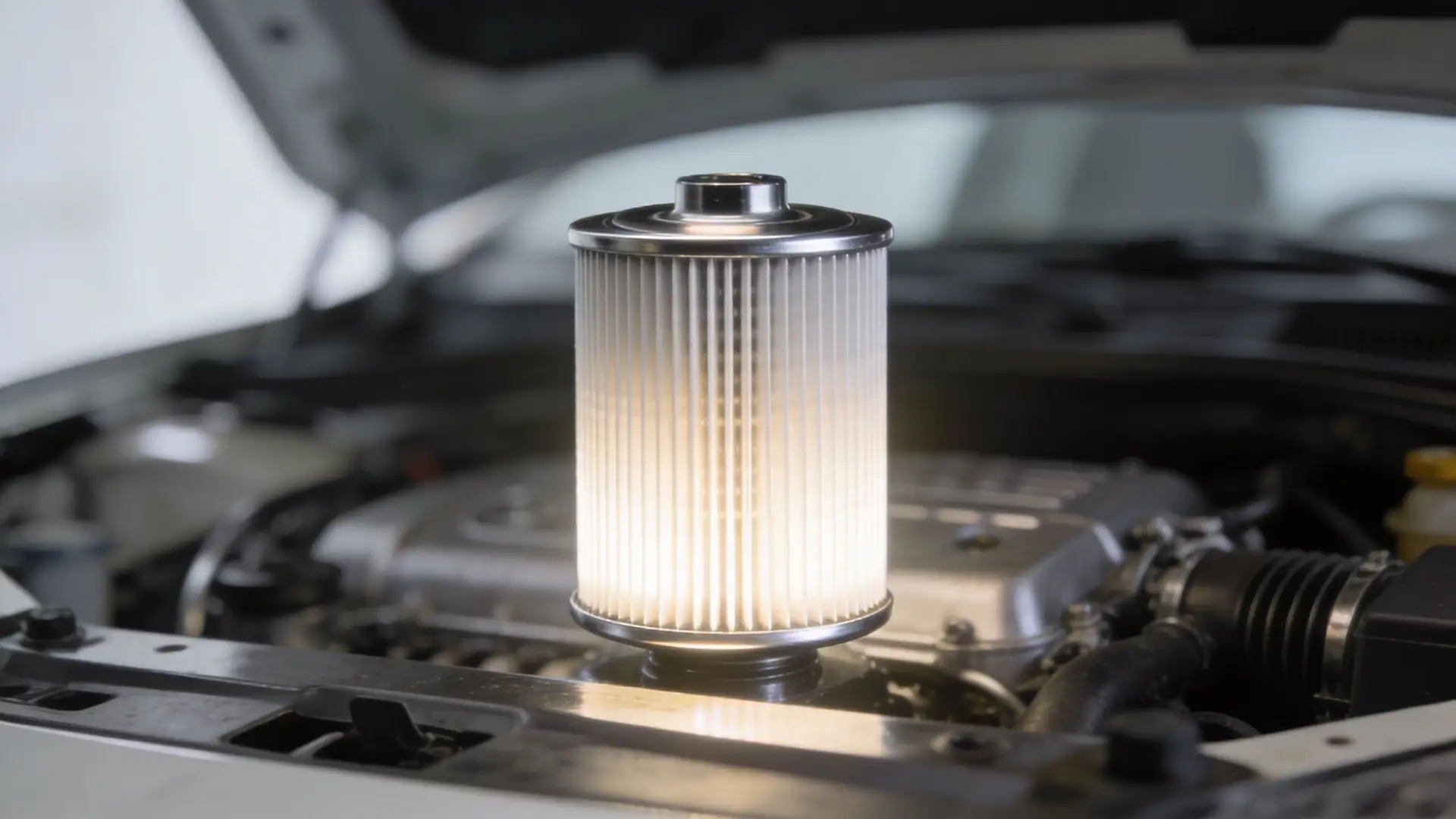
If you’ve ever seen dirty oil drained from a neglected engine, you’ve already seen the problem in liquid form. What the eye can’t see is the smaller debris still suspended in that oil. Those particles move through bearings and other loaded surfaces every time the engine runs.
What happens inside a common spin-on filter
Most vehicles on the road use a spin-on oil filter. In that design, the filter media, anti-drainback valve, and bypass valve are built into one disposable steel canister. Mobil explains that the anti-drainback valve helps keep oil from draining out of the filter when the engine is off, which supports quicker lubrication at startup and helps prevent dry-start wear in a technical overview of oil filter designs.
That anti-drainback valve doesn’t get enough attention. On a vehicle that sits overnight, especially one where the filter mounts sideways or base-up, that valve can make the difference between immediate oil availability and a noisy, delayed startup.
Why clean oil is non-negotiable
Dirty oil still lubricates, but it doesn’t lubricate as safely. Contamination turns a protective fluid into a carrier for abrasive material. That’s how long-term wear sneaks up on owners who otherwise keep up with oil changes.
A healthy filter system helps by doing three things well:
- Catching debris: It removes contaminants before they keep recirculating.
- Maintaining flow: It allows the engine to get oil quickly, even when cold.
- Supporting startup protection: The anti-drainback valve helps keep the filter from emptying between drives.
A filter isn’t there to make oil cleaner in theory. It’s there to keep hard particles away from soft bearing surfaces and other moving parts that can’t tolerate abrasion.
Spin-On vs Cartridge The Two Main Filter Designs
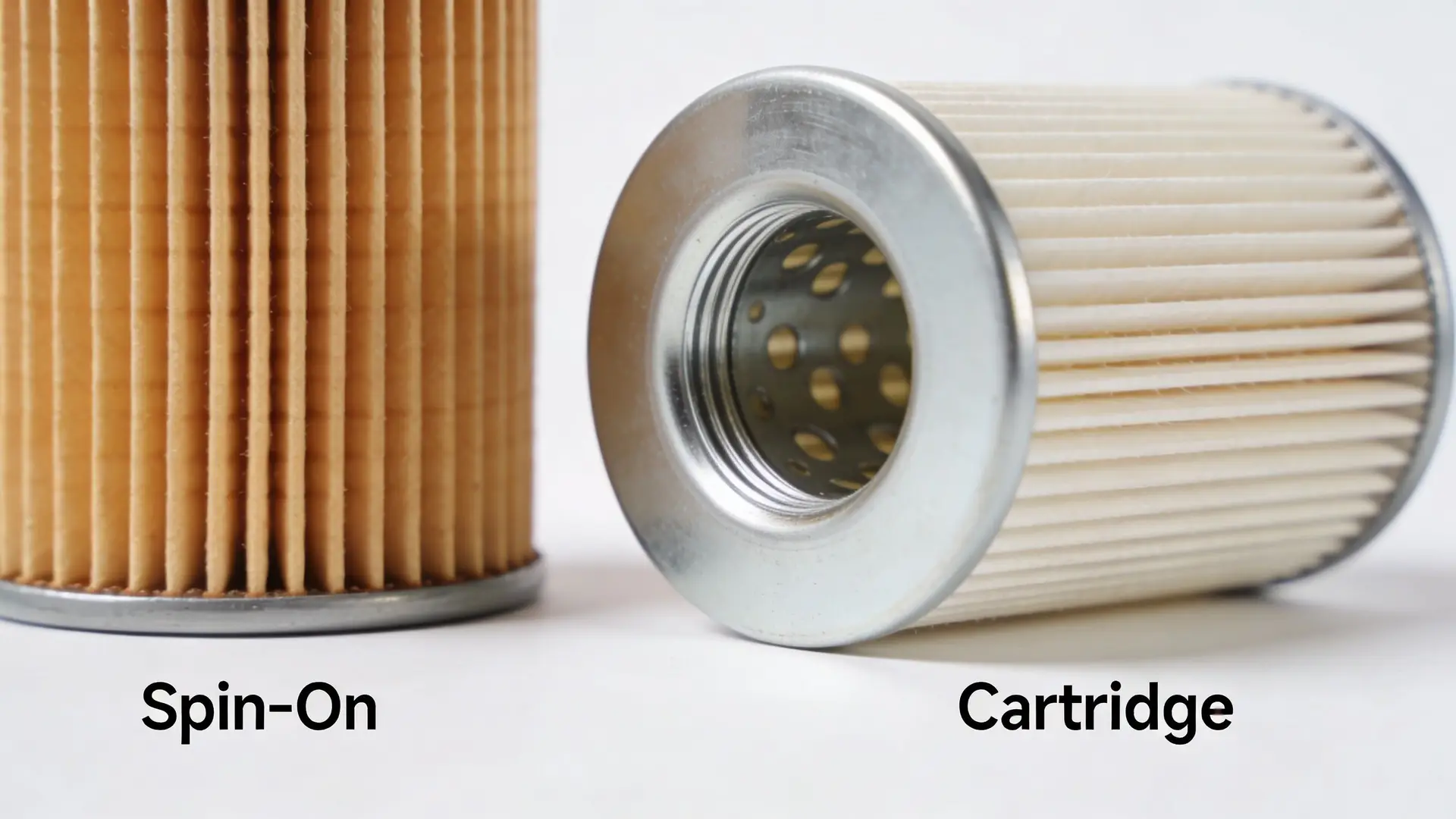
When people search oil filters types, they usually encounter two designs first. Spin-on filters and cartridge filters.
They do the same basic job, but they package that job differently.
Spin-on filters
A spin-on filter is the classic metal canister most drivers recognize. It threads directly onto the engine and gets replaced as a complete unit.
This design dominates the market. FRAM notes that spin-on oil filters are the most common type found in vehicles, and that the canister segment leads a global car oil filter market projected to grow from USD 2.7 billion in 2025 to USD 4 billion by 2035 in its overview of oil filter types.
Why mechanics like them is simple. They’re straightforward to stock, easy to replace, and familiar across a huge range of vehicles.
Strengths of spin-on filters
- Fast service: Remove the old canister, prep the gasket, install the new one.
- Self-contained design: The canister includes the internal components in one part.
- Wide availability: Most parts suppliers stock many common applications.
Trade-offs
- More waste: You throw away the steel canister each time.
- Less direct inspection: You usually don’t see the media unless the filter is cut open.
- Space can be tight: Some engine bays make removal messy.
Cartridge filters
A cartridge filter uses a permanent housing mounted to the engine. During service, the technician opens that housing and replaces only the filter element inside.
This design is common on many newer vehicles. It often appeals to manufacturers because it can reduce waste and allow easier inspection of the removed media.
Side-by-side differences
| Design | What gets replaced | Main advantage | Main drawback | Best fit |
|---|---|---|---|---|
| Spin-on | Entire canister | Quick, simple service | More disposal waste | Many older and mainstream vehicles |
| Cartridge | Internal element only | Less material waste | Housing service can be more involved | Many newer designs |
Shop-floor reality: Neither design is automatically better. The better one is the one your engine was engineered to use, installed correctly, with a quality element inside it.
Which one is easier for owners
For many DIY owners, spin-ons feel simpler. For many professional techs, either design is fine as long as access is good and the right cap socket or filter wrench is used. Cartridge filters can be cleaner on some vehicles, but they can also become frustrating if the cap is overtightened or the housing seal is installed incorrectly.
That’s one reason filter choice isn’t only about type. Service quality matters too.
Decoding Filter Media and Micron Ratings
The outside of the filter tells you the design. The inside tells you the quality.
That internal material is called the filter media. It’s the part that traps contamination as oil passes through.
The three media categories most drivers will encounter
The easiest way to think about media is to compare it to household filters.
A basic cellulose filter is closer to a paper coffee filter. It works, it’s affordable, and it’s common in entry-level products. A synthetic filter is more like a higher-efficiency water purifier element. It’s engineered for finer capture and longer service. Synthetic blends sit in the middle and try to balance cost with better performance.
Here’s the practical difference.
| Media Type | Filtration Efficiency | Lifespan | Best For |
|---|---|---|---|
| Cellulose | Basic filtration, typically used in economy filters | Shorter service life than synthetic media | Conventional oil changes and basic maintenance |
| Synthetic blend | Better balance of filtration and flow than basic paper media | Moderate service life | Drivers who want a step up without going premium |
| Synthetic | Designed for finer particle capture and longer service intervals | Longer service life than conventional media | Synthetic oil users, longer intervals, harder duty |
What a micron rating means in real life
A micron is a tiny unit of measurement used to describe particle size. In oil filtration, lower micron capture matters because small particles can do serious damage even when you can’t see them.
That isn’t marketing fluff. A General Motors study cited in the Bob Is The Oil Guy discussion found that compared with a 40-micron filter, engine wear dropped by 50% with 30-micron filtration and 70% with 15-micron filtration. The same source also notes that particles smaller than 10 microns can cause about 3.6 times more wear on engine components like rods, rings, and main bearings. Those figures appear in the referenced discussion on oil filter media efficiency specifications.
Why “finer” isn’t the whole story
Many parts-counter conversations go off course on this topic. People hear “smaller micron” and assume that automatically means “better filter.”
Sometimes it does. Sometimes it doesn’t.
The filter still has to allow enough oil flow for the engine’s needs, especially during cold starts and heavier load conditions. Good filter engineering is about balance. Media design, surface area, flow path, and valve behavior all matter.
The best oil filter doesn’t just catch small particles. It catches them while still letting the engine get the oil volume it needs.
That’s why two filters with similar-sounding claims on the box can behave very differently in service.
Exploring Advanced and Specialty Filter Systems
Most passenger vehicles use a full-flow system. That means the engine sends all the oil through the main filter before it reaches critical components. It’s the standard setup because the engine needs filtration without starving itself for oil.
That works well for everyday driving, but it doesn’t tell the whole story of oil filters types. There are more specialized systems designed for finer cleanup or special operating conditions.
Bypass filtration systems
A bypass filter doesn’t replace the main full-flow filter. It supplements it.
Its job is to filter a smaller portion of the oil stream much more finely. That slower, secondary cleaning action helps remove particles the primary filter may not catch as effectively.
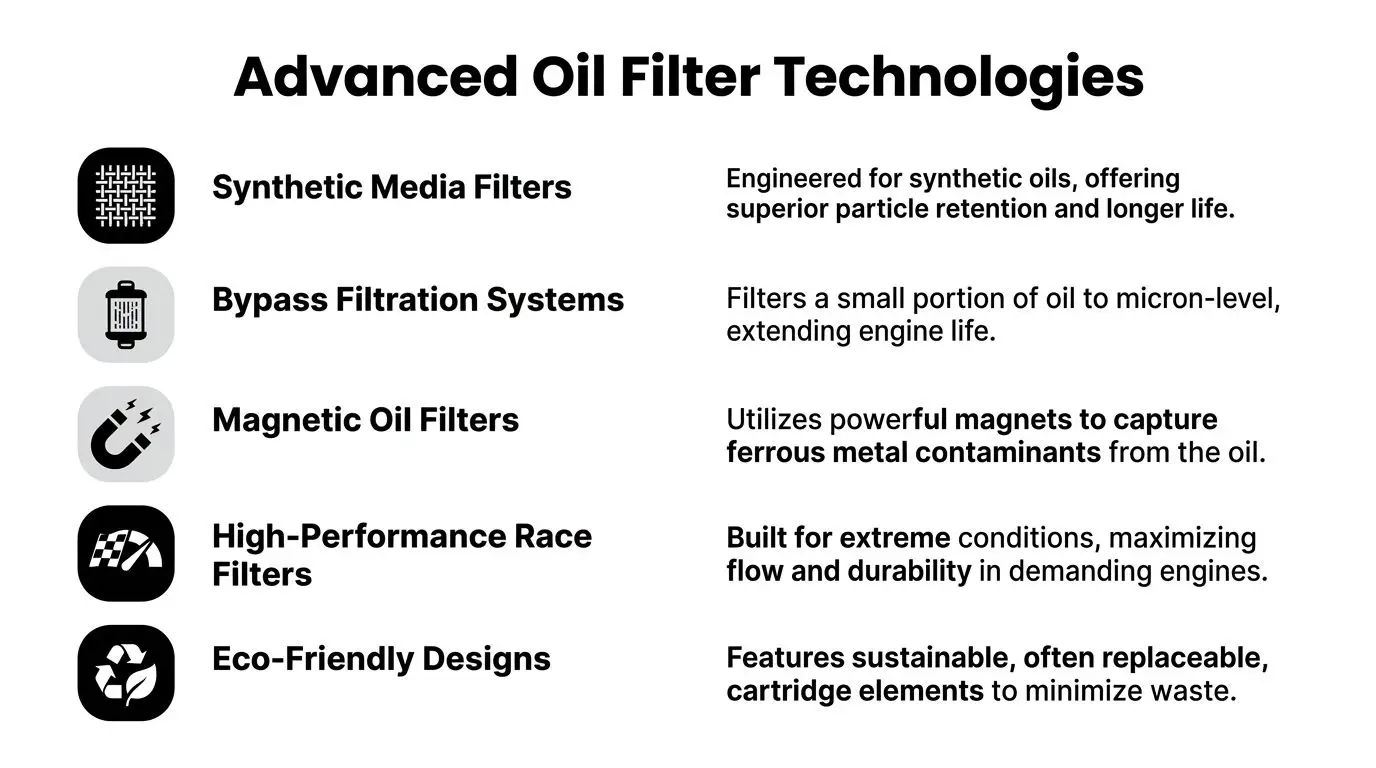
Machinery Lubrication describes a major knowledge gap here. It notes that bypass oil filters clean about 10% of the oil flow and can remove fine particles missed by primary full-flow filters in its discussion of oil filtration systems.
That kind of setup makes more sense for certain users than others.
- Fleet operators: Vehicles that rack up steady mileage may benefit from more advanced contamination control.
- Heavy-duty service: Engines under prolonged load often justify more elaborate filtration strategies.
- Owners focused on longevity: Some enthusiasts want every reasonable edge in wear control.
Magnetic and other specialty filters
Magnetic filters or magnetic filter elements focus on one specific contaminant type. Ferrous metal particles. They don’t replace conventional media, but they can help capture metallic debris that a standard setup may leave in circulation until the next service.
There are also centrifugal systems used in some heavy-duty applications. Instead of relying only on pleated media, they use rotational force to separate contamination from the oil.
Who actually needs advanced filtration
Most daily-driven passenger cars don’t need an elaborate secondary filtration system. The factory-designed full-flow system is usually the right answer for routine use when the owner follows a sensible maintenance schedule.
Still, it helps to know these systems exist.
Some filtration technology is designed to make a normal car survive daily use. Other filtration technology is designed to stretch durability under demanding duty cycles.
That difference matters for fleets, performance builds, towing applications, and owners who plan to keep a vehicle for a very long time.
How to Choose the Right Filter for Your Vehicle
The biggest mistake people make is assuming the finest-sounding filter must be the safest choice.
That isn’t always true.
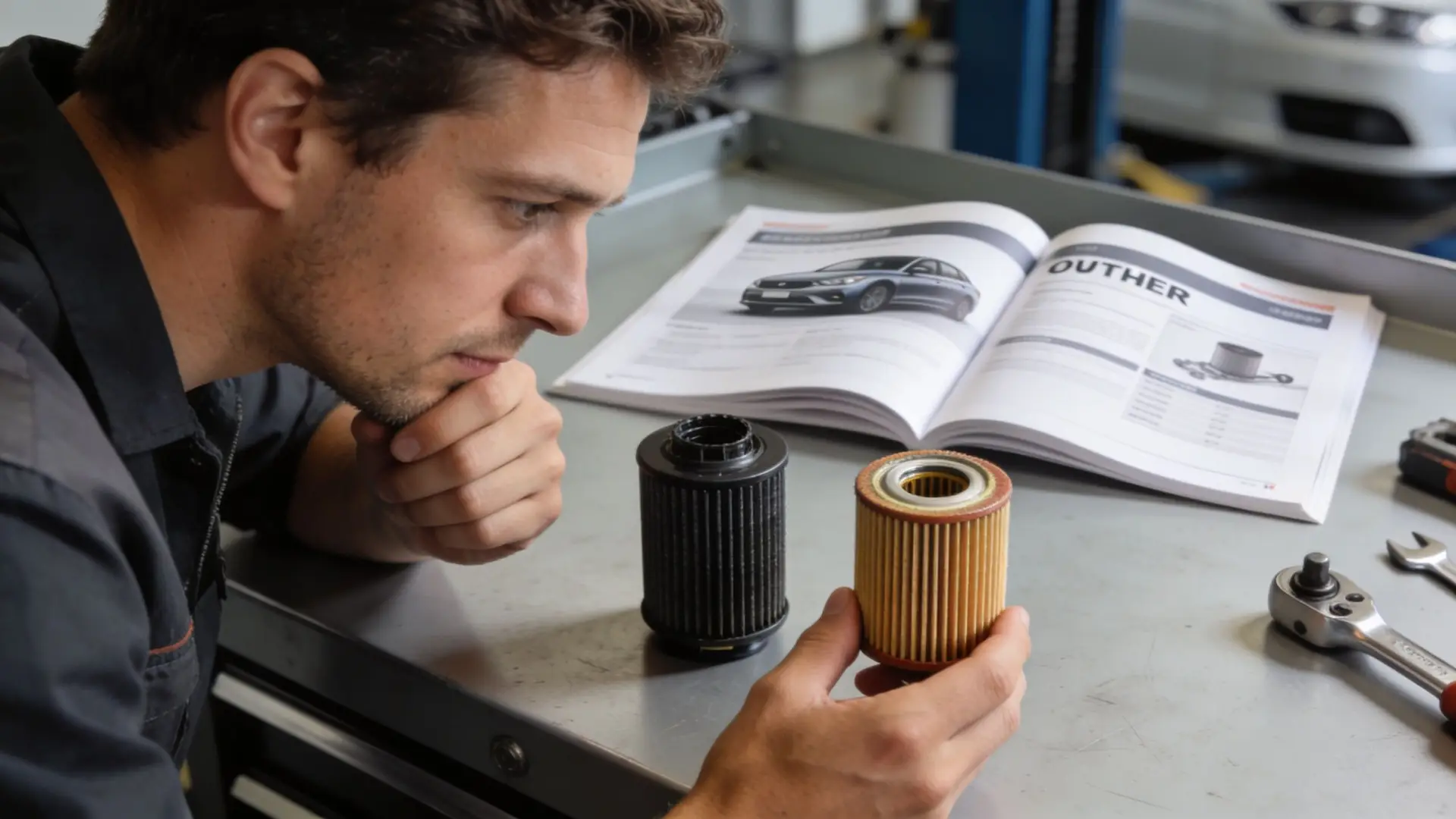
A filter can be too restrictive for a given engine and operating condition. When that happens, pressure drop rises and the bypass valve may open. If the bypass opens, oil can circulate without being fully filtered. Minimac Systems explains this problem directly in its discussion of oil purification trade-offs, noting that a filter with an impressive micron claim can under some conditions deliver zero filtration if the bypass valve is open.
That’s why matching matters more than bragging rights on the box.
Start with the vehicle, not the marketing
The first question is always compatibility. The engine was designed around a certain filter size, sealing arrangement, bypass strategy, and flow expectation. You want a filter built for that application, not a random “upgraded” option that sounds better in isolation.
Use this checklist:
- Follow the manufacturer’s fitment requirements. Thread size, gasket diameter, housing design, and internal valve setup all matter.
- Match the filter to the oil you use. If you run synthetic oil and longer intervals, higher-grade media often makes more sense.
- Think about your driving pattern. Stop-and-go trips, short runs, heavy heat, and long idle time are harder on oil and filters than easy highway cruising.
- Be honest about your goal. Some drivers want basic reliable service. Others want the best practical wear control they can get.
If you’re also trying to match the right oil to the filter, this guide on oil recommendations for my car helps connect viscosity, vehicle needs, and service planning.
Richland Hills driving changes the conversation
Local driving isn’t racetrack use, but it isn’t always easy service either. Repeated short trips, traffic lights, hot pavement, and long summer idle periods all push oil through frequent heat cycles. In those conditions, a well-matched filter with good construction matters more than a flashy label.
A daily commuter often benefits from consistency more than from extremes.
That means:
- a filter that seals properly
- an anti-drainback valve that does its job
- media that fits the oil change interval
- dependable build quality from a known brand
This visual explainer does a good job showing how filter differences affect real-world service decisions.
A practical buying mindset
Don’t buy the cheapest filter by default. Don’t buy the most aggressive micron claim by default either.
Buy the filter that best balances:
| Priority | What to look for |
|---|---|
| Daily reliability | Correct fit, quality construction, dependable valve design |
| Longer interval use | Better media and strong contaminant capacity |
| Cold-start protection | Effective anti-drainback valve performance |
| Engine longevity | Strong filtration without excessive restriction |
Bottom line: The right filter is the one that gives your specific engine clean oil and steady flow under the way you actually drive.
Filter Maintenance and Responsible Disposal
A new oil filter should go on with every oil change. Fresh oil pushed through an old, loaded filter starts its service life at a disadvantage.
That’s basic engine care, not upselling.
If you want to understand the service process itself, this walkthrough of the steps to change oil shows where the filter fits into the job and why the details matter.
What not to do with a used filter
Used oil filters aren’t regular trash. They contain residual oil and collected contaminants, so they need proper handling and disposal. Tossing one in a household bin is careless at best and can violate local disposal rules.
For DIY owners, the mess is usually the easy part. Handling the drain-down, storage, and proper recycling is what gets overlooked. A professional shop takes that burden off your hands and handles the used oil and filter responsibly.
A good oil change ends with the old filter out of the engine and out of the waste stream the right way.
Your Partner for Expert Oil Changes in Richland Hills
Oil filter types can seem simple until you look at what matters. Filter design, media quality, flow characteristics, bypass behavior, and vehicle fit all shape how well that part protects the engine.
That’s why good maintenance isn’t just about changing oil. It’s about choosing the right filter for the engine, the oil, and the way the vehicle is used.
At Express Lube & Car Care’s oil and filter change service, drivers get help from ASE-certified technicians who understand those trade-offs. The focus is practical, honest service. Not pushing parts that don’t fit the application. Not guessing. Not cutting corners on quality.
That matters for busy commuters, families managing multiple vehicles, and fleet operators who can’t afford unnecessary downtime. A walk-in model makes routine service easier, and clear recommendations help drivers avoid surprises later.
Local value matters too. Express Lube Richland Hills offers community-minded savings, including Ladies Day and discounts for military members and first responders. That combination of convenience, technical skill, and straightforward communication is what keeps routine maintenance from turning into expensive repair work.
If your vehicle is due for service, the smartest move is getting the oil and filter changed by a shop that knows what works, what doesn’t, and why.
When you want fast, reliable maintenance from ASE-certified technicians, visit Express Lube & Car Care. Stop by for a walk-in oil change, get honest filter recommendations for your vehicle, and keep your engine protected mile after mile.
Not sure which filter your vehicle requires? During an oil change and preventive maintenance service, the correct filter should be selected for your specific application.