

You notice it at the worst time. Maybe you’re easing toward a light on Boulevard 26 and the pedal feels softer than normal. Maybe the wheel shivers when you slow down. Maybe you hear a squeal that wasn’t there last week, and now every stop feels like a question mark.
That kind of brake concern hits differently in a Mercedes-Benz. Drivers expect a quiet, controlled stop. When that changes, the first worry usually isn’t just safety. It’s also cost, complexity, and whether the repair is going to turn into a dealership-only situation.
It doesn’t have to.
Mercedes brake systems are complex, but they aren’t mysterious when a technician explains them clearly. The hard part for many owners is getting straight guidance in the first place. Online advice often says brake inspections should happen anywhere from 20,000 to 60,000 miles or every six months, yet it rarely explains why that range is so wide or how Texas stop-and-go driving changes the specific answer for your car (Loeber Motors Mercedes-Benz). That gap leads people to wait too long or spend too early.
Your Mercedes Brakes Are Talking Are You Listening
A Mercedes usually gives warning before brake failure. The problem is that the warning doesn’t always sound dramatic.
Sometimes it starts as a faint chirp backing out of the driveway. Sometimes it’s a longer stopping feel in traffic. Sometimes it’s a rough metallic sound that only shows up on the first stop of the morning. If you’ve been searching for what a grinding noise when braking means, you’re already doing the right thing by paying attention before the problem grows.

Why local driving changes the timing
Richland Hills driving is hard on brakes in a very ordinary way. It’s not racetrack use. It’s repeated slowdowns, short trips, traffic lights, school pickup lines, and quick merges onto busier roads.
That matters because generic service intervals don’t account for how your specific vehicle is used. Two Mercedes owners can drive the same model and need service at very different times.
- Short-trip driving: Brakes may not get a clean, even heat cycle.
- Frequent stops: Pads and rotors see more repeated friction.
- Texas heat: Brake fluid and rotor temperatures become more important under load.
- Mixed family and commuter use: One driver may be gentle, another may brake late and harder.
What drivers usually get wrong
The biggest mistake isn’t always ignoring noise. It’s assuming luxury means the car will tell you everything before damage happens.
Mercedes systems are smart, but they still rely on inspection. A worn pad, a heat-checked rotor, or moisture-contaminated fluid can start affecting feel before the warning on the dash tells the full story.
Practical rule: If your Mercedes stops differently than it did a month ago, treat that as a brake symptom even if no warning light is on.
Brake repair for Mercedes Benz works best when it starts early. The goal isn’t just to fix what failed. It’s to catch what’s changing before you end up replacing more parts than necessary.
Decoding Mercedes Brake Warning Signs and Symptoms
Most brake problems show up first as a change in sound, feel, or response. The useful question isn’t “is this bad?” It’s “what part of the system is trying to tell me something?”
Squealing and chirping
A high-pitched squeal often points to pad wear, pad material glazing, or hardware that isn’t moving the way it should. Think of brake pads like tire tread. They still work as they wear down, but they have a point where performance and protection drop off quickly.
If the sound comes and goes, that doesn’t mean the problem is minor. Intermittent noise can still be an early warning.
Grinding means stop postponing
Grinding is more serious. It often means the pad material is worn enough that metal is contacting the rotor, or a wear indicator has progressed beyond the stage where simple pad service is likely.
Once metal starts digging into the rotor face, repair costs usually rise. Rotor damage doesn’t wait.
Pulsation or vibration
A vibrating steering wheel or brake pedal during stops often leads drivers to say the rotors are “warped.” Sometimes that’s the practical explanation, but what matters is what the technician measures.
Mercedes brake systems are sensitive to rotor condition, mounting surfaces, and runout. If the rotor face isn’t running true, you feel that through the pedal and chassis.
Soft pedal or long pedal travel
A pedal that feels spongy, sinks farther than normal, or changes firmness deserves attention fast. That symptom often points to hydraulic issues rather than just pad wear.
Low or moisture-heavy brake fluid can change pedal feel. If you want a quick read on one common cause, this guide on how to tell if brake fluid is low is a useful starting point.
Warning lights and wear alerts
Mercedes vehicles often give better brake-related feedback than older cars, but the message still needs interpretation.
Pay attention to:
- Brake pad wear alerts: These often come from integrated wear sensors.
- ABS or stability warnings: These can involve more than friction materials.
- Red brake warnings: These call for immediate diagnosis, not guesswork.
A warning light tells you the car detected a problem. It doesn’t tell you which repair is smart to delay.
A quick symptom check
Here’s a simple way to think about common symptoms before service:
| Symptom | What it often suggests |
|---|---|
| Squeal | Early pad wear, glazing, or hardware issue |
| Grinding | Severe pad wear or rotor damage |
| Pulsation | Rotor condition or runout issue |
| Soft pedal | Fluid or hydraulic concern |
| Warning light | Sensor, wear, or system-level fault |
The best repair decisions come from matching the symptom to measured condition, not from replacing parts based on noise alone.
Why Mercedes Brakes Are Not Like Other Brakes
A basic brake job on a simple commuter car can be straightforward. Mercedes-Benz often adds layers that change how the work must be done, checked, and finished.
That’s not marketing language. It’s mechanical reality.
Electronic systems change the service process
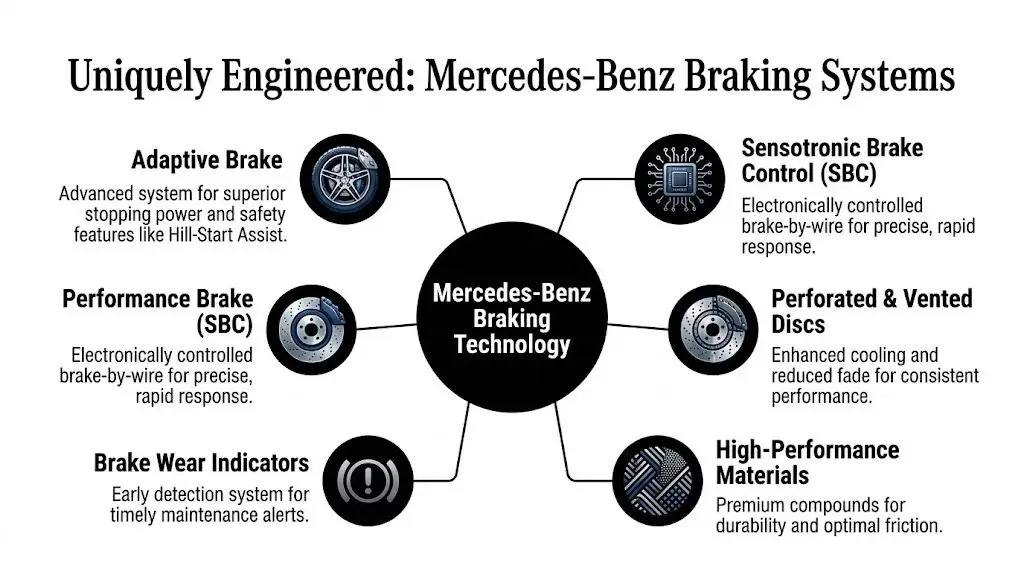
Many Mercedes models use brake wear sensors, electronic parking brake functions, and advanced control modules that have to be considered before a wrench even touches the caliper.
That means the technician isn’t just measuring pad thickness. They’re also confirming whether the vehicle needs a service mode, reset procedure, or electronic reactivation after the mechanical work is complete.
A driver might see a wheel design, trim package, or even a custom Mercedes sticker and think mostly about appearance. Underneath, though, Mercedes braking hardware is engineered around model-specific electronics, pad compounds, and rotor dimensions that can’t be treated like generic parts-bin components.
Sensotronic Brake Control is its own category
Some Mercedes-Benz vehicles use Sensotronic Brake Control (SBC). This system doesn’t behave like a traditional vacuum-boosted setup. According to HELLA’s Mercedes brake repair information, SBC uses an electro-hydraulic design that can generate up to 250 bar of pressure, and the system must be deactivated with diagnostic equipment like XENTRY before service to prevent automatic pressure buildup that can extend caliper pistons and create a safety risk for the technician (HELLA Tech World).
That one fact changes the entire job.
If a shop doesn’t know the vehicle has SBC, or doesn’t have the proper diagnostic workflow, they can create a dangerous condition during routine brake service. After repair, the system also has to be properly reactivated and bled.
Shop-floor reality: On an SBC Mercedes, safe brake service starts with the scan tool, not the impact gun.
Performance expectations are tighter
Mercedes braking systems are also less forgiving of shortcuts. Rotor finish, pad formulation, hardware fit, and sensor handling affect how the car feels when you stop. Customers notice that right away because Mercedes owners are used to a certain pedal response and smoothness.
A repair can be technically “done” and still feel wrong if:
- Pads are the wrong compound: Noise and poor cold bite often follow.
- Rotor surfaces aren’t properly evaluated: Pulsation can return quickly.
- Sensors are reused when they shouldn’t be: Dash warnings may stay on.
- Electronic steps are skipped: Parking brake or warning resets may fail.
Why specialized tools matter
Modern Mercedes brake service often calls for XENTRY or equivalent Mercedes-capable diagnostics, proper caliper retraction methods, brake fluid service equipment, and measurement tools that verify the condition of rotors instead of guessing.
That’s why brake repair for Mercedes Benz isn’t just about replacing worn parts. It’s about restoring the way the system was meant to operate.
The Anatomy of a Typical Mercedes Brake Repair
A Mercedes owner in Richland Hills will often come in with a simple complaint. A light squeal at one stop sign, a soft pedal in traffic on Highway 183, or a warning message that comes and goes. The repair only stays simple if the inspection is done right the first time.
Step one is measurement, not assumption
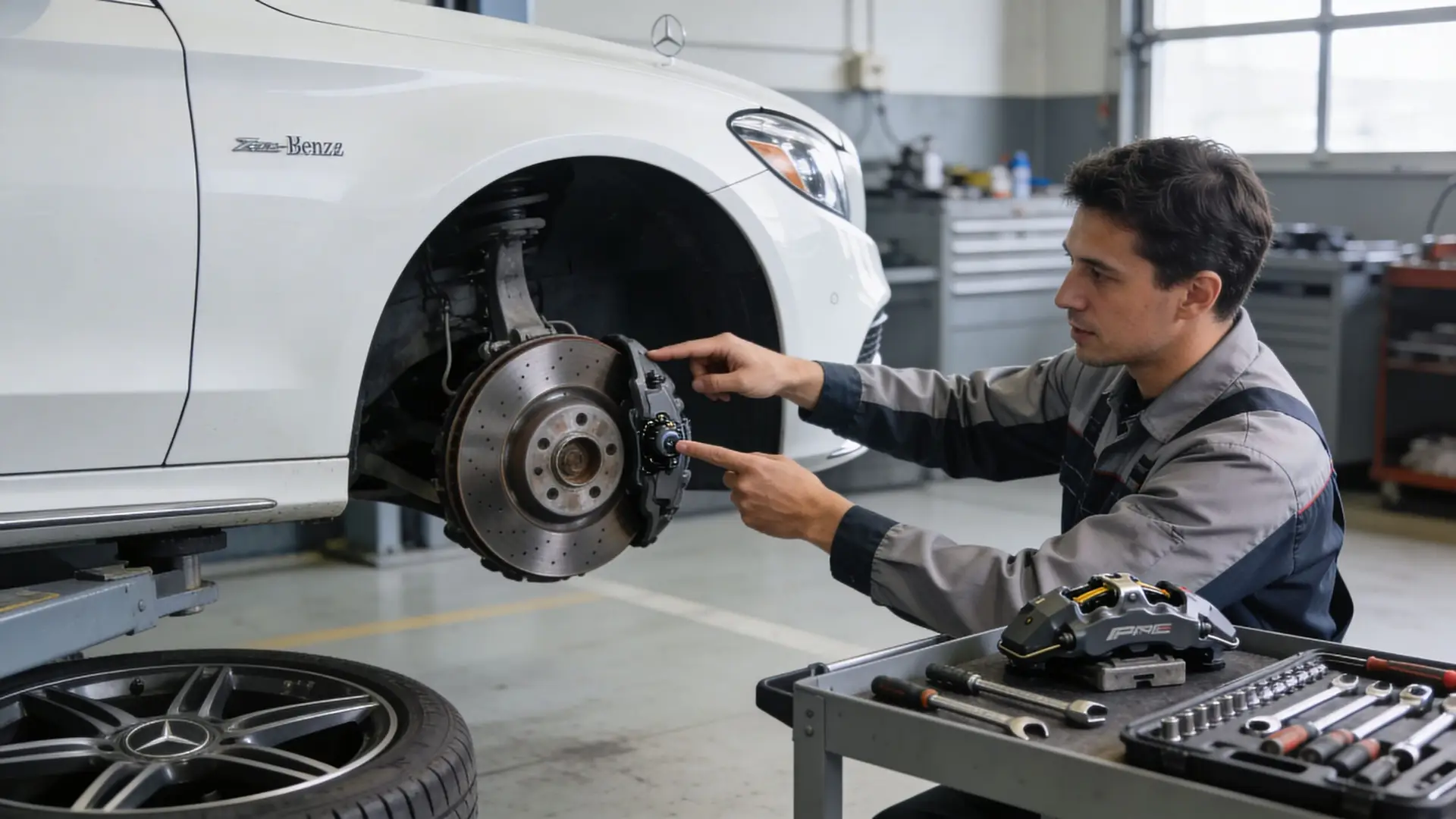
At our level, brake work starts with numbers and condition checks, not a guess based on noise alone. The wheels come off. Pads are measured. Rotors are checked for surface damage, thickness, and lateral runout. Caliper slides, hoses, wear sensors, and brake fluid condition all get inspected before any estimate is finalized.
Mercedes rotors have to meet spec. If runout is excessive or the disc is at or below minimum thickness, the car may brake smoothly one day and pulse the next. Mercedes-Benz service information and brake system references from Brembo explain why rotor thickness and runout measurements matter so much to pedal feel, stopping consistency, and pad life.
That is one reason dealership-level brake service is more about inspection discipline than fancy branding. A neighborhood shop can do this work properly, but only if it measures first and sells parts second.
Common repair paths
A proper inspection usually points to one of four repair plans.
- Pads only: Works when rotor thickness, surface condition, and wear pattern are still within spec.
- Pads and rotors: Common on Mercedes because many owners wait until noise or vibration shows up, and by then the rotors are often no longer good candidates for reuse.
- Brake fluid service with friction work: Makes sense when the fluid tests poor or the pedal feel suggests moisture contamination.
- Caliper or hardware repair: Needed when one side is doing more work than the other, or the pads are dragging.
If you’re comparing recommendations, this guide to brake rotor replacement service explains why rotor condition often decides whether a pad-only job is still a safe option.
Why brake fluid matters more than drivers think
Brake fluid is easy to ignore because you cannot see it wearing out the way you can see a thin pad. It still ages. It absorbs moisture over time, and that lowers its boiling resistance.
According to Bosch brake fluid technical guidance, dry and wet boiling points are a major part of brake fluid performance. In real driving, that matters most during repeated stops, summer heat, heavy traffic, or longer downhill braking where fluid temperature climbs and pedal feel can change fast.
What a careful technician checks before releasing the car
The repair is not finished when the new parts are bolted on. Final checks matter just as much as the install. On a Mercedes, that means confirming pedal feel, warning light status, sensor operation, proper torque, and road-test behavior if conditions are safe.
This walk-through shows the kind of physical wear and service points technicians look for during a brake job.
A clean Mercedes brake repair should leave the driver with:
| Final check | Why it matters |
|---|---|
| Firm, predictable pedal | Confirms the hydraulic side of the system is working correctly |
| No unresolved warning messages | Confirms sensors and reset procedures were handled properly |
| Smooth stopping | Helps catch rotor variation, pad transfer issues, or bedding problems |
| Even braking response | Helps identify a sticking caliper or imbalance before the car leaves |
If a shop cannot clearly explain why your Mercedes needs pads, pads and rotors, fluid service, or caliper work, the diagnosis is incomplete. Richland Hills drivers should expect that explanation before approving the repair.
OEM vs Aftermarket Parts and Typical Repair Costs
A Mercedes owner usually asks the same question at the counter after we confirm the problem. What parts should go on the car, and what is the smart place to spend money?
That question matters because Mercedes brake estimates can look wide even when two shops are addressing the same complaint. The reason is simple. Parts quality, rotor condition, sensor replacement, and electronic reset procedures all change the final number. A neighborhood shop should be able to explain those differences clearly, the same way a dealership should.
OEM parts versus quality aftermarket
OEM parts are made to match the original Mercedes specification for fit, friction behavior, and sensor compatibility. For newer vehicles, drivers who are sensitive to pedal feel, or cars with picky wear sensor systems, OEM is often the safer choice.
Premium aftermarket parts can also be a sound repair. Some brands perform well, control noise properly, and give good service life. The trade-off is consistency. One premium line may work well on a C-Class and be less impressive on a heavier SUV. That is why brand selection matters more on a Mercedes than it does on a basic commuter car.
Low-cost aftermarket parts create the most comebacks. We see more uneven wear, more brake dust, more squeal, and more complaints about the first few stops in the morning. The lower invoice can disappear fast if the car comes back for noise or rough braking.
| Option | Usually works best for | Main trade-off |
|---|---|---|
| OEM Mercedes parts | Drivers who want factory-like braking feel and exact fit | Higher upfront cost |
| Premium aftermarket | Owners balancing cost with reliable day-to-day performance | Quality varies more by brand and application |
| Low-cost aftermarket | Budget repairs where long-term refinement is not the priority | Higher risk of noise, dust, shorter life, or fit issues |
Where costs usually rise
Pads alone are the least expensive version of a brake job, but only if the rotors still measure within spec and the surface condition is good enough to support the new pads. Wait too long, and the repair often grows to include rotors, wear sensors, and sometimes caliper or hardware work.
That is the critical financial decision. Early service gives you more options.
For a broader look at how labor, parts, and inspection findings affect the final invoice, this guide to a Mercedes brake repair cost estimate gives useful local context.
Estimated Mercedes Brake Repair Costs and Times in Richland Hills
Exact repair totals depend on model, axle, part selection, and what the inspection finds. The most defensible way to discuss cost is to separate the known inspection charge from repair categories that vary.
| Brake Service | Estimated Cost Range | Time at Express Lube |
|---|---|---|
| Brake system inspection | $122 to $179 in labor for a 2023 Mercedes-Benz C300 brake system inspection, according to RepairPal's Mercedes-Benz C300 brake system inspection estimate | Often one visit |
| Front or rear pad replacement | Varies by model and part choice | Often same day |
| Pads and rotor replacement | Higher than pad-only service | Often same day |
| Brake fluid exchange | Varies by vehicle and fluid requirements | Often completed during the visit |
| Electronic diagnosis and reset | Varies by system complexity | Depends on fault and model |
The right estimate is the one that shows measurements, explains the part choice, and tells you what can wait versus what should be handled now. That is how Richland Hills drivers get dealership-level brake service without dealership guesswork.
Your Mercedes Brake Service at Express Lube Richland Hills
You pull into the lot after a week of Richland Hills traffic, and the brake pedal feels a little different than it did last month. That is usually how Mercedes brake visits start. Not with a dramatic failure, but with a small change in feel, a warning message, or a noise that shows up when the car is hot.
Mercedes sets brake inspections and fluid service on a regular schedule, and for good reason. These cars are heavy, fast, and sensitive to fluid condition, pad wear, rotor thickness, and electronic brake monitoring. Mercedes-Benz also notes in its maintenance overview that service timing is built around model-specific intervals and required inspections (Mercedes-Benz maintenance information). For local drivers, the practical takeaway is simple. Time and mileage both matter, even if the car still seems to stop normally.
At Express Lube Richland Hills, the goal is to give you the same level of brake care you expect from a dealer, without the vague language or the all-day hassle. A proper Mercedes brake visit should answer three questions clearly. What is worn now, what still measures within spec, and what repair path makes sense for how you drive.
What good service feels like
Good Mercedes brake service starts with measurements and inspection results you can understand.
- You get a clear diagnosis: Pad thickness, rotor condition, fluid condition, sensor status, and any warning-light faults should be explained directly.
- You get real part-choice guidance: OEM parts may be the right call for some drivers. In other cases, a premium aftermarket option can control cost without cutting corners.
- You know what needs attention now: Safety repairs should be separated from items that can be monitored at the next visit.
- You leave with a complete result: The brake warning is addressed properly, the system is checked after the repair, and the car is ready for normal driving.
That transparency matters more on a Mercedes than on many other vehicles. These systems often involve wear sensors, electronic parking brake procedures, and model-specific service steps. If a shop skips those details, the car may still have noise, warning messages, or uneven braking after the invoice is paid.
Why neighborhood convenience matters
Richland Hills drivers do not need dealership pricing or dealership guesswork to get Mercedes brake work done correctly. They need technicians with the right scan tools, the habit of measuring instead of assuming, and the willingness to explain the trade-offs in plain language.
That is the advantage of a trusted local shop. You can ask questions, review the findings, and make a decision based on the condition of your car rather than pressure.
A good Mercedes brake shop fixes the problem and explains why it happened.
If your Mercedes is due by time, mileage, pedal feel, warning light, or brake noise, get it inspected early. Early service often means more repair options, lower parts cost, and less chance of rotor damage or a larger hydraulic problem later.
Mercedes Brake Repair FAQs for Richland Hills Drivers
Does Texas heat shorten brake life
Heat can make brake issues show up sooner, especially with repeated stops and heavier traffic. Fluid condition and rotor condition become more important when the system works harder in hot weather.
Do rotors always need to be replaced with pads
No. A technician should measure them. If the rotors meet specification and the wear pattern is healthy, a pad-only service may be possible. If they’re below spec, heavily scored, or causing pulsation, replacing them is often the better repair.
Can a local shop handle Mercedes electronic brake resets
Yes, if the shop has Mercedes-capable diagnostic equipment and knows the platform. That matters for wear sensors, warning resets, electronic parking brake functions, and systems that require guided procedures.
Is brake fluid service really necessary if the car still stops fine
Yes. Fluid condition affects performance under heat and repeated braking, not just casual daily stops. A car can feel normal in light use and still have fluid that’s no longer protecting the system well.
Is brake repair for Mercedes Benz always expensive
Not always. The expensive repairs usually come after delayed service, especially when worn pads damage rotors or fluid neglect contributes to broader system problems. Early inspection gives you more options.
How do I know if I should stop driving and have it checked now
Have it checked right away if you hear grinding, see a red brake warning, feel a sudden pedal change, or notice braking performance drop sharply. Those symptoms don’t belong on a wait-and-see list.
If your Mercedes doesn’t feel right under braking, let the team at Express Lube & Car Care take a look. You’ll get walk-in convenience, ASE-certified service, clear recommendations, and fair pricing from a local shop that understands both Mercedes systems and Richland Hills driving. Ask about current specials, including military, first responder, healthcare professional, and Ladies Day savings, and stop in for a brake check that helps you drive away with confidence.