

A continuous scraping or metal-on-metal sound while driving usually means worn pads or direct rotor contact, and that calls for an inspection right away. An intermittent high-pitched squeal, especially after rain or on light stops, is often vibration or surface contamination, and you can often clear it up with cleaning, lubrication, or a proper bed-in. If you’d rather skip the guesswork, certified technicians can pinpoint the cause with a digital inspection in one visit.
TL;DR:
- Worn brake pads with metal wear indicators can cause high-pitched squeals that may turn into continuous scraping if ignored.
- Vibration-induced noise is often fixable with cleaning, lubrication, and hardware adjustments rather than part replacement.
- Surface contamination from rust, moisture, or brake dust creates intermittent squeals that typically resolve after driving a few miles.
- Proper bed-in procedures for new pads involve multiple controlled partial stops from highway speeds to ensure even friction layer transfer and quiet operation.
- A thorough brake inspection should include measurements, photos, and hardware checks to diagnose persistent squeal and prevent recurrence.
Table of Contents
- What causes brake squeal: worn parts, vibration, contamination and hardware
- Safe owner checks and DIY fixes to try before a shop visit
- When squeal means you need professional service now
- New pads or rotors squealing: the bed-in procedure and common mistakes
- What a proper shop inspection and repair looks like
- Long-term preventive maintenance strategies to reduce squeal
- Environmental factors influencing brake noise
- Impact of brake design and material composition on squeal
- Technician perspective: why noise often comes back if root causes aren’t addressed
- Express Lube & Car Care: how we diagnose and fix brake squeal
- FAQ
- Sources
What causes brake squeal: worn parts, vibration, contamination and hardware
Most brake noise falls into a few buckets, and figuring out which one applies to your car tells you how urgent the fix really is.
Worn pads are the most serious cause. Many pads have a small metal wear indicator built into the backing plate. Once the friction material wears down, that tab starts touching the rotor and produces a thin, high-pitched squeal, often only when you brake. If you ignore it, the noise can turn into a continuous scrape, even with your foot off the pedal, which Kia’s owner manual notes means the pads have hit minimum thickness and risk damaging the rotor and caliper if you keep driving.
Vibration is a different animal entirely. Brake components can resonate at a frequency your ear picks up as a squeal, even when the pads have plenty of life left. According to Bosch’s troubleshooting guide, this kind of noise is usually fixed by cleaning the contact points and lubricating the sliding hardware rather than replacing parts outright.
Contamination from rust, moisture, or built-up brake dust creates a gritty, intermittent squeal that often disappears once you’ve driven a few miles and the surface clears off. This is especially common after rain or after a car sits overnight.
Hardware failures are an easy one to miss. Seized caliper slide pins, missing anti-rattle clips, or loose caliper bolts let the pad shift slightly against the rotor, and that tiny movement is enough to generate noise.
Finally, rotor condition matters. A glazed surface, uneven pad material transfer, or rotor thickness variation can all cause persistent squeal or vibration you feel through the pedal. If you want a deeper look at what those rotor measurements actually mean, our guide to rotor replacement breaks it down.
Safe owner checks and DIY fixes to try before a shop visit
Before you reach for tools, set up safely: park on level ground, chock the opposite wheel, engage the parking brake, and if you’re removing a wheel, support the car on jack stands rather than a jack alone.
- Inspect pad thickness. Look through the caliper opening and compare the remaining friction material to the metal backing plate; thin, uneven material is a warning sign.
- Check for wear indicators. A small metal tab contacting the rotor is often the source of a thin squeal during braking.
- Examine the rotor surface. Look for shiny glazed spots, grooves, or a blue-tinted discoloration, all signs of heat or uneven contact.
- Look for debris or fluid. Dust buildup, rust flecks, or a greasy sheen near the caliper point to contamination or a leak.
- Clean with brake cleaner and a soft brush, working the spray into the caliper and backing plate. Keep any lubricant off the pad face and rotor surface entirely.
- Lubricate the caliper slide pins and the pad’s metal backing contact points with a brake-specific, high-temperature grease. Never use household lubricants like WD-40 or grease on the friction surfaces themselves.
A light squeal that clears up after cleaning and lubrication is often a temporary fix. Anti-squeal shims or noise-dampening paste can quiet minor vibration, but if the pads are thin, the rotor is glazed, or the noise keeps returning, that’s a sign the real repair is replacement, not another round of cleaning.
Pro Tip: Snap a photo of your pad thickness before and after cleaning. If the squeal returns within a week, that photo helps a technician see whether wear, not vibration, is the real cause.
When squeal means you need professional service now
Some symptoms mean it’s time to stop troubleshooting and get the car looked at.
- Continuous scraping or grinding noise, especially one that persists even when you’re not braking.
- Reduced stopping power, or a pedal that feels soft, long, or inconsistent.
- Pulsation or vibration you feel through the pedal or steering wheel when braking.
- A burning smell or visible smoke near a wheel after driving.
If a high-pitched wear-indicator tone has progressed into a constant scrape, that pad needs to come off now. Kia’s manual and similar manufacturer guidance warn that continuing to drive at that point risks grinding into the rotor and turning a pad replacement into a rotor replacement.
Before your appointment, a little documentation goes a long way. Note which axle the noise seems to come from, front or rear, and whether it happens at low speed, high speed, or only on hard stops. A short video or audio clip on your phone, along with notes on whether it started after rain, helps a technician narrow things down faster. Expect a proper inspection to include pad thickness measurements, rotor thickness and runout checks, a caliper operation test, and a look at the hardware behind the noise. For a refresher on pad wear thresholds, our guide to brake wear signs covers what’s considered normal versus urgent.
New pads or rotors squealing: the bed-in procedure and common mistakes
If you just had pads or rotors installed and they’re squealing, don’t assume something went wrong with the parts. New friction material needs to transfer an even layer onto the rotor surface, and that even transfer is what prevents vibration. Skip it, and you get exactly the kind of uneven contact that causes noise.
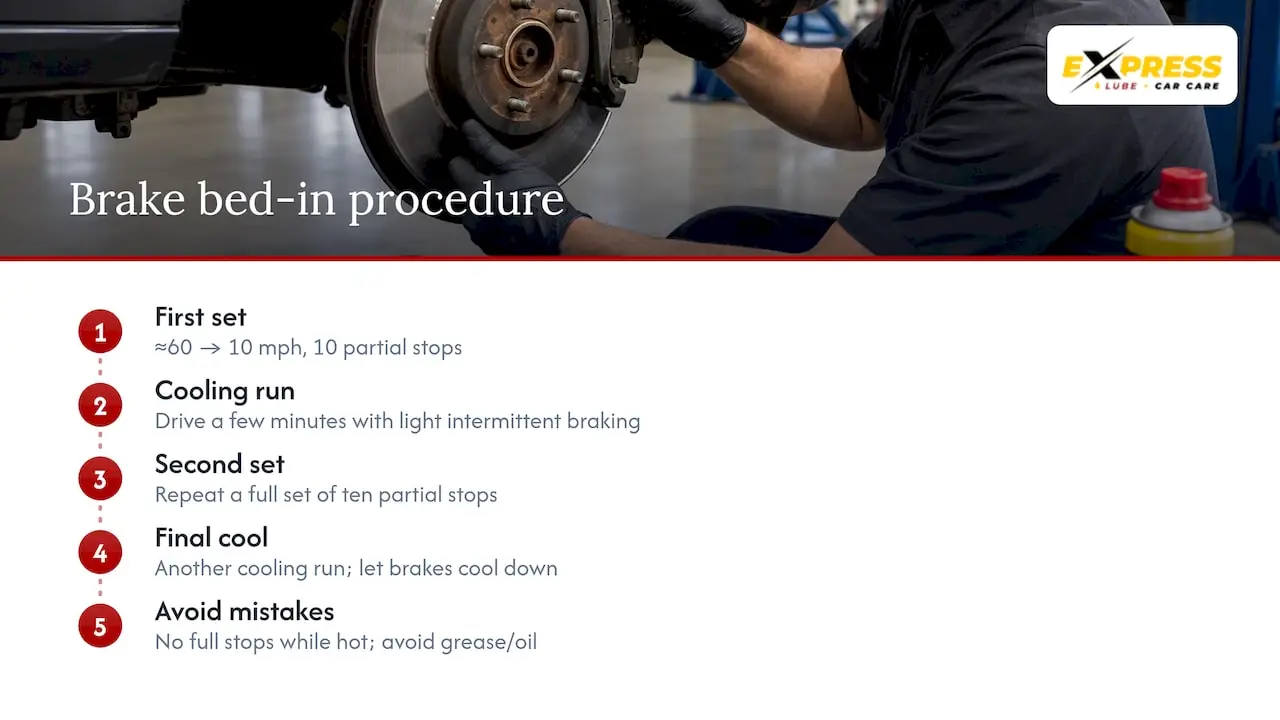
A typical street bed-in, as described by Centric Parts’ StopTech bulletin, involves multiple controlled partial stops from highway speed down to low speed without coming to a complete stop, repeated several times to ensure even pad transfer.
3. Drive a few minutes with light, intermittent braking to let the brakes cool between sets.
4. Repeat a second full set of ten partial stops, followed by another cooling period.
5. Avoid coming to a complete stop and holding the brake pedal while the system is still hot.
A proper bed-in uses two full sets of ten partial stops from roughly 60 mph down to 10 mph, with cooling runs in between and no hard stops while the brakes are hot, according to Centric’s bed-in procedure. Skip a set, or stop and hold the pedal while things are hot, and you risk uneven pad transfer and the squeal you were trying to avoid.
Other common mistakes: touching the new pad surface with greasy hands, letting oil or coolant drip onto the rotor during installation, or assuming a quick five-minute drive counts as a full bed-in. If a rotor has thickness variation or hard spots that bed-in alone won’t fix, a shop may need to machine or replace it rather than just repeating the procedure.
What a proper shop inspection and repair looks like
A trustworthy brake inspection should leave you with more than a verbal “it’s fine.” A thorough brake visit should include a digital inspection with timestamped photos of pad thickness, rotor condition, and hardware wear, so you can see exactly what the technician saw rather than taking their word for it.
- We measure remaining pad thickness and compare it against replacement thresholds.
- We check rotor thickness and runout to decide between cleaning, machining, or replacement.
- We test caliper slide operation and inspect clips, shims, and mounting hardware.
- We document everything with photos before recommending any repair.
Pro Tip: Before you approve brake work anywhere, ask to see the actual measurements and photos, not just a recommendation. A shop that documents pad and rotor readings is giving you the same information an ASE-certified technician uses to decide between a cleaning, a repair, or a replacement.
Every qualifying repair is backed by a substantial warranty, so if hardware or a bed-in issue causes a repeat squeal, coverage is provided.

Long-term preventive maintenance strategies to reduce squeal
Brake noise is easier to prevent than to chase down after the fact. A few habits go a long way toward keeping squeal from becoming a recurring complaint.
Get your brakes inspected at regular service intervals rather than waiting for a noise to show up. Pad wear is gradual, and catching it early means a simple pad swap instead of a rotor replacement. Our guide to brake pad replacement intervals walks through how often that inspection should happen for typical driving.
Have caliper slide pins cleaned and re-lubricated periodically, especially if you drive in wet or salty conditions that accelerate corrosion. A seized pin is a slow-building problem that often goes unnoticed until it starts making noise.
Avoid letting the car sit for long stretches without driving, particularly in humid climates. Surface rust on rotors builds up fast during inactivity, and while it usually clears after a few stops, repeated rust cycles can contribute to uneven pad transfer over time.
If you’ve had pads or rotors replaced recently, follow through on a proper bed-in rather than skipping it because the car “feels fine.” A rushed bed-in is one of the most common reasons squeal shows up again a few weeks after a repair.
Finally, choose quality replacement parts rather than the cheapest option available. Pad composition affects how a brake system behaves under heat and vibration, and mismatched or low-grade friction material is more prone to noise regardless of how carefully it’s installed.
Environmental factors influencing brake noise
Temperature and humidity both play a role in when and how brake squeal shows up, and understanding that pattern can save you an unnecessary worry.
Cold mornings are a classic trigger. Overnight humidity settles a thin layer of surface rust or condensation onto the rotor, and the first few stops of the day often produce a noticeable squeal or grinding sound as that layer wears off. This is usually harmless and should clear within a few stops once the rotor surface is clean again.
Rain and wet roads create a similar effect, but more persistently. Water on the rotor combines with road grit and brake dust to produce a gritty, intermittent noise that can last longer than the quick morning rust squeal, particularly if you’re driving through standing water repeatedly.
High heat has the opposite effect in some ways. Extended hard braking, like repeated mountain descents or heavy stop-and-go traffic in summer, can glaze the pad and rotor surface, leaving a smooth, hardened layer that resists proper friction and tends to squeal under light braking afterward.
Humid climates also accelerate hardware corrosion, which means caliper slide pins and clips are more likely to seize or bind over time, contributing to the kind of hardware-related noise covered earlier in this guide. If you notice your brakes squeal more in certain seasons than others, that pattern itself is a useful clue for whatever technician takes a look.
Impact of brake design and material composition on squeal
Not all brake pads are built the same, and the material composition has a direct effect on how prone a system is to noise.
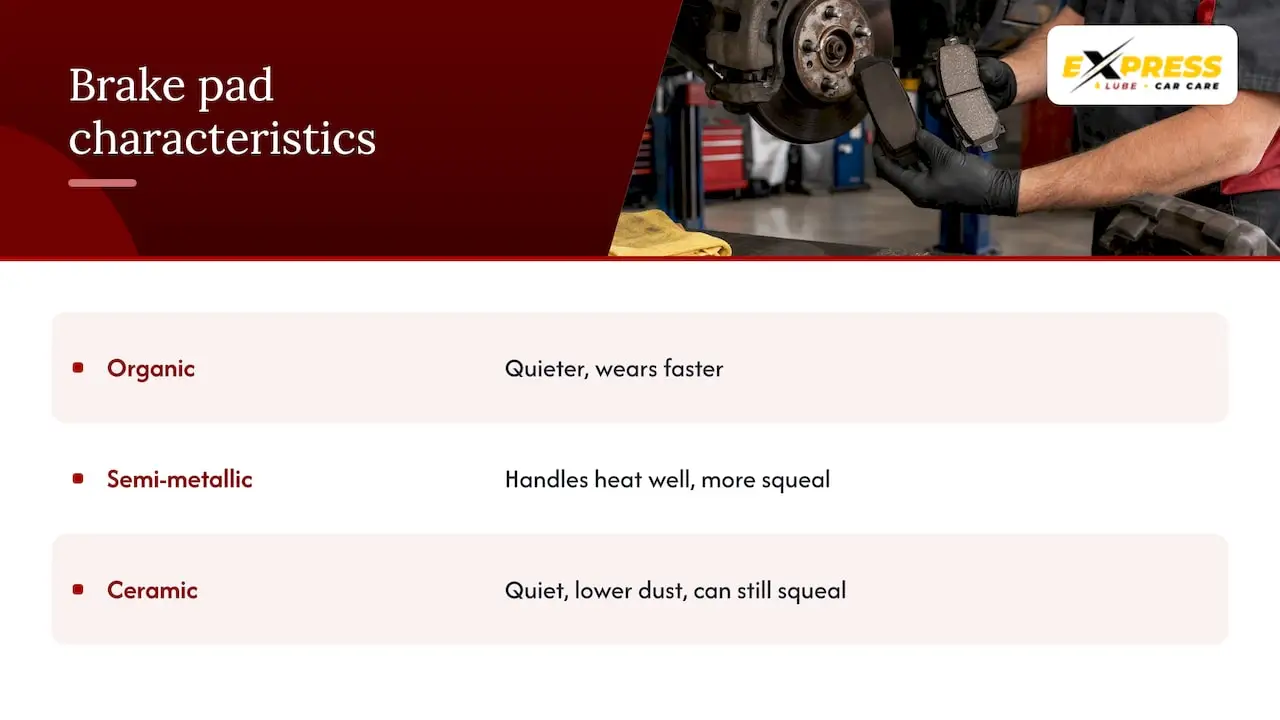
Pads generally fall into a few categories: organic, ceramic, and semi-metallic. Organic pads tend to run quieter but wear faster. Semi-metallic pads handle heat well and are common on trucks and SUVs, but their metal content makes them more prone to vibration-driven squeal, especially at low speeds. Ceramic pads are popular for their quiet operation and lower dust, though they’re not immune to noise if they’re poorly bedded-in or installed with worn hardware.
Rotor design matters too. Vented rotors dissipate heat better than solid rotors, which helps reduce the glazing that contributes to squeal under repeated hard braking. Slotted or drilled rotors, common on performance-oriented vehicles, can behave differently under vibration than a standard smooth rotor, and that’s part of why a parts mismatch, such as pairing aggressive pads with a rotor they weren’t designed for, sometimes shows up as persistent noise that a basic cleaning won’t fix.
Because brake squeal involves complex vibration physics, including the stick-slip motion and mode coupling that happens between the pad and rotor, there’s rarely a single universal fix. Diagnosing a stubborn case sometimes calls for more than a visual check. If your vehicle recently had sensor or camera work done near the wheels as part of a larger repair, it’s also worth asking whether any ADAS calibration needs verification, since brake-related repairs on vehicles with advanced driver assistance features can affect sensor alignment.
Technician perspective: why noise often comes back if root causes aren’t addressed
New pads that squeal are rarely defective. A dry slide pin or uneven pad transfer on the old rotor can make even premium pads noisy within days. Replacing pads without addressing hardware or rotor condition is one of the most common reasons squeal returns. Insist on documented measurements and photos, not just a part swap.
— Express Lube & Car Care
Express Lube & Car Care: how we diagnose and fix brake squeal
Brake squeal diagnosis should include measuring pad thickness and rotor condition, photographing findings, and showing results before recommending a repair. That means no guesswork and no surprise charges once work begins.
- Full brake inspection covering pads, rotors, calipers, and hardware
- Pad and rotor replacement using quality parts, backed by a substantial warranty
- Digital inspection report with photos so you can see exactly what needs attention
- Walk-ins welcome, with same-day service available when possible
Check our current brake service savings or head straight to our brake repair page in Richland Hills to see the full scope of what we handle. Ready to get that noise checked out? Call us at (817) 284-8478 or schedule your visit online today.
FAQ
How do I get my brake to stop squeaking?
Clean the caliper and backing plate with brake cleaner, then lubricate the slide pins and pad contact points with brake-specific high-temperature grease, keeping any lubricant off the pad face and rotor. If the squeal continues or the pads are thin, replacement rather than cleaning is the right fix.
Why do my brakes squeak but pads are good?
This is usually vibration or surface contamination rather than wear. Resonant vibration between the pad and rotor, or rust and moisture on the rotor surface, can cause a high-pitched squeal even when plenty of friction material remains, according to Bosch’s troubleshooting guidance.
Is it bad to drive with squealing brakes?
A brief, intermittent squeal after rain or on light stops usually isn’t urgent, but a continuous scraping or grinding noise means the pads may have reached minimum thickness and need immediate attention. Continuing to drive once you hear constant scraping risks damaging the rotor and caliper.
Can you spray WD-40 on brakes to stop squeaking?
No. Household lubricants like WD-40 should never touch the pad or rotor surface, since contaminating the friction material reduces braking performance and often requires replacing the affected parts. Only a brake-specific, high-temperature grease belongs on caliper slide pins and pad backing contact points.
Sources
- Disc brakes wear indicator — Kia owner manual
- StopTech recommended procedure for bedding-in stock-sized brake systems — Centric Parts
- Brake disc troubleshooting guide — Bosch Aftermarket