

The EPC light means your Volkswagen’s Electronic Power Control system found a fault somewhere in the throttle, brake switch, or sensor chain. If the car still drives normally, get it to a shop soon for a scan. If you’re in limp mode, smell something burning, or the check engine light is flashing, stop driving and arrange a tow. Most causes are relatively inexpensive, but you need a proper diagnosis to know which one you’ve got.
TL;DR:
- The most common cause of an EPC light is a faulty brake light switch, which is often a cheap, easy replacement.
- Loose or corroded connectors at the throttle body, pedal sensor, or ABS module can trigger the EPC light temporarily without indicating a serious problem.
- Carbon buildup on the throttle plate in direct-injection engines often causes false EPC alerts that can be fixed with a professional cleaning and reset.
- Driving with a steady EPC light is usually safe if the car accelerates normally, but immediate towing is necessary if limp mode, flashing warning lights, or smells of burning occur.
- Proper diagnosis with VW-specific tools is essential, as generic scanners can miss critical manufacturer-specific codes that determine the actual fault and repair costs.
Table of Contents
- What Does the VW EPC Light Actually Mean?
- What Are the Most Common Causes of a VW EPC Light?
- Is It Safe to Drive With the EPC Light On?
- Quick DIY Checks Before You Call a Shop
- What Happens During a Professional EPC Diagnosis?
- How Much Does It Cost to Fix a VW EPC Light?
- How Can You Prevent EPC Light Problems?
- Why VW Owners in Richland Hills Trust Our EPC Diagnostics
- A Shop’s-Eye View on VW EPC Lights
- Get Your VW’s EPC Light Checked the Right Way
- Sources
- FAQ
What Does the VW EPC Light Actually Mean?
EPC stands for Electronic Power Control, and it covers the drive-by-wire system that connects your gas pedal to the engine. There’s no cable anymore. When you press the pedal, a sensor sends a signal to the ECM (engine control module), which then tells an electronic throttle motor how far to open. The EPC light comes on when that chain reports something isn’t right.
That’s a different job than the check engine light. Check engine mostly flags emissions and combustion issues. EPC is about driveability and safety systems, including the brake light switch and inputs from the ABS and stability control. When the fault is serious enough, the ECM pulls the car into limp mode, capping power and RPMs so you can’t do damage or lose control. You’ll notice it immediately: the car feels sluggish, acceleration flattens out, and sometimes the transmission won’t shift normally.
What Are the Most Common Causes of a VW EPC Light?
Most EPC triggers trace back to a handful of usual suspects, and they range from a $20 part to something that needs real diagnostic time.
- Brake light switch failure. This tiny switch behind the brake pedal wears out or shifts out of position over time, and it’s widely reported as the single most common EPC trigger, with replacement parts typically running $15 to $50.
- Loose or corroded connectors. A connector at the throttle body, pedal sensor, or ABS module that’s vibrated loose can throw an EPC code that disappears the moment it’s reseated.
- Throttle body carbon buildup. Direct-injection TSI engines accumulate carbon on the throttle plate, which throws off the position readings the ECM relies on.
- Accelerator pedal sensor faults. These sensors drift or fail outright, sending inconsistent signals that the ECM flags as unsafe.
- Wheel speed or ABS sensor issues. Because EPC ties into stability control, a failing wheel speed sensor can pull the light on even though the throttle system is fine.
- Ignition or misfire-related faults. Chronic misfires sometimes cascade into an EPC warning alongside the check engine light.
- ECM faults. Rare, but possible, especially on higher-mileage vehicles with a history of electrical work.
Is It Safe to Drive With the EPC Light On?
It depends entirely on how the car is behaving, not just whether the light is lit.
If the EPC light is on steady, the car accelerates normally, and nothing else feels wrong, you can usually make a careful, short drive to a shop. Avoid hard acceleration and highway merges if you can route around them.
Stop driving and arrange a tow if you notice limp mode (the car won’t go past low RPM or a few miles per hour), a flashing check engine light, a burning smell, or any brake pedal weirdness. A flashing malfunction indicator light points to an active misfire, and combined with EPC and shaking, that’s a drivability emergency that can damage the catalytic converter if you keep driving on it.
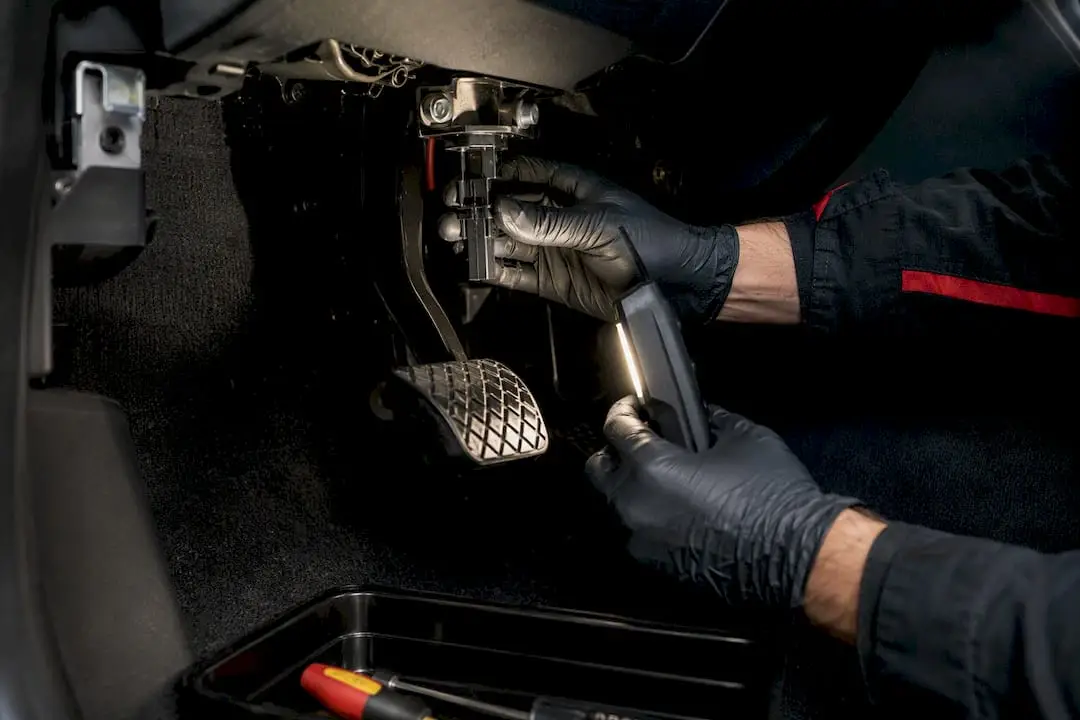
Two quieter effects worth knowing: EPC often disables cruise control automatically, and it can interfere with how brake light signals reach the ABS module. Also, a weak or dying battery frequently throws “ghost” EPC codes that have nothing to do with the throttle system at all, which is one more reason not to assume the worst before checking.
Quick DIY Checks Before You Call a Shop
You can rule out the cheapest causes yourself in about ten minutes, and it might save you a diagnostic fee altogether.
- Test the brake lights. Have someone stand behind the car while you press the brake pedal. If the lights don’t respond consistently, or the light stays on when you take your foot off, the brake light switch is a strong suspect.
- Check the pedal for a “click.” The brake light switch also controls a subtle click you should feel when pressing the pedal. A missing or mushy click points the same direction.
- Check your battery voltage. A multimeter reading below roughly 12.4 volts at rest suggests a weak battery that could be triggering false codes. Clean any corrosion off the terminals while you’re there.
- Look for loose connectors. Pop the hood and visually inspect the connectors at the throttle body and near the brake pedal assembly for anything that looks disconnected or corroded.
- Run an OBD-II scan if you have access to one. A basic scanner reads standard codes, but Volkswagen vehicles often log manufacturer-specific entries that generic tools simply don’t display, so treat a clean generic scan with some skepticism.
Pro Tip: A restart can clear a one-time glitch, especially after a battery hiccup, but if the EPC light comes back within a mile or two, treat that as confirmation of a real fault, not a fluke.
What Happens During a Professional EPC Diagnosis?
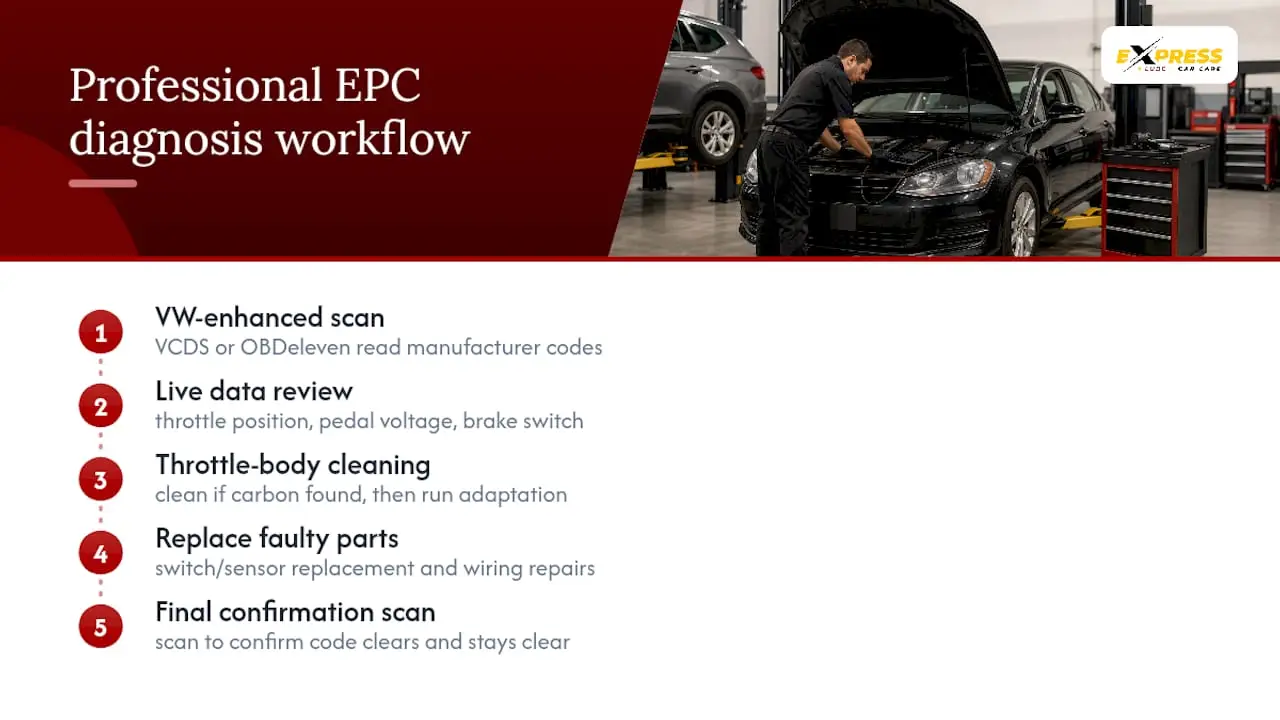
A proper diagnosis starts with a full scan using VW-enhanced tools like VCDS or OBDeleven, which read manufacturer-specific codes and live sensor data that generic readers miss entirely. That live data shows the throttle position, pedal sensor voltage, and brake switch status in real time, which narrows the cause fast.
If carbon buildup is the culprit, a technician cleans the throttle body and then runs a throttle adaptation, sometimes called a basic settings reset, through the VW-specific tool. Skipping that step after cleaning or replacing a throttle body is a common reason EPC lights come right back. Some shops jump straight to quoting a full throttle body replacement without scanning first, and that’s often the wrong first move. A targeted scan frequently turns up something far cheaper. If the switch or sensor is the confirmed fault, replacement and wiring repairs come next, with a final scan to confirm the code clears and stays clear.
How Much Does It Cost to Fix a VW EPC Light?
Costs swing widely because the causes range from a five-minute part swap to a real teardown.
- Brake light switch replacement: parts run roughly $15 to $50, with quick labor since it’s a simple swap.
- Throttle body cleaning: takes about 30 to 60 minutes and often costs $50 to $250, plus the adaptation reset.
- Throttle body replacement: OEM parts run $300 to $700; aftermarket units are usually $150 to $300.
- Sensor or wheel speed repairs: vary by which sensor and location, but generally fall in the low-to-mid range once diagnosed.
- Intake manifold or turbo actuator faults: among the more expensive EPC-related repairs, sometimes exceeding $1,000.
Ask for a diagnostic scan fee up front, and factor in that adaptation labor sometimes adds time beyond the physical repair itself.
How Can You Prevent EPC Light Problems?
A few habits cut down how often this light shows up at all. Get your battery load-tested at every oil change interval, especially once it’s three years old, since a weak battery is a frequent trigger for false EPC codes. Direct-injection engines benefit from periodic throttle cleaning every so often, paired with an adaptation reset so the ECM relearns the clean baseline. Staying current on ignition coils and spark plugs prevents the kind of chronic misfires that sometimes drag EPC along with the check engine light. It’s also worth asking your shop to check connectors at the throttle body, pedal assembly, and brake switch during a digital vehicle inspection, since loose connections rarely announce themselves until they fail.
Why VW Owners in Richland Hills Trust Our EPC Diagnostics
Our ASE-certified technicians run VW-capable diagnostic workflows built around tools like VCDS and OBDeleven, so we’re reading the same manufacturer-specific data your dealer would see, not just generic codes. Every EPC visit includes a digital vehicle inspection with photos, so you can see exactly what triggered the light before you approve any repair. Covered repairs carry our 24-month/24,000-mile warranty, and since we run a walk-in shop, most EPC diagnostics and minor fixes get handled the same day.
A Shop’s-Eye View on VW EPC Lights
The mistake we see most often is a throttle body getting replaced before anyone bothers to scan for the actual fault. Running a VW-specific scan first reveals that often the fix is a brake light switch or a connector that just needed reseating, rather than an expensive part. Transparent diagnostics protect your wallet more than any single repair skill does.
Get Your VW’s EPC Light Checked the Right Way
Skip the guesswork and the inflated parts quote. Express Lube & Car Care runs a full diagnostic scan, checks the brake light switch, cleans and adapts the throttle body when that’s the actual cause, and traces electrical faults with the same VW-specific tools a dealer uses.
Every EPC repair is backed by our 24-month/24,000-mile warranty, performed by ASE-certified technicians, and documented with a digital inspection so you see exactly what needed fixing. Walk-ins are welcome, and if the diagnosis turns up more than a quick fix, easy financing is available. Ready to get that EPC light sorted out? Schedule your appointment online or call us at (817) 284-8478.
Sources
For deeper reading on VW-specific diagnostic codes and driving safety with an EPC light, see the guides from Steer and Drivers Advice. For related engine warning guidance, visit our check engine light diagnostics page.
- EPC Light Volkswagen: What It Means & How to Fix It – Steer
- VW EPC Light, Shaking, and Loss of Power: What It Usually Means – Drivers Advice
- VW EPC Light On: What It Means and How to Fix It – Daily Car Tips
FAQ
What Causes the EPC Light to Come On in a VW?
The most common cause is a failing brake light switch, followed by throttle body carbon buildup, a faulty accelerator pedal sensor, or a weak battery throwing false codes.
Can I Drive My Volkswagen With the EPC Light On?
Yes, if the car drives normally and the light is steady, a careful drive to a shop is fine, but stop immediately if you notice limp mode, a flashing check engine light, or a burning smell.
How Do I Fix My VW EPC Problem?
Start by testing the brake lights and checking battery voltage, then get a VW-specific scan since generic OBD-II readers often miss the manufacturer codes that point to the real cause.
Does the EPC Light Mean the Same Thing as the Check Engine Light?
No. The check engine light mostly flags emissions and combustion issues, while EPC covers the throttle, pedal sensor, and brake switch inputs that control drive-by-wire acceleration.