

A Sprinter problem rarely shows up at a convenient time. It starts with a warning light on the way to a delivery route, a sudden drop in power pulling onto Highway 121, or a van that shifts hard when the day’s schedule is already packed. For owner-operators and fleet managers in Richland Hills, that’s not a minor inconvenience. It’s lost time, missed jobs, and a repair decision that has to be made fast.
Mercedes-Benz built the Sprinter to work, but it’s still a complex commercial vehicle. It has tight service requirements, emissions systems that don’t tolerate neglect, and diagnostics that can fool shops that treat it like a generic van. The average annual maintenance and repair cost for a Mercedes-Benz Sprinter 2500 is $1,778, which is well above the average across Mercedes-Benz models, and severe repairs carry a 13% probability according to RepairPal’s Sprinter 2500 ownership data. That doesn’t mean every Sprinter is a money pit. It means guessing is expensive.
Owners around Northeast Tarrant County usually need three things: a clear explanation, a realistic repair path, and a shop process that doesn’t waste a day before the vehicle even gets looked at. Good mercedes benz sprinter repair comes down to catching patterns early, using the right diagnostic approach, and knowing where the van’s weak points usually show up first.
Your Essential Guide to Mercedes Sprinter Repair in Richland Hills
In Richland Hills, Sprinters do hard duty. They haul tools, packages, service crews, mobile inventory, and in some cases a family or a full camper build. That mix matters because the same van platform gets used in very different ways, and the repair pattern changes with it. A delivery van that idles all day in town won’t stress the same systems the same way a highway-run cargo van or an RV conversion will.
The calls usually sound familiar. “The check engine light came on and now it won’t accelerate.” “It says something about DEF.” “It drove fine yesterday, but now it’s shifting rough.” Those aren’t cosmetic complaints. On a Sprinter, they often point to systems that are tied together. A fuel filtration issue can show up like a drivability complaint. An emissions fault can turn into limp mode. A skipped service can come back later as a much larger bill.
What helps most is approaching the van like a working asset, not just a passenger vehicle.
Shop-floor truth: The fastest repair usually starts with the best information. Mileage, last service, fuel system history, warning messages, and when the symptom started all help narrow the problem before parts get wasted.
Richland Hills owners also have to weigh local realities. If the van is booked all week, a long dealership queue may not fit the job. If it’s an older Sprinter, the smart move may be targeted maintenance and diagnostics instead of replacing every suspect component. The goal isn’t to chase perfection. The goal is dependable uptime, safe operation, and repair decisions that make financial sense.
Identifying Common Sprinter Repair Issues
A Sprinter can leave the route in a hurry. One warning for DEF, a sudden loss of power on Highway 183, or a rough 2-3 shift pulling away from a stop in Richland Hills is often enough to turn a workday into a tow bill, missed deliveries, and a scramble to reschedule jobs.
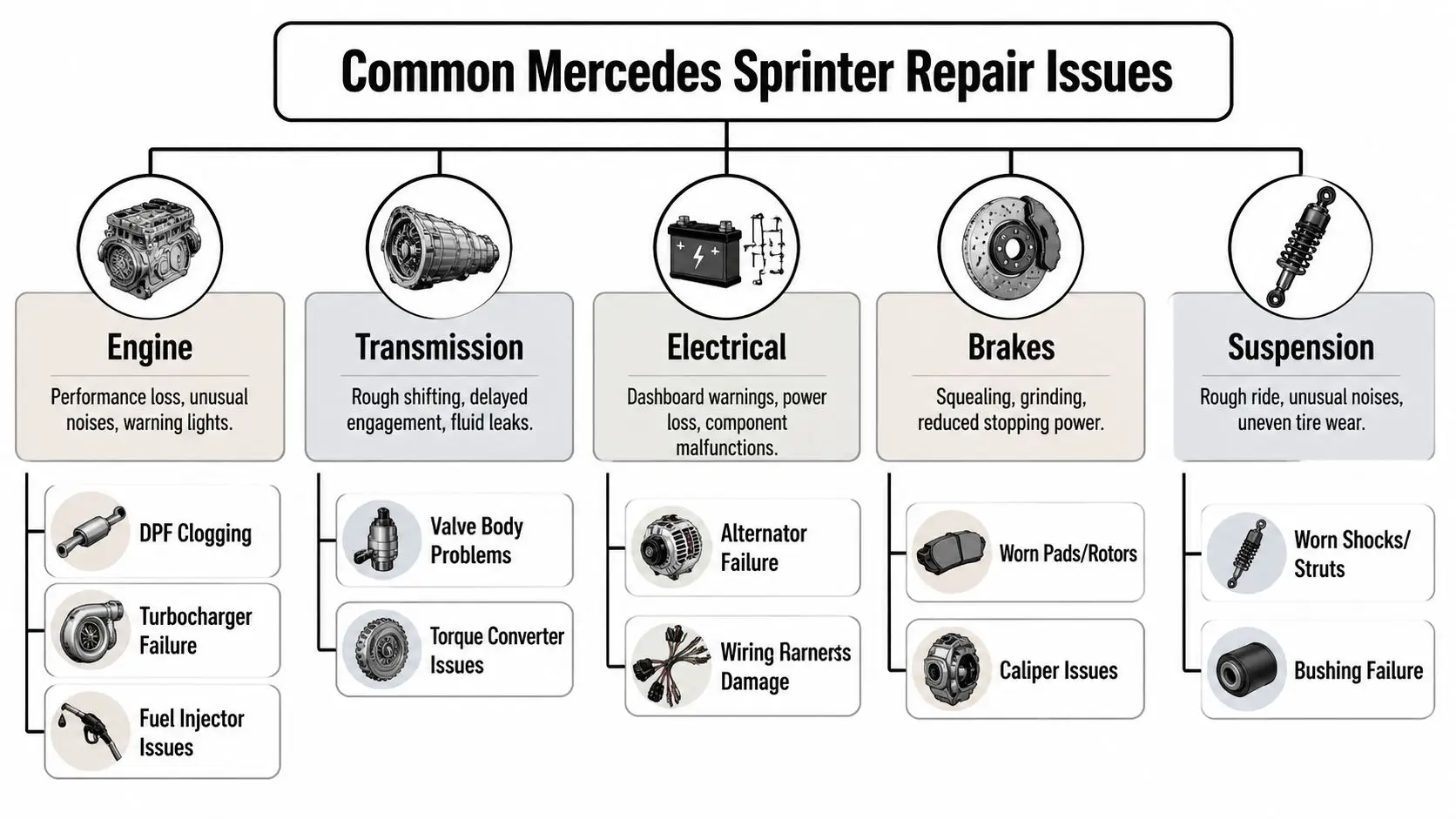
The pattern is usually the same. A few systems cause most of the expensive downtime, and the early warning signs are easy to dismiss until the van limits power or becomes unsafe to drive. At an independent shop like Express Lube, the job is to sort out which fault is primary, which ones are side effects, and which repairs are worth doing now versus planning for later.
Emissions faults that trigger limp mode
On many Sprinters, the first major trouble spot is the emissions system. As noted earlier by Rolf’s Import common Sprinter repair issues overview, DEF-related faults show up often and can push the van into limp mode.
That usually starts with a failed sensor, contaminated or poor-quality DEF, a dosing problem, or a restriction that prevents the system from working as designed. The driver sees a message on the dash first. Then come reduced power, poor throttle response, and in some cases a restart countdown that puts real pressure on the schedule.
EGR and DPF faults are tied into the same chain. The EGR system routes exhaust back into the engine to control combustion temperatures and emissions. The DPF traps soot and burns it off during regeneration. Short-trip use, long idle time, injector issues, boost leaks, and overdue maintenance can all interfere with that process.
Common signs include:
- Power loss under load: The van struggles on hills or feels capped at a lower power level.
- Repeat warning lights: Clearing codes without fixing the cause usually brings the same problem back.
- Failed or incomplete regeneration: Soot load builds until exhaust restriction starts affecting drivability.
- Poor response in traffic: Hesitation and lazy acceleration often show up before a complete no-go condition.
For local owners, this matters because usage around Richland Hills often works against the system. A van that spends the day idling at stops or making short city runs has a harder time completing normal regeneration than one that sees steady highway miles.
Transmission complaints that get expensive fast
Transmission problems usually give warning before they turn into a major repair. The signs are familiar in the shop. Hard shifts when cold, delayed engagement into drive or reverse, slipping under load, or a flare between gears when the van is full.
Those symptoms deserve quick diagnosis, not guesswork. Sometimes the issue is fluid condition, adaptation values, conductor plate or valve body behavior, or related electrical faults. Sometimes internal wear is already underway. The trade-off is simple. Catch it early and the repair may stay targeted. Keep driving it for weeks and heat damage can spread through the unit.
| Symptom | What it may point to | Why waiting hurts |
|---|---|---|
| Hard shifting | Fluid condition issues, adaptation problems, or internal wear | Extra heat and shock load wear parts faster |
| Delayed engagement | Hydraulic pressure loss or valve body faults | Each drive cycle increases clutch and seal stress |
| Slipping | Clutch pack wear or degraded fluid | Slip creates more heat and can turn a repair into a rebuild |
For fleet managers, this is one of the biggest dealership-versus-independent decisions. If the van still moves, a fast local inspection with transparent pricing can save days of downtime compared with waiting in a dealer queue.
Engine and fuel system problems that imitate other faults
Sprinter fuel and air problems often look like something else. Low rail pressure can feel like a turbo issue. A restricted fuel filter can act like an emissions fault. A boost leak can send the van into reduced power and leave the driver convinced the transmission is slipping.
Good diagnosis matters more than parts volume. We look at live data, fault history, fuel filter service, rail pressure behavior, charge-air leaks, and injector balance before recommending expensive components. That approach saves money and avoids replacing parts that were never the cause.
Service records help here too. If a recently purchased van has missing history, assumptions get expensive fast. verifying service history helps owners catch skipped fuel filter changes, overdue transmission service, and repeat emissions repairs before they become their problem.
A Sprinter that feels weak usually has a system-level fault behind it. The symptom is low power. The cause may be fuel delivery, boost control, exhaust restriction, or electronics.
Brakes, shocks, and wear items that still cost uptime
Plenty of Sprinter visits have nothing to do with DEF or turbo plumbing. Weight, cargo distribution, stop-and-go use, and rough pavement wear out brakes, shocks, steering parts, and tires faster than some owners expect.
Rear shocks are a common example, especially on loaded cargo vans and camper conversions. Worn shocks increase bounce, reduce control over broken pavement, and add stress to other suspension parts. Brake issues follow the same pattern. A slight pulsation, longer stopping distance, or uneven pad wear may not stop the route today, but it can easily take the van out of service tomorrow.
These repairs are usually more manageable than major diesel faults, but they still deserve attention. At a local shop, they are also easier to price clearly and handle on a walk-in basis, which matters when the goal is getting the van back on the road without turning a routine chassis repair into an all-week delay.
The Mercedes Sprinter Maintenance Schedule to Prevent Problems
Preventive service is where Sprinter ownership gets cheaper, calmer, and more predictable. These vans use a Flexible Service System, or FSS, that calls for Service A and Service B at intervals of 10,000 to 20,000 miles. Service A includes a synthetic oil and filter change. Service B adds a brake fluid change, cabin filter, and engine air filter. Sticking to that schedule can cut downtime by 40% according to Knauz Continental Autos’ Sprinter service schedule summary.
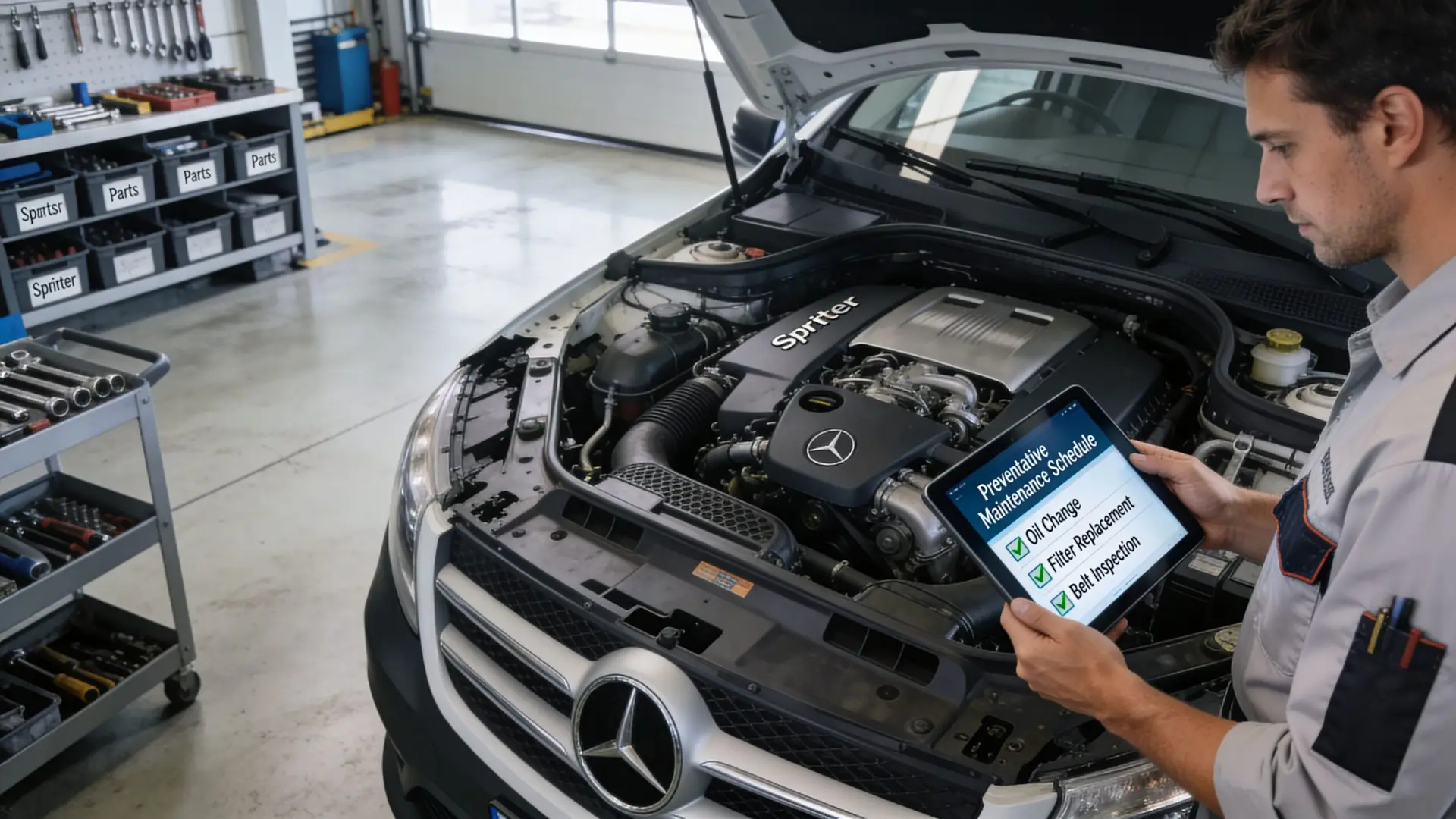
Why Service A matters more than it sounds
A lot of owners hear “oil service” and think basic maintenance. On a Sprinter, it’s more than that. The engine depends on the correct Mercedes-Benz oil spec, the right filter, and a clean service reset. If the wrong oil goes in, the problem isn’t immediate drama. It’s accelerated wear in systems that are expensive to replace later.
Service A is also a chance to inspect the van before a small issue gets buried under work miles. Tire condition, leaks, filter condition, and warning history all matter more on a commercial van than on a lightly used commuter car. If a van is loaded daily, every missed inspection gives wear a bigger head start.
What Service B prevents
Service B is where owners often save themselves from avoidable repairs. Brake fluid service protects hydraulic components. Fresh filters support airflow and cabin function. The broader inspection catches things that don’t always show up as a dashboard warning.
Some of the practical benefits are straightforward:
- Brake fluid renewal: This helps protect hydraulic parts from internal corrosion and keeps pedal feel more consistent.
- Engine air filter service: Clean airflow supports combustion and keeps restriction from adding stress elsewhere.
- Cabin filter replacement: This won’t save the engine, but it does improve HVAC performance and driver comfort on long routes.
- Inspection time: This is often when techs catch seepage, wear, and loose or aging components before the van comes in on a tow truck.
Maintenance only works if the history is real
A common problem with used Sprinters is incomplete records. Owners buy the van because it looks clean, then discover the service history is thin or missing. That matters because a skipped transmission service or poor oil history can change the repair risk right away. If you’re buying a used work van or taking over a fleet unit, verifying service history is one of the smartest early checks you can make.
Practical rule: If the records are unclear, build your own baseline. Fluids, filters, brake inspection, and a full once-over cost less than assuming the previous owner stayed on schedule.
The best maintenance plan is the one that matches the van’s real use. A Sprinter that idles through city routes needs a different level of attention than one that stretches its legs on highway miles. The onboard reminder system helps, but good maintenance decisions still depend on driving pattern, load, and whether the van has already shown weakness in emissions, fuel, or transmission behavior.
Diagnosing Sprinter Problems Before They Escalate
When a Sprinter starts acting up, the first step isn’t ordering parts. It’s getting a clean diagnosis. These vans generate fault information, but reading a code and understanding the actual failure are two different jobs.

What the warning lights are really telling you
The check engine light is the obvious one, but Sprinters also throw warning messages tied to DEF, glow plug operation, and other control systems. Owners often make one of two mistakes. They either ignore the light because the van still runs, or they panic and replace the first part that sounds related.
Neither approach works well.
A warning light on a Sprinter usually means the system has already seen a problem pattern, not just a one-time glitch. The job is to determine whether the issue is active, stored, recurring, or caused by something upstream. A DEF warning might be fluid quality, injector flow, sensor data, or a control issue. A glow plug code might be the plug itself, the module, or a related electrical problem. The code is the start of the conversation, not the answer.
Why generic code readers miss too much
A basic OBD-II scanner can pull broad emissions and powertrain codes. That’s useful for a first look, but it doesn’t go deep enough for many Sprinter faults. According to SprinterManual’s technical guidance on specialist diagnostics, tools like XENTRY can reveal specific faults that generic OBD-II scanners miss, reducing misdiagnosis rates by up to 50%. The same source notes that neglected fuel filtration can cause a 10% to 15% drop in fuel efficiency and trigger limp mode on complex turbo-diesel setups.
That difference matters because a good diagnostic process answers questions a cheap code reader can’t:
- Is the fault current or historical
- What supporting modules are seeing the same event
- Are sensor values plausible under load
- Did a failed component cause the code, or did another system trigger it
For local owners trying to understand that process, this guide to Mercedes-Benz diagnostic testing gives a useful overview of how professional scan data fits into real repair decisions.
What a real diagnostic routine looks like
A proper Sprinter diagnosis usually combines several things. The technician checks the complaint history, scans all relevant modules, reviews live data, confirms service history, and then physically inspects the likely failure area. On a DEF complaint, that may include fluid condition and delivery behavior. On a fuel pressure fault, it may involve filtration history and rail data. On a hard shift complaint, scan results alone won’t replace a road test and fluid assessment.
This short video shows the kind of hands-on diagnostic environment Sprinter owners should expect when warning lights and drivability issues show up.
“If the first answer is a parts list instead of a test result, slow the job down.”
The expensive mistake is the parts cannon approach. That’s when a shop or owner keeps replacing components until the light goes away. Sometimes the light does go away. Then it comes back because the root cause never changed. On a Sprinter, disciplined diagnostics aren’t a luxury. They’re what keep a manageable repair from turning into three invoices.
Understanding Sprinter Repair Costs and Turnaround Time
A Richland Hills contractor drops off a Sprinter first thing in the morning because the van lost power on the way to a job. The first question is almost always the same. How much is this going to cost, and can I get it back fast enough to keep the week on track?
The honest answer starts with diagnosis, not guessing. Sprinter repairs vary widely because the same warning light can come from a sensor issue, a wiring fault, a clogged emissions component, or a mechanical problem that takes more labor to reach and verify. At Express Lube, the goal is to narrow that down quickly, explain what we found in plain language, and give approval options that fit the van’s role and the owner’s budget.
Published ownership data on Sprinters shows what many owners already learn firsthand. Annual repair costs tend to run higher than on lighter-duty vans, and the expensive years usually show up after service gets postponed or a small drivability complaint is left alone. That pattern matters more than any single average because one ignored fault can turn a controlled repair into a multi-day outage.
What major Sprinter repairs can look like
Some jobs stay reasonable. Others climb fast because access is tight, diagnosis takes time, or related parts need attention once the system is opened up.
A few examples:
| Repair item | Typical cost range |
|---|---|
| Timing chain tensioner replacement | Mid-hundreds to low four figures |
| Heater core replacement | Often well into four figures |
| Rear shock replacement | Commonly higher than many owners expect, especially with OEM parts and labor |
Those ranges are not a quote. They are planning numbers. The invoice depends on engine type, model year, parts choice, and what turns up during inspection.
Labor drives a lot of the cost on these vans. Sprinters are built for payload and service life, not quick access. A repair that looks simple on paper can take much longer once covers, intake plumbing, emission components, or interior trim have to come apart to reach the failed part. That is one reason transparent estimating matters. Owners need to know whether they are paying for the fix itself, the testing needed to confirm it, or the labor required to get in and out without creating new problems.
Parts choice also changes the total. Some systems do fine with a quality aftermarket part. Some do not. Sensors, turbo plumbing, DEF components, and certain electronic parts are where I usually tell owners to be careful. Saving money on the front end only helps if the van stays out of the bay afterward.
A practical estimate should account for:
- Diagnostic time to confirm the fault before parts are ordered
- Parts source and whether OEM or aftermarket makes sense
- Labor access based on the engine and body configuration
- Related wear items found during disassembly
- Whether the van can stay in service safely while waiting on parts
Turnaround time matters just as much as the invoice. For a personal van, a delay is inconvenient. For a working Sprinter, downtime means missed stops, rescheduled crews, and revenue that does not come back. The total repair cost is the bill plus the cost of downtime while the vehicle can’t earn.
That is why local fleet owners usually care as much about process as price. Walk-in access, quick write-ups, and same-day communication can save a day before the wrenching even starts. Shops that handle Sprinter fleet service in Richland Hills should be able to explain what is confirmed, what is still being tested, and what can wait until the next service window.
One more detail gets overlooked. If your vans are shared across drivers or crews, lost keys and poor key control can stretch a one-day repair into two. Fleet operators using automotive key management systems usually have fewer avoidable delays at drop-off and pickup.
Dealerships have their place, especially for warranty work and certain programming situations. But for many Richland Hills owners, an independent shop with Sprinter experience, walk-in convenience, and clear pricing is the better fit when time matters. The job is not finished when the part is installed. It is finished when the van is back in service without confusion about the bill, the timeline, or the reason the repair was needed.
Specialized Fleet Services for Sprinter Vans in Richland Hills
Fleet managers don’t manage a vehicle. They manage interruption. One Sprinter down can throw off routes, labor schedules, customer windows, and backup vehicle planning all at once. In Richland Hills, where many small businesses rely on a few core vans instead of a huge reserve fleet, repair strategy has to support operations, not just mechanical correctness.
The dealership model doesn’t always fit that reality. MB Vans’ service information, cited in the verified data above, notes that fleet managers often face 3 to 5 day wait times at dealerships for Sprinter repairs, while independent shops can often resolve 80% of common DEF and glow plug issues 40% cheaper and much faster, helping businesses avoid over $1,500 in downtime costs per incident. For a small local fleet, that difference can decide whether the week stays on track.
What fleet managers actually need from a shop
A fleet-friendly Sprinter repair process should be simple and repeatable. The van comes in, the complaint gets documented clearly, the diagnosis starts quickly, and the approval path is easy for the business owner or manager. Anything that adds friction adds downtime.
The most useful support usually looks like this:
- Walk-in access: When a route van throws a warning light, waiting for next week’s appointment doesn’t help.
- Transparent estimates: Managers need to know what’s confirmed, what’s recommended, and what can wait.
- Routine maintenance discipline: Fleets save money when service intervals are tracked before failures start stacking up.
- Practical repair sequencing: Sometimes the right answer is handling the uptime-critical issue first and scheduling the rest around operations.
The local advantage of an independent partner
For Sprinter fleets in Northeast Tarrant County, local independent service has one major advantage. It’s built around responsiveness. A fleet manager can often get a faster initial look, clearer communication, and a repair plan that reflects business realities rather than a one-size-fits-all process.
That includes operational details outside the engine bay. If you’re managing multiple vans, key control is part of uptime too. Losing access to one unit or failing to track duplicate keys can create delays that look like repair issues from the outside. Resources on automotive key management systems are useful for businesses tightening control over driver handoffs, spare keys, and multi-vehicle access.
A local fleet program also works better when it’s centralized. Instead of scattering work between quick lube chains, tire stores, and a dealer service lane, many businesses do better with one service relationship that handles preventive work, diagnostics, and repair planning in one place. For Richland Hills operators comparing options, fleet maintenance support for commercial vehicles is the kind of service model worth evaluating.
The best fleet repair setup isn’t the one with the fanciest waiting room. It’s the one that keeps vans moving and invoices understandable.
Why Trust Express Lube for Your Sprinter Repair
Sprinter repair works best when the shop respects two facts at the same time. First, the vehicle is technically demanding. Second, the owner needs practical answers quickly. A shop can have strong technicians and still lose trust if communication is vague. It can also be friendly and fast, but still miss the diagnosis if it doesn’t understand the platform.
That’s why the right fit matters. Express Lube & Car Care in Richland Hills combines ASE-certified technicians, walk-in convenience, modern diagnostic capability, and the kind of transparent pricing that matters when a work van is already costing you time. For owners who want to know what that credentialed expertise means in practice, this overview of a certified Mercedes mechanic gives useful context.
What owners should expect from a trustworthy Sprinter shop
A reliable mercedes benz sprinter repair experience should feel clear from the first conversation. The advisor should ask good questions. The technician should diagnose before recommending a stack of parts. The estimate should separate confirmed needs from optional or future work.
That standard matters even more on commercial vehicles because there’s less room for vague advice. If a van needs to be parked, the reason should be specific. If it can keep working until parts arrive, the owner should know the risk. If a maintenance item can prevent a repeat failure, it should be explained in plain English.
Here’s what tends to separate a solid Sprinter shop from a frustrating one:
- Platform familiarity: Sprinters have their own failure patterns and service logic.
- Diagnostic discipline: Good shops test systems. They don’t chase guesses.
- Fair communication: Owners should know what the van needs today and what can be planned.
- Respect for downtime: Fast intake and realistic timelines matter as much as wrench time.
Why process matters as much as skill
Many bad repair experiences come from process failures, not bad intentions. The vehicle sits too long before anyone looks at it. The estimate is unclear. The owner approves one repair and later learns the original complaint had another root cause. That’s how trust gets lost.
A stronger process protects both sides. Document the symptom. Scan the vehicle correctly. Inspect the likely cause. Confirm the repair path. Then communicate. Shops that work that way usually produce fewer surprises and fewer repeat visits for the same complaint.
There’s also a professionalism piece that owners don’t always see directly. Repair facilities have to think about vehicle care, liability, and documentation the same way vehicle owners think about trust. If you want a better sense of why that matters, Garage Keepers Liability Insurance is a useful reference for understanding how responsible businesses protect customer vehicles while they’re in the shop’s custody.
Why local drivers keep coming back
In Richland Hills, convenience is only part of the equation. People come back to a shop when the diagnosis was right, the bill matched the explanation, and the repair held up. That’s especially true with Sprinters because owners have often already learned the hard way what a generic approach costs.
Express Lube fits that need well because it’s built around the kind of service local owners use. Walk in without the friction of a long scheduling delay. Get straightforward recommendations. Handle routine maintenance and harder repair work in the same shop. That combination makes a difference when the van isn’t a weekend toy. It’s transportation, payroll, appointments, and daily business wrapped into one vehicle.
If your Sprinter has a warning light, drivability issue, maintenance need, or fleet service concern, the best next step is simple. Get it looked at before the symptom turns into downtime you can’t control.
If you need honest Express Lube & Car Care help with Sprinter maintenance, diagnostics, or repair in Richland Hills, stop by for walk-in service and clear answers. Their ASE-certified team handles everything from routine service to complex troubleshooting with transparent pricing, dependable turnaround, and the kind of local support that keeps personal vans and working fleets on the road.