

Maximizing time at a quick lube shop means arriving prepared, choosing the right visit window, and communicating clearly with the service team so your oil change moves from check-in to completion without unnecessary delays. The industry term for this type of service is “fast lube” or “quick lube” maintenance, and shops like Jiffy Lube and Express Lube & Car Care have built their entire model around speed. Most drivers lose time not because the service is slow, but because they show up at the wrong hour, without the right information, or without a plan. Fix those three things and you can walk out in under 30 minutes on a routine visit.
What are the best times to visit a quick lube shop to maximize time?
Timing is the single biggest variable in how long your visit takes. Saturday mornings and weekday lunch hours between 11 AM and 1 PM are peak traffic windows that can double your wait time. That means a service that normally takes 20 minutes can stretch to 40 or 50 minutes simply because three other cars arrived before you. The parking lot fills up fast during those windows, and bays that were open at 9 AM are stacked by noon.
The fix is straightforward. Mid-morning or early afternoon on weekdays can cut your wait to as little as 10 to 15 minutes. Tuesday and Wednesday mornings between 9 AM and 11 AM are consistently the quietest windows at most quick lube locations. If your schedule allows any flexibility at all, shifting your visit by even one hour can make a real difference.
Here is a practical breakdown of timing windows and what to expect:
- Best times: Tuesday through Thursday, 9 AM to 11 AM or 2 PM to 4 PM
- Acceptable times: Monday or Friday mornings before 11 AM
- Avoid: Saturday mornings, any weekday between 11 AM and 1 PM, and Friday afternoons
- Why it matters: Off-peak hours improve throughput and reduce delays by balancing bay capacity against customer volume
One more thing worth knowing: quick lube shops operate on a first-come, first-served basis for walk-ins. That means the car that pulls in two minutes before you does not just take one spot. It can push your wait by a full service cycle. Arriving early in a slow window is the closest thing to a guaranteed fast visit.
Pro Tip: Call the shop 30 minutes before you plan to arrive and ask how many cars are currently in the queue. Most shops will give you an honest count, and it takes 60 seconds to save you 30 minutes.
How to prepare and communicate before and during your quick lube visit
Preparation before you pull into the bay is where most time savings actually happen. Appointments prioritize customers over walk-ins, meaning scheduled clients get served first while walk-ins wait for an open bay. Not every quick lube shop takes appointments, but many do. Calling ahead to confirm availability or book a slot is the simplest way to skip the line entirely.
Before you arrive, confirm two things: the oil type your vehicle requires and the specific services you want. Your owner’s manual lists the correct oil viscosity, whether that is 5W-30 conventional, 0W-20 full synthetic, or something else. Walking in already knowing this prevents the technician from having to look it up or ask questions that slow the process down. You can also check your quick lube service guide to understand exactly what a standard oil change includes so you are not caught off guard.
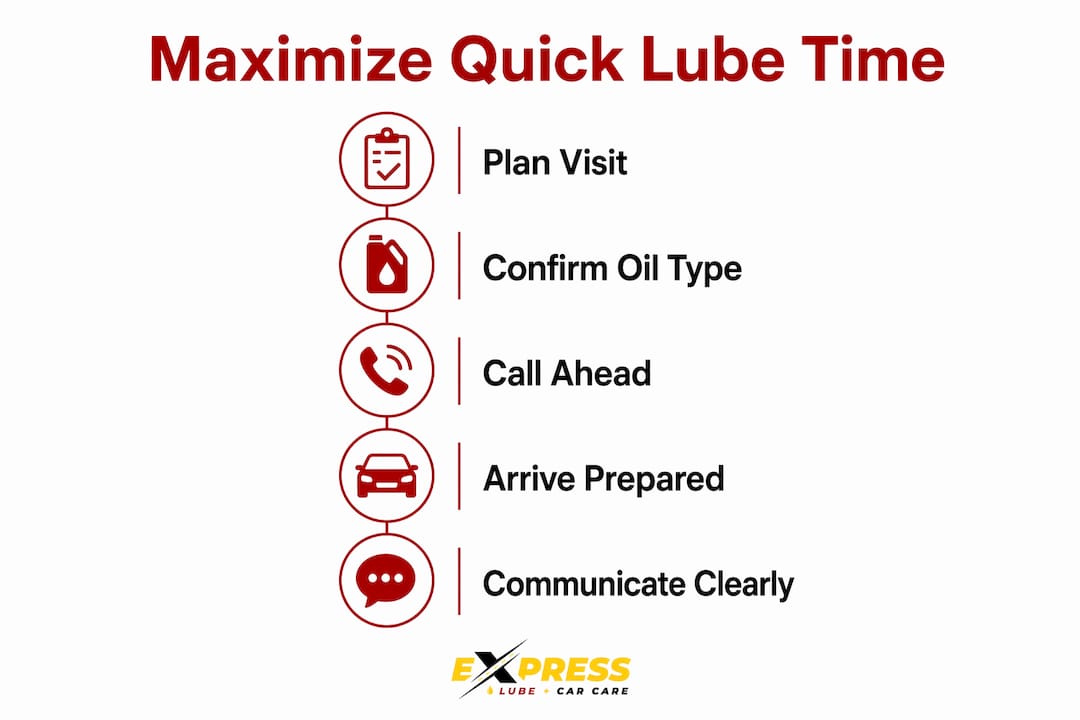
Communication at the counter matters more than most drivers realize. Telling the technician you are on a tight schedule encourages them to focus on the primary service and limit upsell discussions. This is not rude. It is practical, and experienced technicians respect it. A simple phrase like “I just need the oil change today, I’m on a deadline” sets the tone without creating friction.
Here is how to handle the most common time-wasting scenarios at the counter:
- Declining add-ons: Say “Not today, just the oil change please” and hold firm. Technicians are trained to offer additional services, but a polite no is always accepted.
- Confirming your oil type: Have your make, model, year, and mileage ready. This takes 10 seconds and prevents a back-and-forth that can add 5 minutes.
- Asking about current wait: Ask directly when you arrive. If the wait is longer than you expected, you can decide to stay or come back during a quieter window.
- Payment readiness: Have your payment method out before the service is complete. Fumbling for a card at checkout adds unnecessary minutes.
Pro Tip: If you drive a vehicle that uses a less common oil type, such as a European specification oil like 5W-40 or a diesel-rated oil, call ahead to confirm the shop stocks it. A stuck or missing filter and an uncommon oil are the two most common reasons a 15-minute oil change turns into a 45-minute one.
What steps during your visit minimize total service time?
Once you are at the shop, your behavior in the first two minutes sets the pace for the entire visit. Pull into the correct lane, have your keys ready, and give the service writer your vehicle information immediately. Shops that use digital check-in systems, like many Express Lube & Car Care locations, can pull up your vehicle history automatically if you are a returning customer. That alone can shave several minutes off the intake process.

Stay close to the waiting area and keep your phone accessible. Technicians sometimes need a quick approval before proceeding, especially if they find a filter that needs replacing or notice a fluid that is low. If you are unavailable for 10 minutes because you stepped outside or got absorbed in a call, the service pauses. Being present and responsive keeps the job moving.
Use the wait time productively rather than watching the clock. Bring a laptop, answer emails, or handle a phone call you have been putting off. Drivers who stay mentally occupied report feeling like the wait was shorter, and they are less likely to interrupt the technicians with questions that slow the process. Understanding the typical oil change duration before you arrive also sets realistic expectations so you are not anxious if it takes 25 minutes instead of 15.
One often-overlooked tip: avoid bringing your vehicle in with a nearly empty gas tank. Some shops will not move your car into the bay if the fuel level is too low for safety reasons, and that creates a delay you did not plan for.
How do different quick lube services impact your total time?
Not all oil change services take the same amount of time, and choosing the right service level for your actual needs is a genuine time-saving decision. Most quick oil changes take 15 to 30 minutes and cover the core tasks: draining the old oil, replacing the filter, and refilling with fresh oil. That is the baseline. Everything added on top of that extends your visit.
The table below shows how service type affects your time at the shop:
| Service type | Typical time | What’s included |
|---|---|---|
| Quick oil change | 15 to 30 minutes | Oil drain, filter swap, refill, basic fluid check |
| Full-service oil change | 45 to 60 minutes | Oil change plus multi-point inspection, top-offs |
| Oil change with tire rotation | 60 to 90 minutes | All of the above plus tire rotation |
| Comprehensive maintenance visit | 90 minutes or more | Oil, tires, filters, belts, and additional inspections |
Adding tire rotations or full inspections can push your total visit to 60 to 90 minutes. That is not a problem if you have the time and the services are due. But if you are trying to get in and out during a lunch break, combining services is the fastest way to blow your schedule. Review the fast lube service types available at your shop before you arrive so you can make that call in advance rather than at the counter.
The DIY oil change question comes up often. Doing it yourself saves money but rarely saves time when you factor in buying supplies, setting up, and disposing of old oil properly. For most busy drivers, a well-timed quick lube visit is faster than a DIY job in the driveway. The exception is if you already have all the supplies on hand and your vehicle is easy to work on. Otherwise, a shop visit during off-peak hours wins on time every time.
Key takeaways
Visiting a quick lube shop during off-peak hours, arriving prepared with your vehicle information, and communicating your time constraints to the service team are the three actions that most reliably cut your total visit time.
| Point | Details |
|---|---|
| Time your visit strategically | Mid-morning weekday visits can reduce wait times to 10 to 15 minutes versus double that during peak hours. |
| Book ahead when possible | Appointments are served before walk-ins, making a quick call the easiest way to skip the line. |
| Know your oil type in advance | Confirming your oil spec before arrival prevents delays caused by lookups or uncommon supply shortages. |
| State your time constraint clearly | Telling the technician you are on a deadline limits upsell discussions and keeps the service focused. |
| Match service type to your schedule | A basic oil change takes 15 to 30 minutes; adding tire rotation or inspections can triple that time. |
What we have learned from years of fast lube service
We have seen every version of the rushed oil change visit at Express Lube & Car Care, and the pattern is always the same. The customers who get in and out fastest are not the ones who show up demanding speed. They are the ones who showed up prepared. They know their oil type, they arrive during a quiet window, and they say something simple like “just the oil change today” without any drama.
The piece of advice I give most often is this: do not treat your quick lube visit as something you squeeze in at the worst possible moment. Saturday at noon, right before a road trip, with a car you have not serviced in 8,000 miles is a recipe for a long wait and a stressed experience. Plan it like any other appointment, even if the shop does not technically require one.
One thing I want to push back on is the idea that faster always means better. A true 15-minute oil change requires no complications, the right supplies in stock, and a straightforward vehicle. If your technician takes 25 minutes, that is not a failure. It might mean they checked something worth checking. Speed and thoroughness are not opposites, but they do require the right conditions. Our job is to create those conditions on our end. Your job is to show up ready to help us do that.
— Express Lube & Car Care
Save time on your next oil change at Express Lube & Car Care
Express Lube & Car Care in Richland Hills makes efficient lube shop visits easy for busy drivers. No appointment is needed. Walk-ins are welcome, and our certified ASE technicians are set up to move quickly without cutting corners on quality.
Right now, we have oil change specials running that make your visit even more worthwhile. Whether you need a standard conventional oil change or a full synthetic service, you can check current pricing and available deals before you arrive. Combine that with a mid-week morning visit and you have the formula for a fast, affordable, stress-free oil change. Come see us at Express Lube & Car Care and find out why drivers across Richland Hills keep coming back.
FAQ
What is the fastest time a quick oil change can take?
Quick lube shops can complete an oil change in as little as 10 to 15 minutes when volume is low and no complications arise. Arriving during off-peak hours on a weekday gives you the best shot at that turnaround.
Does making an appointment actually speed things up?
Yes. Appointments are served before walk-ins, so scheduled customers skip the queue that walk-ins wait in. Even a quick phone call to confirm availability can save you 20 to 30 minutes.
When should I avoid going to a quick lube shop?
Avoid Saturday mornings and weekday lunch hours between 11 AM and 1 PM. These are the peak windows where wait times can double compared to quieter periods.
Will adding a tire rotation significantly increase my visit time?
Adding a tire rotation or full inspection to your oil change can push your total visit from 30 minutes to 60 to 90 minutes. If you are short on time, schedule those services separately on a different visit.
Does telling the technician I am in a hurry actually help?
It does. Communicating your time constraint signals to the technician to focus on the primary service and skip the upsell conversation, which keeps the visit moving without any awkwardness.