

Car maintenance between work meetings is defined as a set of targeted, time-boxed vehicle checks and services a professional completes during short breaks in the workday, without sacrificing safety or vehicle performance. You do not need a free Saturday or a two-hour block at a shop to keep your car in good shape. With the right tasks, tools, and services, you can protect your vehicle during a 15-minute break, a lunch hour, or a quick stop before your next call. Gas-powered vehicle owners pay over $1,300 annually on maintenance, and consistent scheduling is the single most effective way to manage that cost.
Which car maintenance tasks can you realistically do between meetings?
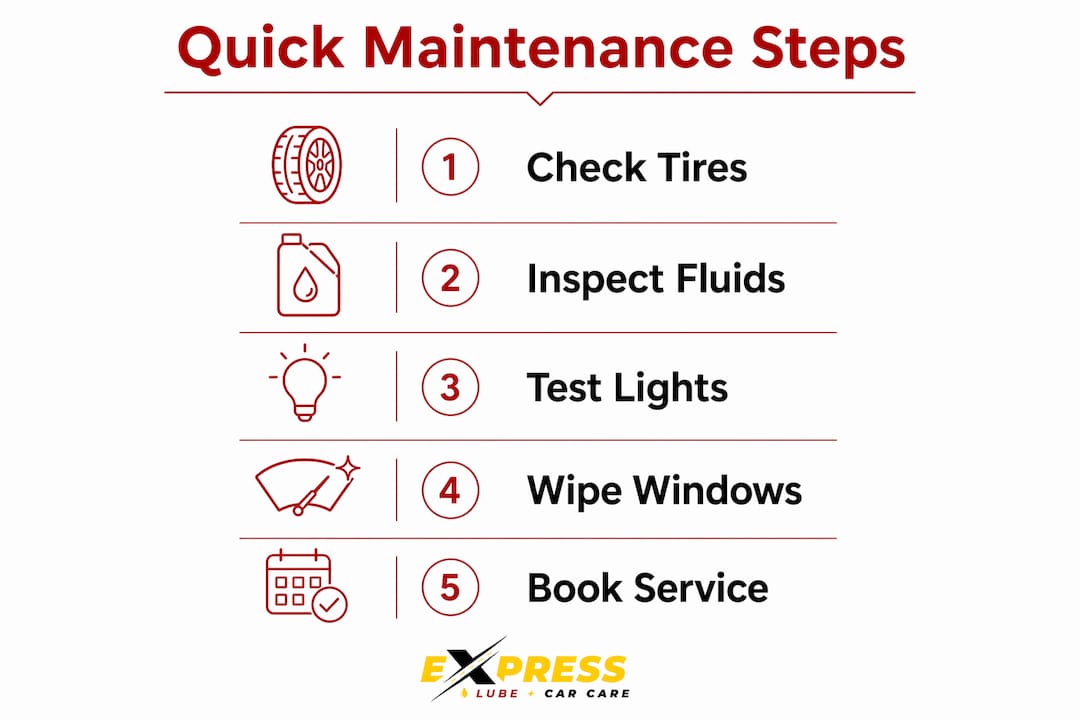
Routine vehicle upkeep, what the auto industry calls preventive maintenance, covers a wide range of tasks. The good news is that several of them take under five minutes and require nothing more than your hands and a basic kit. Here is what actually fits into a short break.
- Tire pressure check (2 minutes): Low tire pressure increases fuel consumption and accelerates tread wear. A digital gauge reads faster and more accurately than a dial gauge, so you get a reliable number without guessing.
- Fluid level inspection (3 to 5 minutes): Windshield washer fluid, engine oil, and coolant all have clearly marked reservoirs under the hood. A quick visual check tells you whether a top-up is needed before your next drive.
- Exterior light inspection (2 minutes): Walk around the car and confirm that headlights, brake lights, and turn signals are working. A burned-out brake light is a safety and legal issue that takes seconds to spot.
- Wiper blade condition (1 minute): Lift each blade and look for cracking or splitting along the rubber edge. Replacing wiper blades takes about three minutes and costs under $20 at most auto parts stores.
- Tire tread visual check (1 minute): Look for uneven wear patterns or visible cord. Uneven wear often signals an alignment or inflation problem that needs professional attention.
Minor DIY tasks like fluid checks are well within reach for most drivers, while complex issues and dashboard warning lights require a certified technician. That boundary matters. If a warning light is on, do not ignore it and do not attempt to diagnose it yourself in a parking lot. Schedule a professional check-up instead.
Pro Tip: Never pop the hood immediately after a long highway drive. Coolant and oil are under pressure and heat. Wait at least 10 minutes before checking fluid levels to avoid burns.
A car care checklist for busy schedules can help you track which tasks you have completed and which are coming due, so nothing slips through the cracks.
What tools and supplies do you need for effective quick maintenance?
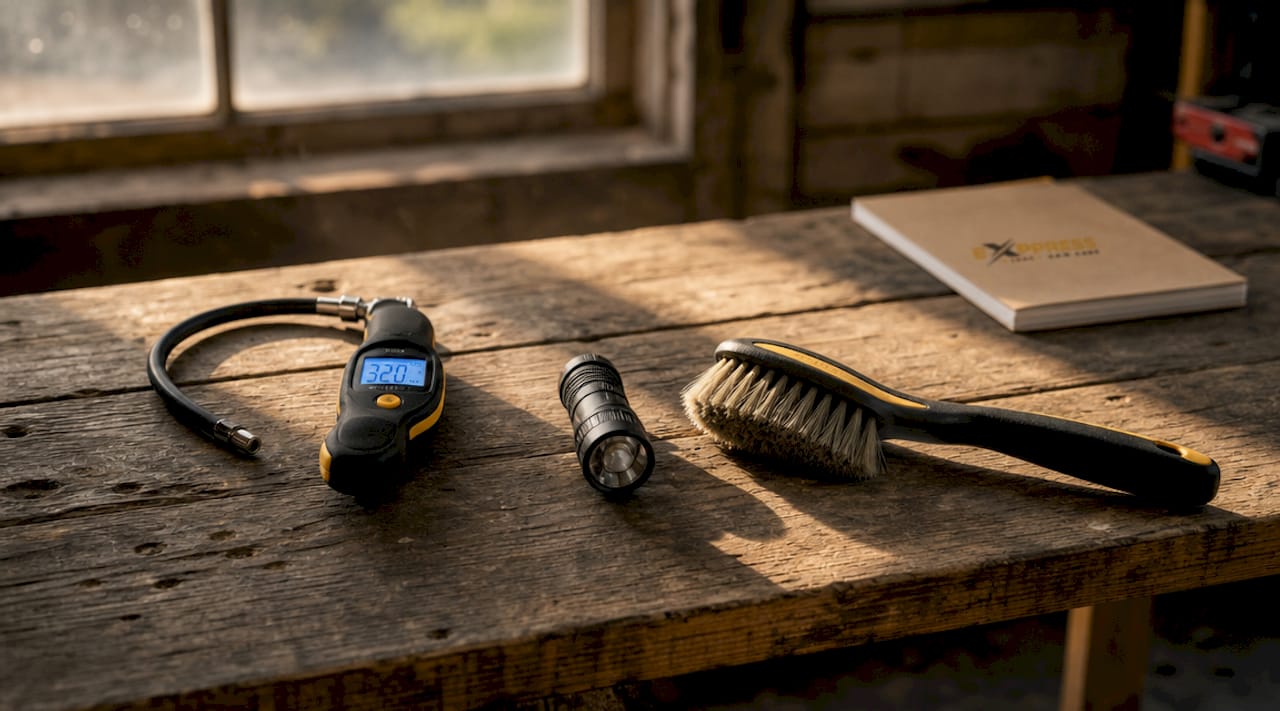
The right kit turns a vague intention into a two-minute task. Experts recommend a dedicated kit containing a tire pressure gauge, a funnel, and pre-mixed windshield washer fluid for quick top-ups during breaks. Pre-mixed fluid matters because it eliminates the step of diluting concentrate, which is easy to get wrong when you are in a hurry.
| Tool | Why it matters | Time saved |
|---|---|---|
| Digital tire pressure gauge | Reads PSI instantly with no dial interpretation | 2 to 3 minutes vs. analog |
| Collapsible funnel | Prevents spills when topping up oil or coolant | Avoids cleanup time |
| Pre-mixed washer fluid (1 qt.) | Ready to pour, no measuring required | 1 to 2 minutes |
| LED flashlight or headlamp | Lets you inspect under the hood in dim parking garages | Immediate visibility |
| Microfiber cloth | Wipes dipstick and cleans up drips without scratching | Keeps hands clean |
Store the kit in a small zip bag or a compact organizer in your trunk. The goal is to grab it without digging through jumper cables and emergency flares. Accessibility is what separates a kit you actually use from one that sits untouched for six months.
Pro Tip: Choose a digital tire gauge with a backlit display. Parking garages are darker than you think, and squinting at a dial gauge in low light leads to misreads.
How can mobile auto repair services save time and ensure thorough maintenance?
Mobile mechanic services bring a certified technician to your location, whether that is your office parking lot, a client site, or your driveway. Mobile auto repair allows clients to stay productive with flexible scheduling and full transparency on what is being done and why. For a busy professional, that means your car gets serviced while you are on a call or finishing a report.
The range of services mobile mechanics can handle is broader than most people expect:
- Oil and filter changes
- Battery testing and replacement
- Brake pad replacement (front and rear)
- Serpentine belt replacement
- Spark plug replacement
- Pre-purchase inspections
What they cannot do is equally worth knowing. Wheel alignments, tire mounting, transmission flushes, and air conditioning recharges require shop equipment. These services need to be scheduled at a fixed facility.
Mobile mechanics are not a replacement for a full-service shop. They are a complement to it. Use them for the tasks that fit, and let a trusted shop handle the rest.
Cost is a fair concern. Mobile services typically carry a small travel fee on top of parts and labor, but the time you save by not driving to a shop, waiting, and driving back often offsets that premium. Scheduling maintenance reduces breakdown risk and preserves engine, transmission, and brake components, which protects resale value over time. That math favors paying a modest convenience fee now rather than absorbing a major repair bill later.
One practical scenario: you have a 90-minute lunch break on Tuesdays. You book a mobile oil change for 12:15 PM at your office. The technician arrives, completes the service in 45 minutes, and you are back at your desk before your 1:30 PM meeting. No waiting room. No Uber back to the shop. No lost afternoon.
Mobile mechanics need a level, paved surface to operate safely. Confirm your parking lot qualifies before booking, because a gravel lot or a sloped surface can disqualify the location and force a reschedule.
What common mistakes should you avoid when doing maintenance between meetings?
Speed is the enemy of accuracy when you are squeezing car care into a tight schedule. These are the mistakes that cost professionals the most time and money.
- Checking tire pressure on hot tires. Tire pressure must be checked when tires are cold to avoid inaccurate readings that lead to under-inflation. If you just drove 20 minutes to the office, wait until the tires have cooled, or check them first thing in the morning before you leave home.
- Attempting complex repairs without expertise. Air conditioning degassing, ignition system work, suspension, and brake modifications are not DIY tasks. Getting them wrong creates safety hazards and voids warranties.
- Over-servicing based on habit rather than your manual. Changing your oil every 3,000 miles made sense in 1990. Most modern vehicles specify 5,000 to 10,000-mile intervals. Follow your owner’s manual, not an old habit.
- Ignoring dashboard warning lights. A check engine light or low oil pressure warning is not a suggestion. Driving on an active warning light can turn a $200 sensor fix into a $2,000 engine repair.
- Skipping maintenance records. Keeping maintenance records and working with a trusted local mechanic supports better scheduling and helps predict upcoming repairs before they become emergencies.
Pro Tip: Use a free app like Drivvo or AUTOsist to log every service, fluid top-up, and tire rotation. A 30-second entry after each task builds a history that saves money at resale and prevents duplicate services.
How to integrate quick car maintenance into your daily work routine
The professionals who keep their cars in the best shape are not the ones who spend the most time on maintenance. They are the ones who treat it like a recurring calendar item rather than a reactive emergency.
Here is how that looks in practice versus the reactive approach most people default to.
| Approach | Method | Outcome |
|---|---|---|
| Reactive | Wait for a warning light or breakdown | Higher repair costs, unplanned downtime |
| Scheduled DIY | Weekly 5-minute check during a break | Catches issues early, low time investment |
| Mobile service | Book technician to office location | Zero commute time, professional quality |
| Shop visit | Quarterly drop-off at a trusted shop | Handles complex work DIY cannot |
| Combined routine | Mix of all three above | Lowest total cost, highest reliability |
Time-blocking works here the same way it works for email or project reviews. Assign Monday mornings to a two-minute tire and light check before you leave home. Schedule a mobile oil change every 5,000 miles directly in your work calendar. Book a quarterly shop visit for the services that require a lift, like brake inspections and tire rotations.
A car maintenance schedule by mileage gives you a concrete framework for knowing what is due and when, so you are never guessing. Pair that with a seasonal car maintenance checklist to account for weather-related wear on tires, batteries, and cooling systems throughout the year.
Proactive minor repairs prevent escalation into costly major failures and extend vehicle longevity. That is not a theory. It is the consistent finding across consumer automotive research, and it is the strongest argument for building even a five-minute check into your weekly routine.
Key takeaways
Busy professionals who combine brief DIY checks, a compact maintenance kit, and scheduled mobile or shop services protect their vehicles at the lowest possible time cost.
| Point | Details |
|---|---|
| Prioritize cold-tire checks | Always check tire pressure before driving, not after, to get accurate readings. |
| Keep a compact kit in your trunk | A gauge, funnel, and pre-mixed fluid turn a 5-minute break into a productive maintenance window. |
| Use mobile services strategically | Book mobile oil changes and battery swaps during lunch breaks to eliminate shop commute time. |
| Follow your owner’s manual intervals | Modern vehicles need oil changes every 5,000 to 10,000 miles, not every 3,000. |
| Log every service | Maintenance records improve scheduling, reduce costs, and protect resale value. |
What we have learned from years of working with busy drivers
I will be honest: the professionals who come into Express Lube & Car Care in the worst shape are rarely the ones who ignored their cars on purpose. They are the ones who kept meaning to get to it and never found the right moment. The car that blows a head gasket in the middle of a client week is almost always the one that had a coolant warning light on for three months.
What I have found actually works is a split approach. Handle the two-minute checks yourself, on a fixed schedule, before the workday starts. Delegate the rest. Mobile services and walk-in shops like ours exist precisely because your time is worth more than a waiting room chair. The professionals who treat car care like a recurring task rather than a crisis to manage spend less money, have fewer breakdowns, and honestly seem less stressed about the whole thing.
The peace of mind that comes from knowing your vehicle is in good shape is not a small thing. It is one less variable in a day that already has plenty of them.
— Express Lube & Car Care
Keep your car running without losing your day
At Express Lube & Car Care in Richland Hills, we built our shop around one idea: your time matters. Our certified ASE technicians handle everything from quick oil changes to full engine diagnostics, and you never need an appointment to walk in. Whether you have 30 minutes between meetings or need a more thorough check-up, we work around your schedule, not the other way around. Check out our oil change service specials and see how fast professional maintenance can actually be. For more complex needs, our engine diagnostics team is ready when you are.
FAQ
What car maintenance can I do in under 5 minutes?
Tire pressure checks, fluid level inspections, exterior light tests, and wiper blade visual checks all take under five minutes and require only a basic kit. These tasks catch the most common issues before they become expensive repairs.
Is it safe to check my oil right after driving?
No. Wait at least 10 minutes after turning off the engine before checking oil or coolant levels. Hot fluids are under pressure and can cause burns if the reservoir cap is opened too soon.
What can a mobile mechanic do at my office parking lot?
Mobile mechanics handle oil changes, battery replacements, brake pad swaps, and spark plug replacements on-site. They require a level, paved surface to work safely, so confirm your lot qualifies before booking.
How often should I actually change my oil?
Most modern gas-powered vehicles specify oil changes every 5,000 to 10,000 miles depending on the oil type and engine. Check your owner’s manual rather than defaulting to the outdated 3,000-mile rule.
Why should I keep maintenance records?
Maintenance records support better scheduling and help a trusted mechanic predict upcoming repairs before they escalate. They also increase resale value by proving the vehicle was consistently serviced.