

If your car seems to be running fine, it’s easy to push routine maintenance to the back burner. But that thinking is exactly what leads to expensive engine problems down the road. Quick lube service, the industry’s shorthand for what professionals call fast-lube or express oil service, is not an emergency repair. It’s the scheduled, fast-turnaround maintenance that keeps your engine healthy between those bigger service visits. Understanding what it covers, how it works, and when to use it can save you time, money, and a whole lot of headaches.
Table of Contents
- Key takeaways
- What quick lube service actually covers
- How quick lube shops operate so fast
- Benefits and limitations worth knowing
- Quick lube vs. traditional oil change and full-service repair
- How to choose and prepare for your visit
- My honest take on quick lube service
- Fast, reliable service at Express Lube & Car Care
- FAQ
Key takeaways
| Point | Details |
|---|---|
| Quick lube is routine maintenance | It covers oil changes, fluid top-offs, and inspections, not emergency repairs. |
| Most visits take 15 to 25 minutes | Efficient workflows and technology keep service times short without cutting corners. |
| No appointment needed at most shops | Walk-in service makes it easy to fit maintenance into a busy schedule. |
| It differs from full-service repair | Quick lube handles regular upkeep; complex repairs still need a full-service shop. |
| Choosing the right shop matters | Look for ASE-certified technicians and transparent pricing to get reliable service. |
What quick lube service actually covers
A quick lube oil change is the backbone of the service, but most shops do quite a bit more during your visit. Think of it like a pit stop. The goal is to get your vehicle back in peak condition fast, without making you sit around for an hour.
Here’s what a typical visit covers:
- Oil drain and refill: The technician drains your old, degraded oil and refills with fresh oil to your vehicle’s specification, whether that’s conventional, synthetic blend, or full synthetic.
- Oil filter replacement: A clogged filter defeats the purpose of fresh oil. Replacing it is standard in every visit.
- Fluid top-offs: Windshield washer fluid, coolant, power steering fluid, and brake fluid get checked and topped off as needed.
- Tire pressure check: Tires are inspected and inflated to the manufacturer’s recommended pressure.
- Belt and hose inspection: Technicians do a visual check for cracks, wear, or loose connections that could signal future problems.
- Air filter check: Some packages include a cabin or engine air filter inspection.
According to the industry, most oil changes finish in 15 to 25 minutes at a quick lube shop, using a pit crew-style workflow where multiple technicians work on your vehicle at once. That’s the key difference from a traditional mechanic’s bay where one person handles everything sequentially.
Pro Tip: Always ask for a service checklist at the end of your visit. A reputable shop will hand you a printed or digital summary of everything that was checked, topped off, or replaced. If they don’t offer one, ask for it.
Even if your car feels perfectly fine, routine quick lube services prevent internal engine wear and extend the life of your vehicle. Oil breaks down over time and loses its ability to lubricate. Waiting too long between changes accelerates that wear.
How quick lube shops operate so fast
Speed at a quick lube shop is not accidental. It’s designed. Quick lube operations are engineered around efficient vehicle flow, technician safety, and consistent repeatable processes, much like a factory assembly line adapted for car care.
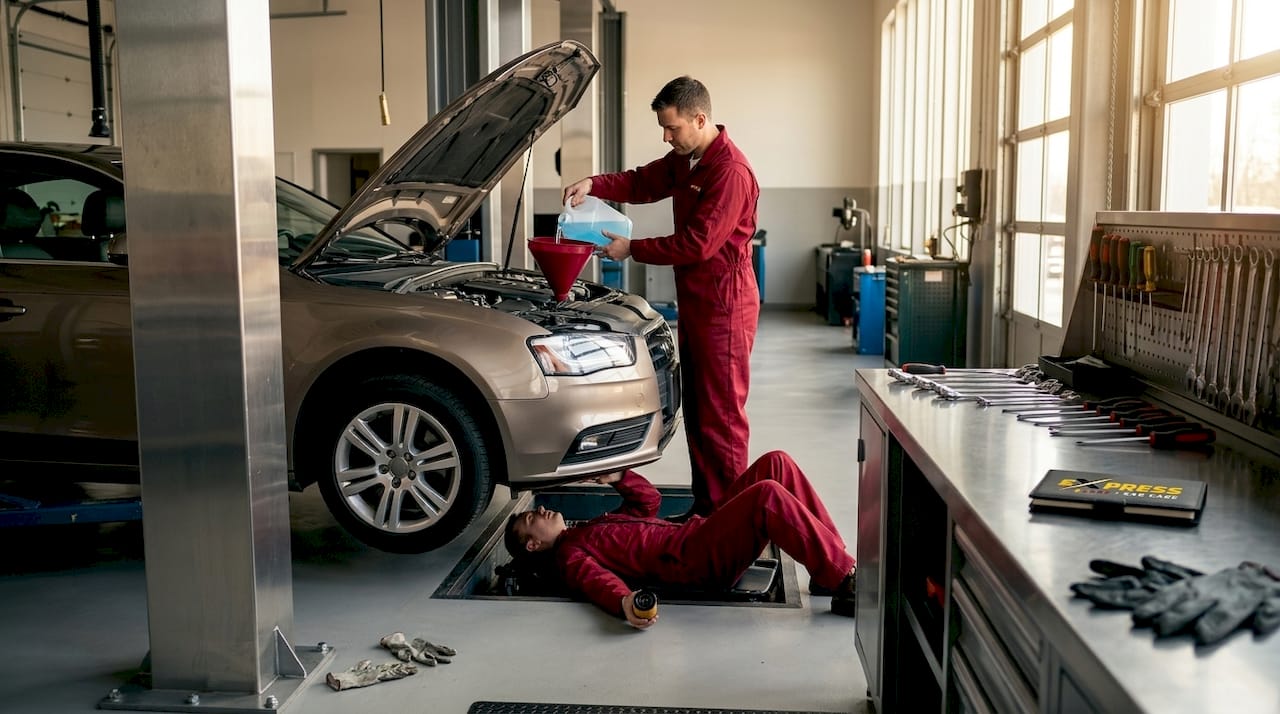
Most shops use a drive-through pit model where your car pulls over a raised bay. Technicians work from below and above simultaneously. This cuts the time dramatically compared to putting the car on a traditional lift. Some newer operations, like stay-in-your-car models, push efficiency even further by removing longer tasks such as tire rotations entirely from the service menu, keeping the focus purely on oil changes and fast inspections.
Technology plays a bigger role here than most drivers realize. VIN scanners and AI cameras now assist technicians in quickly pulling up vehicle specs, identifying the correct oil type, and flagging potential issues without slowing down the workflow. The result is faster service and fewer errors.
| Service model | Typical time | Vehicle exit required | Services offered |
|---|---|---|---|
| Stay-in-car pit model | 10 to 15 minutes | No | Oil change, fluid check, filter |
| Drive-in and wait | 20 to 30 minutes | Yes | Oil change, inspections, tire pressure |
| Full-service quick lube | 25 to 45 minutes | Yes | Oil change, multi-point inspection, add-ons |
One thing worth knowing: delays at quick lube shops usually come from two sources. Either you added extra services, or your vehicle has a hard-to-reach oil filter or a skid plate that requires extra steps. Neither is a problem, just something to keep in mind when planning your visit.
Pro Tip: If you want the fastest possible service, stick to the core oil change on your first visit. Add extras like cabin filter replacement or wiper blades on the next trip so the technician can focus on a single efficient workflow.
Benefits and limitations worth knowing
Understanding the benefits of quick lube services helps you use them smartly rather than just defaulting to whatever’s convenient.
The clear advantages:
- Time savings. You’re in and out in under 30 minutes in most cases. For a working parent or a commuter, that difference between 20 minutes and two hours at a dealership is real.
- No appointment needed. Walk-in service means you can go when your schedule allows, not when the shop has an opening three weeks out.
- Cost-effectiveness. Quick lube shops tend to run leaner operations, which often translates to lower prices than dealership service departments for equivalent maintenance work. Profit margins range from 15% to 40% in the industry, driven by repeat customers and standardized service, which keeps overhead predictable.
- Consistency. Because procedures are standardized, you get reliable service quality visit after visit.
Where it falls short:
Quick lube is not the place for complex diagnostics or major repairs. If your check engine light is on, a quick lube shop can tell you the code, but they likely won’t fix the underlying problem. The scope of work is intentionally narrow. That’s the trade-off for speed.
Some drivers worry about parts quality. It’s a fair concern. Ask upfront what oil brand and filter brand the shop uses. A quality shop will tell you without hesitation and offer you options. For oil change benefits that go beyond just the service itself, understanding what each product does for your engine helps you make a smarter choice.
Quick lube vs. traditional oil change and full-service repair
People often use “quick lube” and “oil change” interchangeably, but there’s a real distinction worth understanding. And neither of those is the same as a full-service repair shop visit.
Here’s how they stack up:
| Attribute | Quick lube | Traditional mechanic | Dealership service |
|---|---|---|---|
| Appointment needed | Rarely | Usually | Almost always |
| Typical wait time | 15 to 30 minutes | 1 to 3 hours | 1 to 4 hours |
| Service scope | Routine maintenance | Maintenance and repairs | Manufacturer-specific service |
| Price range (oil change) | $40 to $100 | $50 to $120 | $70 to $150+ |
| Technician specialization | Fast lube trained | General auto repair | Brand-certified |
| Best for | Regular upkeep | Diagnosed problems | Warranty work |
Quick lube shops offer no-appointment walk-in service targeting basic maintenance, while full-service shops cover complex repairs that require longer visits and specialized tools. The two are not competitors. They serve different moments in your car’s maintenance lifecycle.
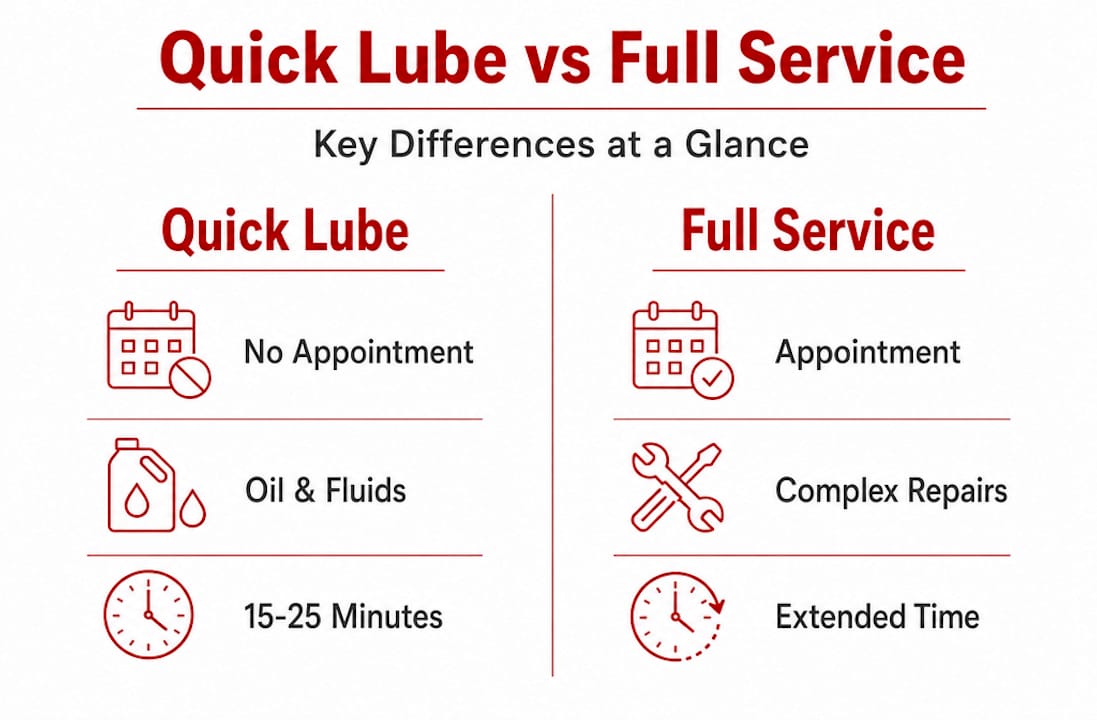
Where does quick lube fit best? Think of it as your every-three-to-six-month routine. It keeps the engine lubricated and the fluid levels correct between those bigger visits to your mechanic or dealership. If something flagged during your quick lube visit points to a larger issue, a good technician will tell you and refer you elsewhere. That’s honest service, not a sales pitch.
For a deeper look at how these lube service types differ in practice, it’s worth reading up before your next visit.
How to choose and prepare for your visit
Getting the most out of a quick lube appointment comes down to a little preparation and knowing what to look for in a shop.
- Check for ASE certification. Shops with ASE-certified technicians meet a professional standard for competence. It’s not a guarantee of perfection, but it’s a solid baseline.
- Read recent reviews. Look for comments specifically about pricing transparency and whether the shop tried to upsell unnecessary services. A few pointed reviews tell you more than an average star rating.
- Know your vehicle’s oil type. Check your owner’s manual. Knowing whether you need 5W-30 conventional or full synthetic before you arrive saves time and prevents the technician from guessing.
- Ask about current specials. Many shops run rotating discounts on oil changes, especially for first-time customers. It never hurts to ask.
- Communicate clearly. Tell the technician exactly what you want done. If you only want the oil change and filter, say so. If you want the full inspection package, say that too. Clarity prevents surprises on the invoice.
Red flags to watch for include pressure to approve services on the spot without explanation, vague answers about what oil brand they use, or no printed service summary at the end. A shop that operates with transparency doesn’t need to rush you into anything.
Pro Tip: Before heading in, check how long oil changes take at different shop types. Knowing what’s typical helps you spot when something is running unusually long and gives you a smarter conversation to have with the technician.
My honest take on quick lube service
I’ve seen a lot of drivers come in believing that quick lube service is somehow a lesser option. The idea that “real” maintenance only happens at a dealership or a full-service shop is outdated and, frankly, costs people money.
In my experience, the shops that get dismissed as “just an oil change place” are often the ones keeping vehicles running well between the bigger visits. The issue isn’t the service. It’s choosing a shop that takes it seriously.
What I’ve learned over the years is that consistency matters more than anything else. A driver who comes in every 5,000 miles for a clean, properly done oil change will almost always have fewer engine problems than one who waits too long and tries to compensate with a more expensive service. The engine doesn’t grade you on how fancy the shop looked.
The technology improvements in this industry have been real. VIN scanning, multi-point digital inspections, and AI-assisted diagnostics have made quick lube service more accurate and reliable than it was even five years ago. My recommendation: find a shop with certified technicians, transparent pricing, and no pressure tactics, and stick with them. Your engine will thank you for the regularity, not the occasion.
— Express Lube & Car Care
Fast, reliable service at Express Lube & Car Care
If you’re in the Richland Hills area and want a quick lube experience that feels nothing like the rushed, impersonal visits you might have had elsewhere, Express Lube & Car Care is worth a stop.
Our ASE-certified technicians handle your oil change and multi-point inspection with care, and you never need an appointment. Walk in, tell us what your vehicle needs, and we’ll have you back on the road fast. We’re transparent about pricing from the moment you pull in, and we’ll show you exactly what was done before you leave. Check out our current oil change specials to see what’s available right now, including deals on oil changes and add-on services that give you more value per visit. You can also browse our full list of auto services in Richland Hills to see everything we offer beyond the basic oil change.
FAQ
What does quick lube service include?
Quick lube service typically includes an oil drain and refill, oil filter replacement, fluid top-offs, tire pressure check, and a visual belt and hose inspection. Most visits are completed in 15 to 25 minutes.
Is quick lube worth it compared to a dealership?
Yes, for routine maintenance. Quick lube shops offer faster turnaround, no appointment requirements, and lower prices for standard oil changes, making them a practical choice for regular upkeep between dealership visits.
How often should I get a quick lube oil change?
Most vehicles need an oil change every 3,000 to 7,000 miles depending on the oil type and manufacturer recommendation. Check your owner’s manual for the exact interval for your car.
Can quick lube handle complex repairs?
No. Quick lube service is designed for routine maintenance, not diagnostics or complex repairs. If a technician spots a larger issue during your visit, they’ll typically recommend you take it to a full-service shop.
What should I bring to a quick lube visit?
Bring your vehicle, your owner’s manual if you’re unsure of the oil type, and any coupons or specials you want to use. No appointment is needed at most quick lube shops, including Express Lube & Car Care.