

Most car owners assume that “fast” and “quality” can’t coexist in the same service bay. That thinking leads a lot of people to skip quick oil change services or write them off as something you settle for when you’re too busy to do it right. But that assumption costs you. An express oil change is a fully professional service designed to get you in, out, and back on the road in roughly 10 to 15 minutes without cutting corners on what your engine actually needs. This guide breaks down exactly what it is, how it works, and whether it makes sense for your vehicle.
Table of Contents
- Key takeaways
- What is an express oil change, really?
- Benefits of choosing express oil change services
- How the express oil change process works, step by step
- When to get an oil change and which oil type matters
- My honest take on express oil change services
- Keep your car running right with Express Lube & Car Care
- FAQ
Key takeaways
| Point | Details |
|---|---|
| Speed without sacrifice | Express oil changes take 10–15 minutes and include the same core steps as traditional service. |
| No appointment needed | Walk-in convenience means you fit maintenance into your schedule, not the other way around. |
| More than just oil | Technicians check fluids, tire pressure, brakes, and other systems during the same visit. |
| Records protect your investment | Documented service history can boost resale value by 10–15% compared to vehicles without records. |
| Skipping is expensive | Reactive repairs cost 10–50 times more than routine oil changes over time. |
What is an express oil change, really?
An express oil change is a streamlined version of a standard oil change, performed by trained technicians who follow a set workflow designed for speed and accuracy. You pull in without an appointment, and the service typically wraps up in 10 to 15 minutes. No waiting room marathons. No scheduling headaches.
Here’s what typically happens during that window:
- The technician checks your current oil level and condition, and identifies the correct oil type for your vehicle
- Old oil is drained from the engine completely
- The oil filter is removed and replaced with a new one
- Fresh oil is added to manufacturer specifications
- Other fluid levels are checked and topped off as needed
- A basic vehicle health inspection covers things like tire pressure, battery, belts, hoses, and brake fluid
That last point is what surprises most people. Express centers include comprehensive vehicle inspections beyond just swapping the oil. You’re not just getting a filter change. You’re getting a quick look at your whole vehicle.
Express oil change vs traditional: what actually differs

The honest answer is less than you’d think. Both services perform the same core steps. The difference is in how the workflow is organized and how long it takes.
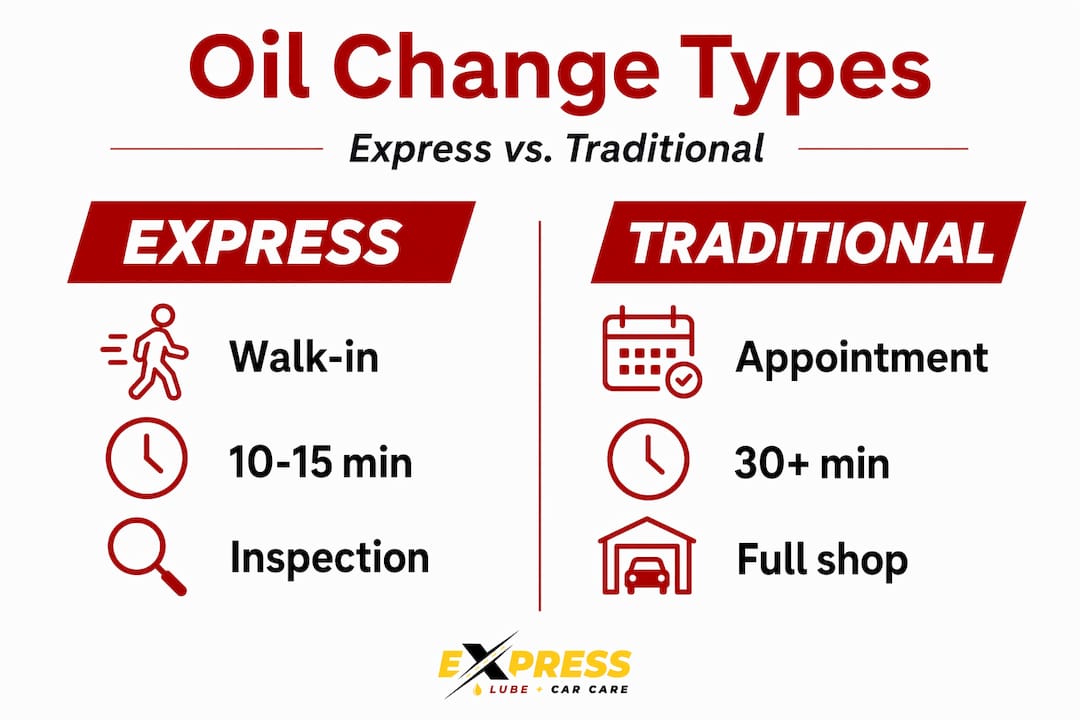
| Feature | Express oil change | Traditional oil change |
|---|---|---|
| Appointment required | No | Usually yes |
| Time to complete | 10–15 minutes | 45–90 minutes |
| Technician training | Specialized, fast workflow | General mechanic |
| Vehicle inspection included | Yes, multi-point | Varies by shop |
| Cost | Comparable | Comparable to higher |
| Walk-in availability | Yes | Often limited |
The longer wait at a traditional shop doesn’t mean better care. It usually reflects a different workflow, not more attention to your engine.
Benefits of choosing express oil change services
Time is the obvious win. But the benefits of express oil change services go further than a shorter wait.
Consistent maintenance is engine protection
Your engine oil breaks down over time. It picks up metal particles, absorbs moisture, and loses its ability to lubricate and cool the engine components it’s protecting. Skipping or delaying oil changes doesn’t just put off a task. Skipping routine maintenance can cost drivers up to 75% more over five years because small problems compound into expensive repairs. Express oil change services make it genuinely easy to stay on schedule, which is the whole point.
Certified technicians, not shortcuts
One of the biggest misconceptions about quick oil change services is that speed means sloppiness. Express service centers optimize their workflows and staff training to perform the service rapidly without cutting corners. The technicians know exactly what they’re doing because they do it all day, every day. That specialization is actually an advantage, not a compromise. You can learn more about how this ties into overall oil change benefits for your car’s long-term health.
You get more than you expect
Beyond the oil itself, routine maintenance like tire rotations and fluid flushes significantly contributes to long vehicle life. Most express oil change visits include checks on coolant, power steering fluid, brake fluid, and windshield washer fluid. Some technicians also inspect belts and hoses while they’re under the hood. That’s a multi-point inspection wrapped into a 15-minute stop.
Pro Tip: Ask your technician to print a copy of every inspection report and file it with your vehicle records. Vehicles with documented maintenance histories sell for 10–15% more than those without. That paper trail pays off.
How the express oil change process works, step by step
Walk-in, drive through, and you’re done. But what actually happens during those 10 to 15 minutes? Here’s the full picture.
-
Vehicle assessment. The technician checks your oil cap, current oil level, and oil color to assess condition. They confirm the correct oil viscosity and filter type for your specific make and model.
-
Drain the old oil. The drain plug is removed from the oil pan and old oil flows out completely. Rushing this step would leave dirty oil behind, so technicians wait until the flow stops.
-
Replace the oil filter. The old filter traps contaminants over time. A new filter goes in with every oil change, otherwise fresh oil immediately contacts built-up debris from the old one.
-
Add new oil. The correct oil type and volume is added per manufacturer specifications. Whether that’s conventional, synthetic blend, or full synthetic depends on your vehicle and driving conditions.
-
Top off other fluids. Coolant, brake fluid, power steering fluid, and windshield washer fluid are checked and filled as needed. This step is what separates a professional express visit from a DIY job done at home.
-
Responsible oil disposal. Used oil is disposed of safely using proper recycling methods that prevent environmental contamination. This is standard practice at reputable express shops.
-
Final checks and record keeping. The technician verifies there are no leaks at the drain plug or filter, resets the oil life monitor if your vehicle has one, and logs the service to your vehicle’s maintenance record.
Pro Tip: If your dashboard oil life monitor reads anywhere below 15%, don’t wait for it to hit zero. Schedule a visit now. Letting it drop too low puts real stress on engine components, especially in stop-and-go city driving.
When to get an oil change and which oil type matters
For years, the standard advice was every 3,000 miles. That guidance is outdated. Modern synthetic oils allow longer intervals between oil changes, with many manufacturer recommendations landing at 5,000 miles or more. Your owner’s manual is the most reliable source for your specific vehicle.
Here’s what actually shapes how often you should change your oil:
- Oil type. Full synthetic oil lasts significantly longer than conventional. Synthetic oil advancements have genuinely shifted what’s possible for maintenance intervals. You can dig into the specifics of mileage on synthetic oil to understand what your vehicle can actually handle.
- Driving conditions. Short trips, frequent idling, and towing put more stress on oil than highway driving. If most of your driving is urban stop-and-go, lean toward shorter intervals.
- Climate. High heat degrades oil faster, recommending earlier changes by 500 to 1,000 miles in hot regions. Texas heat is not your oil’s friend, and if you’re in the Richland Hills area, that’s a real consideration.
- Vehicle age and mileage. Older engines with higher mileage often benefit from more frequent changes because they accumulate oil contaminants faster.
| Oil type | Typical interval | Best for |
|---|---|---|
| Conventional | 3,000–5,000 miles | Older vehicles, light driving |
| Synthetic blend | 5,000–7,500 miles | Mixed driving conditions |
| Full synthetic | 7,500–10,000+ miles | Modern vehicles, extreme temps |
For synthetic blend guidance specific to your car, the oil change interval with synthetic blend is worth a read before your next visit. And if you’re not sure whether your car is already overdue, the signs your car needs an oil change are often more obvious than people realize.
My honest take on express oil change services
I’ve seen a lot of car owners come in after months of putting off oil changes because they thought they didn’t have the time, or because they didn’t trust a quick service to do the job right. Both of those concerns are understandable. Neither one holds up once you see how these services actually work.
What I’ve learned from working with busy drivers is that consistency matters more than the specific shop you choose. An oil change done on time at an express center beats a “perfect” appointment that gets rescheduled twice and pushed back three months. The engine doesn’t care about your good intentions. It responds to what you actually do.
The thing I hear most often is, “I didn’t think they’d check all of that.” People are genuinely surprised by the multi-point inspection. And that surprise is a missed opportunity because catching a low brake fluid level or a fraying belt during a 15-minute oil change is exactly the kind of early catch that keeps a $150 service from turning into a $1,500 repair. Neglecting engine care long enough can even lead to engine replacement territory, which is a consequence no one plans for but too many drivers face.
My honest advice: trust the process, keep your records, and don’t let the idea of being too busy become the thing that costs you the most.
— Express Lube & Car Care
Keep your car running right with Express Lube & Car Care
If you’re in the Richland Hills area and looking for fast, dependable vehicle maintenance, Express Lube & Car Care has you covered with no appointment required.
Our certified ASE technicians perform a full express oil change in about 10 minutes, and every visit includes a complimentary multi-point inspection covering fluids, tires, brakes, belts, and more. We use quality oil products matched to your manufacturer’s specifications, and we keep detailed service records for every vehicle we service. Check out our current oil change specials to see what’s available for your vehicle right now. Walk in anytime and drive out knowing your engine is protected.
FAQ
What is an express oil change?
An express oil change is a professional oil change service that typically takes 10 to 15 minutes and requires no appointment. It includes draining old oil, replacing the filter, adding new oil, and checking other vehicle fluids and systems.
How is express oil change vs traditional service different?
The core steps are the same in both services. The key difference is speed and convenience. Express oil changes use optimized workflows and don’t require scheduling, while traditional shop visits can take 45 to 90 minutes or more.
Is an express oil change worth it for busy drivers?
Yes. Consistent oil changes prevent costly engine damage, and the walk-in convenience of express services makes it far easier to stay on schedule. Skipping oil changes because you’re too busy is one of the most expensive mistakes a car owner can make.
How often should I get an express oil change?
It depends on your oil type and driving conditions. Conventional oil typically needs changing every 3,000 to 5,000 miles, while full synthetic can go 7,500 to 10,000 miles or more. Always check your owner’s manual for your vehicle’s specific recommendation.
Does an express oil change include a vehicle inspection?
Yes. Most express oil change centers perform a multi-point inspection during the same visit, checking tire pressure, fluid levels, battery, belts, hoses, and brake fluid in addition to the oil service itself.