

Knowing when to change your car's fluids is just as important as knowing why. Think of it like a regular health check-up for your vehicle—it's the single best way to keep it running strong, ensure it's safe, and avoid those nasty, unexpected repair bills.
For a quick rule of thumb, it's always a good idea to have your fluids checked every time you come in for an oil change. But for a more detailed plan, your owner's manual is your best friend.
A Quick Reference for Car Fluid Changes
Every fluid in your car has a critical job, whether it's lubricating the engine, cooling the radiator, or providing the hydraulic muscle for your brakes. They are literally the lifeblood of your vehicle. Over time, though, constant heat and contamination break them down, making them less effective.
Ignoring old, worn-out fluid is like asking your engine to run a marathon in the Texas heat without any water. It’s just not going to end well.
Proactive maintenance isn't just a suggestion from your mechanic; it's a smart financial move. More and more drivers are choosing to keep their current vehicles longer, and regular fluid service is a huge part of that. This is a big reason the U.S. automotive aftermarket continues to grow—people know that taking care of what you have pays off.
Key Fluid Change Timelines
While every car is a little different, there are some general timelines that apply to most vehicles on the road today. Sticking to these basic intervals is the easiest way to stay ahead of trouble and keep your car happy. For an even more comprehensive look, our complete car maintenance checklist can give you the full picture.
To help you visualize it, here’s a quick look at the most common service schedules for your car’s most important fluids.
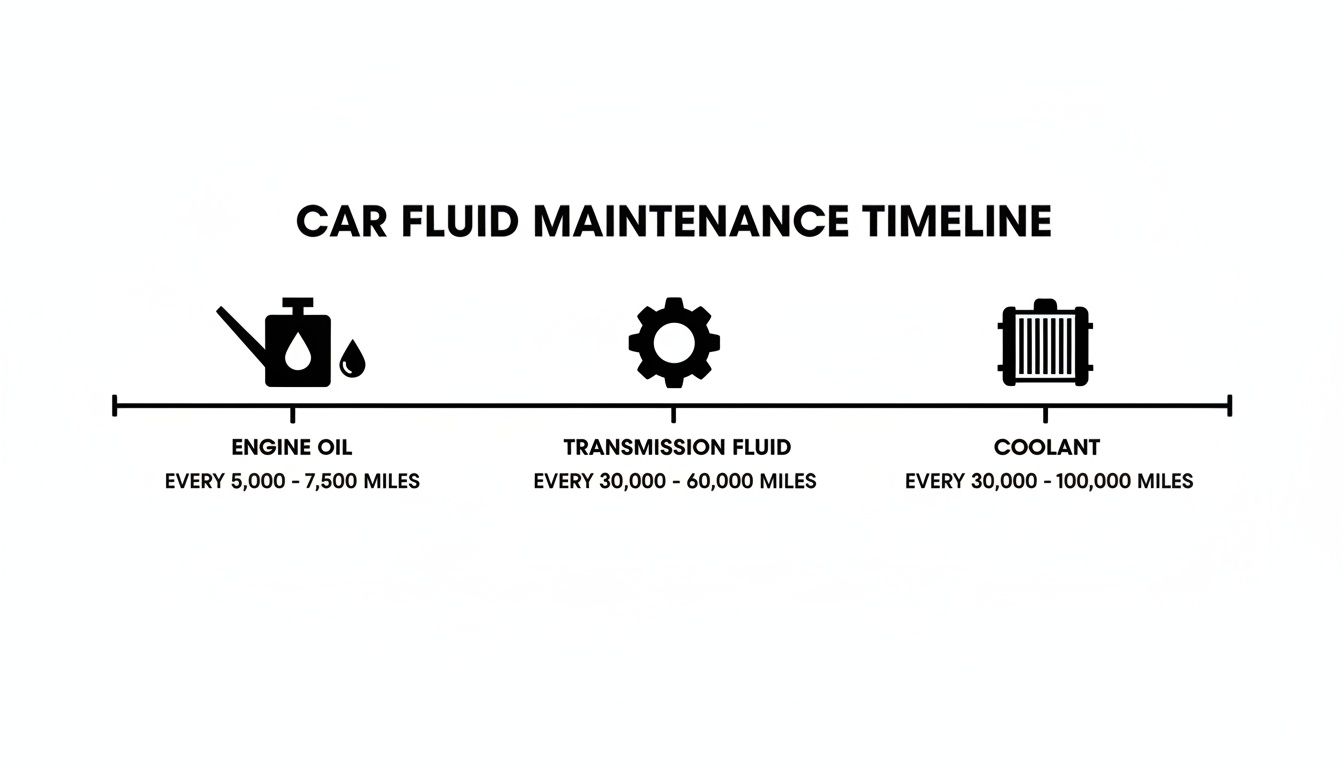
As you can see, your engine oil needs the most frequent love, while other fluids like coolant and transmission fluid have a much longer lifespan.
Recommended Car Fluid Change Intervals at a Glance
To make things even simpler, we've put together this quick-glance table. Think of it as a cheat sheet to help you stay on track.
| Fluid Type | Typical Mileage Interval | Typical Time Interval |
|---|---|---|
| Engine Oil | 3,000 – 10,000 miles | 3 – 12 months |
| Transmission Fluid | 30,000 – 60,000 miles | 2 – 4 years |
| Coolant / Antifreeze | 30,000 – 100,000 miles | 2 – 5 years |
| Brake Fluid | 30,000 – 45,000 miles | 2 – 3 years |
| Power Steering Fluid | 50,000 – 75,000 miles | 3 – 5 years |
Just remember, these are solid general guidelines. For your specific vehicle, your owner's manual is the final authority.
Key Takeaway: Staying on top of your fluid maintenance schedule is the most effective way to prevent premature wear on your car’s most expensive parts. It saves you money, stress, and time in the long run.
Here at Express Lube & Car Care in Richland Hills, we make it painless. No appointment is needed, so you can swing by whenever it's convenient for a fast, professional fluid check-up.
Understanding Your Engine's Most Vital Fluid
Think of your engine as the heart of your car. If that's the case, then engine oil is its lifeblood. This hard-working fluid is constantly circulating through thousands of tiny, intricate passages, doing three critical jobs that keep everything running smoothly. Without it, the intense heat and friction would seize the engine in just a few minutes.
First and foremost, engine oil’s job is lubrication. It forms a thin, slippery film between all the moving metal parts—pistons, crankshafts, bearings—preventing them from grinding themselves into dust. This is what keeps wear and tear to a minimum and gives your engine a long, healthy life.
But it also plays a huge role in cooling. As the oil moves, it pulls a massive amount of heat away from the hottest parts of the engine. Finally, modern oils are packed with detergents that clean the engine from the inside out, grabbing sludge, carbon deposits, and other junk and holding onto it until your next oil change.
The Different Types of Engine Oil
When you pull in for an oil change, you'll hear us talk about conventional, synthetic blend, and full synthetic. Knowing the difference helps you make the right call for your car and your driving habits here in Richland Hills.
-
Conventional Oil: This is your old-school, traditional oil refined from crude. It offers solid, basic protection for many older vehicles or low-mileage cars with simpler engines. The downside? It breaks down much faster under high heat.
-
Synthetic Blend: Just what it sounds like—a mix of conventional and synthetic oils. It gives you better protection and performance than conventional alone. It's a great middle-ground choice for drivers wanting a bit more protection without the full price tag of a full synthetic.
-
Full Synthetic Oil: This is the high-tech stuff, engineered in a lab for ultimate performance. Full synthetic oil provides the best protection possible, resisting breakdown at extreme temperatures, flowing better on cold starts, and cleaning your engine more effectively. It's the required choice for most modern and high-performance engines for a reason.
Expert Insight: For anyone dealing with constant stop-and-go traffic, brutal Texas summers, or towing a trailer, full synthetic oil is a no-brainer. Its stability under stress means your engine stays protected when it's working its hardest.
How to Check Your Engine Oil
Checking your oil is one of the easiest and most important things you can do for your car. It literally takes less than five minutes and gives you a direct window into your engine's health.
- Get The Car Ready: Park on a flat surface and shut off the engine. You need to wait at least 5-10 minutes for the oil to drain back down into the pan to get a true reading.
- Find and Pull the Dipstick: Pop the hood and look for the dipstick—it usually has a brightly colored handle, often yellow or orange. Pull it all the way out.
- Wipe and Re-Dip: Use a clean paper towel or a lint-free rag to wipe the dipstick totally clean. Push it all the way back in, then pull it right back out.
- Read the Level: Look at the tip. You'll see two marks, lines, or holes that show the "Full" and "Add" levels. The oil film should be somewhere between those two marks.
What to Look for Besides the Level
The level is only half the story. The condition of the oil is just as important, and it can tell you if you need to change your fluids even if you're not due on mileage yet.
Color and Consistency
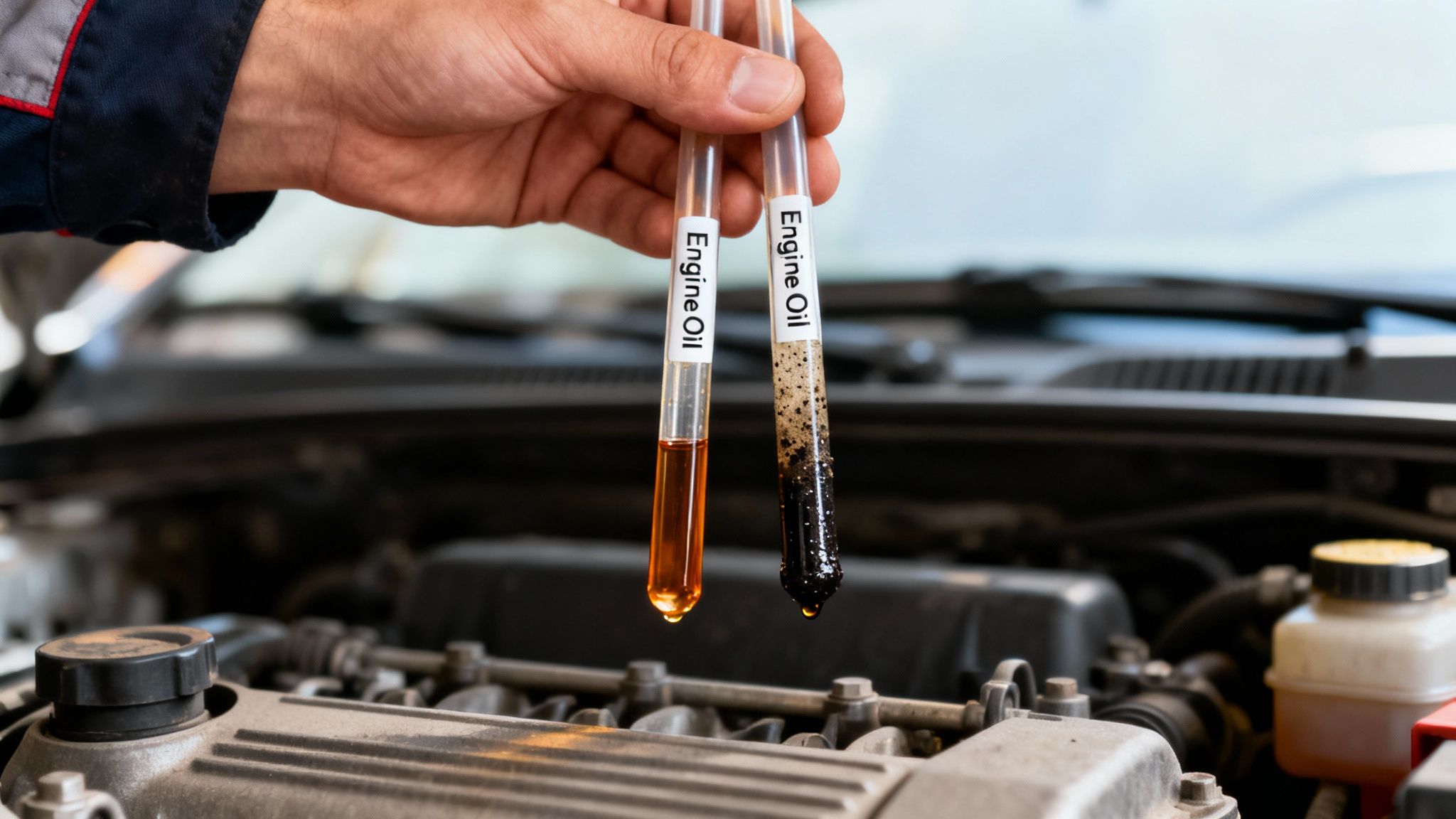
- Clean Oil: Fresh, new oil is usually a clean, see-through, honey or amber color.
- Dirty Oil: As it cleans your engine, oil will naturally darken to a brown or black. That's normal. But if it's thick, jet-black, and you can't see through it at all, it's long overdue for a change.
- Texture: Rub a little drop between your thumb and finger. If it feels gritty or you can see tiny metal specks, it's a bad sign. That means the oil filter is clogged and can't trap contaminants anymore.
If the oil on your dipstick looks milky or frothy, like a coffee-colored milkshake, stop right there. This is a massive red flag that coolant is leaking into your engine. This needs immediate professional attention to prevent catastrophic engine damage. Don't ever ignore this sign.
How Coolant Protects Your Engine From Extremes
While engine oil handles internal heat and friction, coolant (or antifreeze) is the dedicated bodyguard protecting your engine from brutal Texas weather. Its main job is managing the incredible heat your engine creates, keeping it running in that "just right" temperature zone for performance and a long life.
Think of it as your car’s own air conditioning system. Coolant circulates through the engine, soaking up heat. Then it flows to the radiator up front, where airflow whisks that heat away before the fluid cycles back to do it all again.
This is what keeps you from overheating in a summer traffic jam. But it also has additives that stop it from freezing solid during a surprise Texas cold snap, which could literally crack your engine block.
The Dangers of Neglecting Your Coolant
Putting off a coolant service is a huge gamble. Over time, the special additives that protect your engine break down, and the fluid turns acidic. This is where the real trouble starts.
Acidic coolant begins eating away at all the metal parts it's supposed to protect. That corrosion creates rust and gunk that clogs up the small passages in your radiator and engine, choking off the flow just like a blocked artery. The fallout is always severe and expensive.
- Overheating and Engine Damage: This is the most common result. A seriously overheated engine can lead to a warped cylinder head or a blown head gasket—repairs that easily run into the thousands.
- Corrosion and Leaks: The acidic fluid destroys rubber hoses, seals, and plastic parts from the inside out, causing leaks that can leave you stranded.
- Water Pump Failure: All that corrosion debris acts like sandpaper, grinding away at the seals in the water pump—the heart of the whole cooling system—causing it to fail.
Critical Warning: If you ever see your temperature gauge shoot into the red, pull over as soon as it's safe and shut off the engine. Driving even a little bit farther can cause catastrophic, irreversible damage.
Checking Coolant Level and Condition
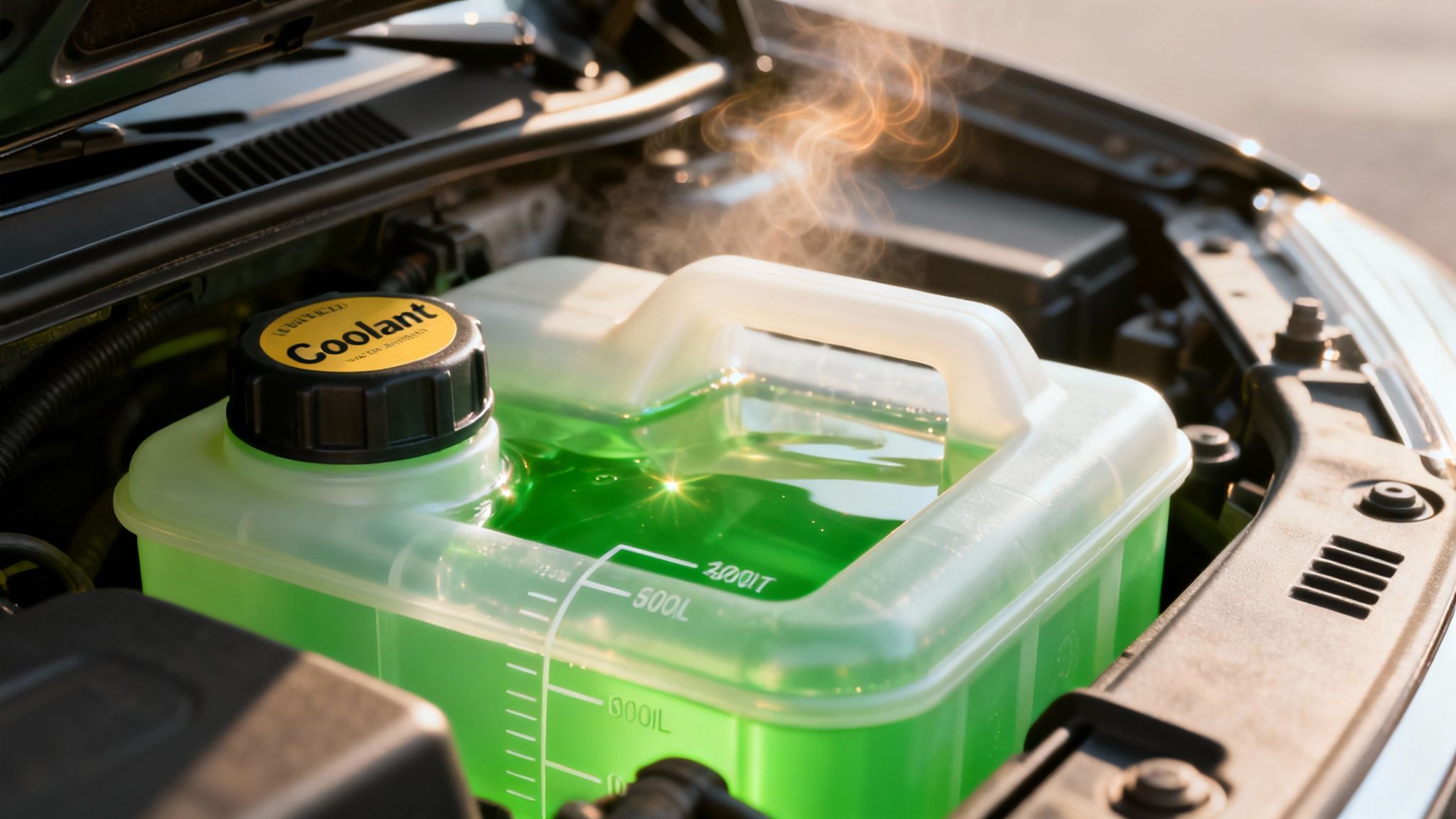
The good news is that checking your coolant is simple. Just make sure the engine is completely cool first. Find the plastic overflow tank—it’s usually see-through and has "MIN" and "MAX" lines on the side. The level should be somewhere in between.
The color tells you even more. Fresh coolant is bright and clean—usually a vibrant green, orange, pink, or blue.
Signs It's Time for a Coolant Flush
- Dark or Rusty Color: If your coolant looks like muddy water or has rust floating in it, its protective additives are gone.
- Oily Film: Seeing a rainbow sheen on the surface is a major red flag for a potential head gasket leak, which allows oil and coolant to mix.
- Thick or Sludgy Texture: If the coolant has turned to sludge, it can't flow properly and needs to be flushed immediately.
Most automakers suggest a coolant flush every 30,000 to 100,000 miles, but the intense Texas heat often shortens that timeline. If you spot any of the warning signs, don't wait. A professional coolant flush at a shop like Express Lube & Car Care gets all the old, contaminated gunk out and refills the system with the exact coolant your car needs to stay protected.
The Other Critical Fluids Your Car Depends On
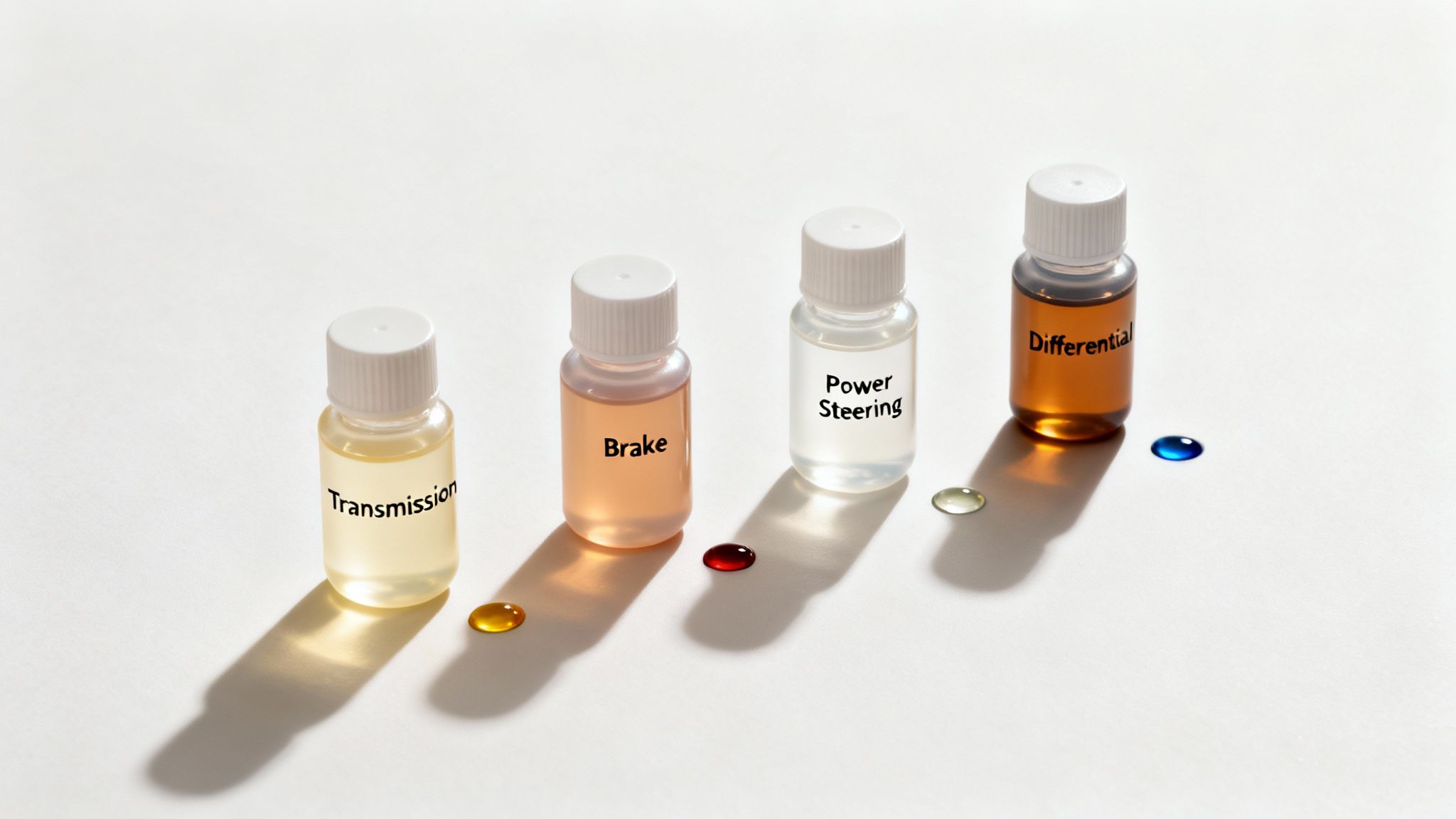
Beyond the big names like engine oil and coolant, your car depends on a whole team of specialized fluids working behind the scenes. These unsung heroes handle everything from shifting gears smoothly to stopping on a dime. Knowing when to change these other fluids is just as crucial for your safety and avoiding a massive repair bill down the road.
The good news? These fluids don't demand attention nearly as often as your engine oil. But ignoring them can lead to some of the most expensive and dangerous failures a car can have. Understanding what they do and the red flags to watch for puts you in the driver's seat.
More and more drivers are catching on. The global market for vehicle maintenance was valued at a staggering USD 936.33 billion and is expected to hit USD 1,374.05 billion by 2034. This just shows that people understand routine fluid changes are a direct investment in their car's health and their own peace of mind. You can see more on this trend over at Precedence Research.
Transmission Fluid: The Key to Smooth Shifting
Your car’s transmission is a maze of gears and clutches that gets power from the engine to the wheels. Transmission fluid is the lifeblood that makes it all work—it's a lubricant, a coolant, and a hydraulic fluid all in one.
When the fluid is clean, your car shifts gears so smoothly you barely notice. But after tens of thousands of miles, that fluid breaks down from heat and gets contaminated with tiny metal shavings from normal wear.
Once the fluid loses its mojo, you'll start to feel it. If you're curious about what a transmission fluid change really involves, our detailed guide explains everything.
Signs of Trouble with Transmission Fluid:
- Rough or Delayed Shifting: Does your car hesitate, jerk, or slam into gear? That's a classic sign the fluid isn't providing the right hydraulic pressure.
- Grinding or Whining Noises: Strange sounds during gear changes usually mean there isn't enough lubrication, and metal parts are grinding against each other.
- A Burning Smell: Overheated transmission fluid has a unique, acrid smell, almost like burnt toast. This is a serious red flag that your transmission is running way too hot.
- Gears Slipping: If the engine revs but the car doesn't accelerate—or it pops out of gear—the fluid might be too low or worn out to hold pressure.
Most manufacturers suggest a transmission fluid service every 30,000 to 60,000 miles. Always check your owner’s manual for the exact interval for your vehicle.
Brake Fluid: Your Most Important Safety Fluid
When you slam on the brakes, you're trusting an incompressible fluid to transfer that force to the wheels. That's the all-important job of brake fluid. Without it, your car simply won't stop.
Brake fluid's biggest enemy is moisture. It’s "hygroscopic," which is a fancy way of saying it absorbs water right out of the air. Just a tiny bit of water contamination—as little as 3%—can seriously lower the fluid's boiling point.
That’s dangerous because braking creates a ton of heat. If the fluid boils, it creates air bubbles in the brake lines. Unlike liquid, air can be compressed, which leads to a terrifying loss of stopping power.
Safety First: A "spongy" or "soft" brake pedal that sinks toward the floor is the most urgent warning sign that your brake fluid is compromised. This needs immediate professional attention, no exceptions.
A brake fluid flush is usually recommended every 2 to 3 years or 30,000 to 45,000 miles, no matter how the fluid looks. It's a time-based service because of how it naturally absorbs moisture.
Power Steering and Differential Fluids
Two other fluids play vital roles, especially in the trucks and SUVs we see all over Richland Hills.
Power Steering Fluid
This is the hydraulic fluid that makes turning the steering wheel feel easy. When the fluid gets low or old, you might notice:
- A groaning or whining sound when you turn the wheel.
- Steering becomes stiff and difficult, especially at slow speeds.
- The steering wheel feels choppy or responds slowly.
A quick look at the power steering reservoir can tell you a lot. If the fluid is dark brown or has gunk floating in it, it’s time for a change—typically around 50,000 to 75,000 miles.
Differential and Transfer Case Fluid
For any rear-wheel, all-wheel (AWD), or four-wheel drive (4WD) vehicle, the differential and transfer case need their own heavy-duty gear oil. This fluid lubricates the gears that send power to the wheels. Neglecting it can lead to grinding noises from under the car and, eventually, a very costly failure. Service intervals are all over the map, from 30,000 to 60,000 miles, so checking your manual is key.
Signs Your Car Fluids Need Attention
Sometimes, your car tries to tell you something's wrong before it becomes a major problem. This table connects common symptoms to the likely fluid issue so you can catch things early.
| Symptom You Notice | Potential Fluid Issue | Recommended Action |
|---|---|---|
| Whining/Groaning When Turning | Low or old Power Steering Fluid | Check the fluid level and color. A flush may be needed. |
| Spongy or Soft Brake Pedal | Contaminated Brake Fluid (air/moisture in the lines) | Immediate professional inspection. Do not drive if unsafe. |
| Hesitation or Jerking During Gear Shifts | Worn or low Transmission Fluid | Check fluid level and condition. A service is likely due. |
| Sweet, Syrupy Smell in Cabin | Coolant/Antifreeze leak | Check for visible leaks and monitor the temperature gauge. |
| Grinding Noise from Under the Vehicle | Old Differential/Transfer Case Fluid | Consult your owner's manual for service intervals. |
| Acrid, Burnt Smell | Overheated Transmission Fluid | Pull over safely and have the vehicle inspected. |
| Squealing When Starting Engine | Possible leak of any fluid onto a belt | Visually inspect the engine bay for drips or wet spots. |
Paying attention to these signs can be the difference between a simple fluid change and a complicated, expensive repair. If you notice any of these symptoms, it's always best to get it checked out.
DIY Checks vs. Professional Service: Who Should Do the Work?
Knowing when your car's fluids need attention is half the battle. The other half is deciding if it's a job you can tackle in the driveway or one that’s best left to a pro.
Making the right call here is a big deal. It’s about protecting your car, your safety, and your wallet.
Safe DIY Fluid Checks Anyone Can Do
You don't need a toolbox full of wrenches to keep an eye on your car's health. In fact, some of the most important checks are incredibly simple and give you a heads-up on potential problems.
These are the checks every driver should feel confident doing between professional services:
- Engine Oil: Popping the hood and checking the dipstick is the classic DIY car task for a reason. It’s fast, easy, and we even have a simple guide on how to check your car oil level to walk you through it.
- Coolant (Antifreeze): Make sure your engine is completely cool first. Then, just glance at the see-through plastic reservoir. The fill lines are clearly marked.
- Windshield Washer Fluid: This is the easiest one of all. Find the cap with the little windshield symbol, pop it open, and top it off. You can't mess this one up!
Doing these quick checks helps you catch slow leaks or other small issues before they turn into a major headache and leave you stranded.
When to Hand the Keys to a Professional
Checking a fluid level is one thing; changing it is another. For some of your car’s most critical systems, a small mistake can lead to catastrophic failure. This is where you absolutely want a trained technician on the job.
Expert Advice: Systems like your brakes and transmission are complex and unforgiving. Using the wrong fluid or procedure can lead to thousands in damage or, even worse, compromise your safety on the road.
Here’s why certain jobs are strictly for the pros:
- Brake Fluid: Your brakes are not something to gamble on. If you accidentally introduce a single air bubble into the brake lines during a fluid change, you can end up with a spongy pedal and dangerously reduced stopping power. We use specialized pressure bleeders to ensure the system is perfectly sealed and safe.
- Transmission Fluid: Many modern cars don't even have a transmission dipstick, making a fluid service impossible without special tools. Plus, there are dozens of different fluid types, and using the wrong one can burn up a transmission in no time.
- Proper Disposal: All those used fluids are considered hazardous waste. A professional shop like Express Lube & Car Care has the systems in place to make sure every drop is recycled and disposed of responsibly, protecting our local environment.
The Peace of Mind You Get From an ASE-Certified Technician
When you bring your vehicle to us, you're getting more than just a fluid change. Our ASE-certified technicians have the experience to spot other problems you might miss, like a bulging hose, a leaky gasket, or a water pump that’s on its last legs.
That kind of preventative insight is priceless. It’s about catching a $100 problem before it becomes a $1,000 repair. This is exactly why more and more drivers are seeing the value in professional service. A recent J.D. Power study even noted that customer satisfaction is on the rise, thanks to quick, reliable service and fair pricing. It just goes to show that trusting your car to an expert is the smartest move you can make.
Your Richland Hills Partner in Vehicle Maintenance
Staying on top of your car's fluid maintenance isn't just another item on your to-do list—it's one of the smartest investments you can make in your vehicle's health and your own peace of mind. Keeping up with that schedule is truly the best defense against the wear and tear of daily driving.
Think of each fluid change as a shield. You're protecting critical parts from heat, friction, and grime that build up over time. This proactive approach helps you sidestep the sudden, expensive breakdowns that always seem to happen at the worst possible moment. It’s not about spending money; it’s about saving it down the road.
Why Richland Hills Drivers Trust Us
Here in our community, you need a local shop you can count on—one that gets your car and respects your time. At Express Lube & Car Care, we’ve worked hard to become that trusted neighborhood partner, blending real-world expertise with the convenience a busy life demands.
We keep car care simple and transparent. Here’s what you can always expect from us:
- No Appointment Needed: Life doesn’t run on a perfect schedule, so why should your car maintenance? Just stop by whenever it’s convenient for you.
- Expert ASE-Certified Technicians: Our team has the hands-on training and experience to do the job right the first time, using the correct fluids and parts for your specific vehicle.
- Community-Focused Savings: We're proud to support our neighbors with discounts for military members, first responders, and healthcare professionals, along with our popular weekly Ladies Day specials.
We’re not just another auto shop; we are your neighbors. Our goal is to keep your vehicle running safely and reliably for years to come with honest advice and dependable service every single time.
Ultimately, keeping your car in top shape is a team effort. You bring the vehicle, and we'll bring the expertise to make every mile a smooth one. Stop by today and see what a difference a dedicated local partner makes.
We Hear You: Answering Your Top Questions About Car Fluid Changes
Even with the best intentions, it's easy to have questions about your car's fluids, especially when you factor in the realities of driving around North Texas. We get asked these questions all the time by drivers here in Richland Hills, so we put together some quick, no-nonsense answers.
Our job is to make sure you feel totally confident about your car's maintenance. When you understand the "why" behind the service, you can make smarter decisions that keep your vehicle running strong.
Does This Texas Heat Really Affect My Fluid Change Schedule?
You bet it does. That relentless heat is one of the toughest things your car will ever face, and it puts a massive strain on every single fluid inside. In the auto world, this is a textbook example of "severe" driving conditions.
High temperatures cause vital fluids like engine oil and transmission fluid to break down and lose their effectiveness way faster than they would in a cooler climate. Think of it like cooking oil—the hotter it gets, the quicker it degrades. For Richland Hills drivers, this means the "normal" schedule in your owner's manual might not be enough. We almost always recommend tightening up those intervals to give your engine and transmission the protection they need to survive the heat.
What Happens If I Use the Wrong Type of Fluid?
Putting the wrong fluid in your car is one of the fastest ways to cause catastrophic damage. It’s not an exaggeration to say it’s like giving a person the wrong blood type—the internal systems will reject it, and the results are never good.
- Wrong Coolant: Using the wrong antifreeze can trigger a chemical reaction that creates a thick, sludgy gel, corrodes metal parts, and clogs your entire cooling system.
- Wrong Transmission Fluid: This is a recipe for disaster. It can lead to jerky shifting, severe overheating, and completely frying the delicate clutches and gears inside.
- Wrong Brake Fluid: Different brake fluids have different boiling points. Using the wrong one or mixing types can seriously compromise your ability to stop safely.
Always, always double-check your owner’s manual or let a pro handle it. The risk of a multi-thousand-dollar repair bill just isn’t worth guessing.
My Maintenance Light Popped On. Is It Just Time for an Oil Change?
Not necessarily. That little "Maintenance Required" or "Service Engine Soon" light is often linked to your oil life, but it’s really a catch-all reminder. It could be telling you it’s time for a tire rotation, that a major factory-recommended service is due, or it could be flagging a specific problem detected by your car’s computer.
Whatever you do, don't just ignore it. The best move is to swing by for a quick diagnostic check. Our ASE-certified technicians can plug in, read the specific code, and tell you exactly what your car is trying to say.
Keeping your vehicle's fluids fresh is the single most effective way to ensure a long, reliable life on the road. For expert advice you can trust and service that gets you back on your way fast, count on the team at Express Lube & Car Care. Stop by our Richland Hills shop today—no appointment needed! Learn more at https://www.expressluberichlandhills.com.