

A brake warning light on your dash means the system has detected a brake-related fault. Check your parking brake first, then test the pedal. A firm pedal usually means you can cautiously drive to a shop. If the pedal feels soft or sinks toward the floor, stop driving and arrange a tow instead of chancing it.
TL;DR:
- A soft brake pedal combined with a red brake light indicates a fluid leak or air in the system requiring immediate towing.
- Low brake fluid from worn pads is a normal wear indicator, but a sudden drop from a leak demands urgent repair and cautious driving.
- An ABS or wheel-speed sensor fault may still allow driving but forfeits anti-lock control and often signals moderate urgency.
- Most dash lights caused by parking brake issues or electrical glitches tend to be low urgency if the pedal remains firm.
- Always check pedal feel and fluid level first, and avoid highway driving if the pedal sinks or the ABS and brake lights illuminate together.
Table of Contents
- Why Is My Brake Light On? The Pedal Test That Decides What To Do Next
- What Causes a Brake Light To Come On?
- How Do I Check My Brakes Before Calling a Shop?
- Should You Drive To a Shop or Call For a Tow?
- What Happens When You Bring It In for a Diagnosis?
- Why We Take Every Brake Light Seriously
- Get Your Brake Light Checked Without the Guesswork
- Sources
- FAQ
Why Is My Brake Light On? The Pedal Test That Decides What To Do Next
Not every brake light means the same thing, and the color on your dash tells you how urgent the problem is. A red BRAKE light points to something in the hydraulic system itself, low fluid, a caliper issue, or a parking brake that’s still partially engaged. An amber or yellow ABS light usually means your anti-lock system has a sensor or module fault. Your regular brakes still work, but you lose the extra control ABS gives you in a hard stop. A parking-brake icon alone, without the red BRAKE light, is often just a switch that didn’t reset.
The pedal is your fastest diagnostic tool, faster than any code reader. Press it firmly while parked. A firm, solid pedal with the red light on generally means you can drive carefully to a shop. A pedal that feels spongy, sinks slowly toward the floor, or needs pumping to build pressure is a sign of air or fluid loss in the system, and that’s not something to test further on the road.
If the light comes on while you’re driving, work through this quickly:
- Signal and ease off the gas.
- Find a safe spot to pull over, away from traffic.
- Confirm the parking brake is fully released.
- Press the pedal and note how it feels.
- If it’s soft or sinking, call for a tow rather than continuing.
Statistic Callout: Both a brake light and ABS light illuminating together at the same time is treated by most technicians as a signal to stop as soon as it’s safe and get professional help, rather than a routine “get it checked when you can” situation.
What Causes a Brake Light To Come On?
The most common trigger is embarrassingly simple: the parking brake isn’t fully released, or its switch is slow to reset. If your pedal feels normal and the light clears once the brake is fully down, that’s usually a low-urgency fix.
Low brake fluid is the next most frequent cause, and it has two very different explanations. Worn brake pads gradually lower the fluid level in the master cylinder reservoir as the caliper pistons travel farther to reach thinner pads, which is a normal wear pattern rather than an emergency. A sudden fluid drop from a leak is different; look for puddles under the car, a pedal that pulls to one side, or a spongy feel that wasn’t there yesterday.
Here’s a quick breakdown of what tends to cause the light, and how urgent each one usually is:
- Parking brake or switch issue: common, usually low urgency if the pedal is firm.
- Low fluid from worn pads: moderate urgency, plan a service visit soon.
- Low fluid from a leak: high urgency, especially with a soft pedal.
- ABS or wheel-speed sensor fault: moderate urgency, brakes still work but lose anti-lock function.
- Electrical glitch (bulb, level sensor): low urgency but should still be confirmed, not assumed.
Worn pads deserve their own mention because pad-wear indicators are designed to trigger a dash warning before metal-on-metal contact happens. If you’ve been putting off a pad replacement, this could be your light.
Pro Tip: If the light comes on right after you had brake work done somewhere else, or after a battery disconnect, suspect an electronic parking brake that didn’t finish its retraction cycle. It’s a known quirk on newer vehicles and it’s not the same as a hydraulic problem.
How Do I Check My Brakes Before Calling a Shop?
You don’t need tools to gather most of the information a technician will ask for. Work through these checks in order, and stop immediately if anything feels wrong.
- Release the parking brake fully. On a mechanical handbrake, pull it all the way up, then push it all the way down. On an electronic parking brake, use the dash switch and listen for the motors to disengage; if it won’t release or the light stays on, don’t force it.
- Check the brake fluid reservoir. Pop the hood and find the reservoir near the firewall. Fluid should sit between the MIN and MAX lines marked on the side. Low fluid near MIN with no visible leak often points to pad wear; fluid well below MIN suggests a leak somewhere in the system.
- Look underneath the car. Check for wet spots, drips, or a sheen near the wheels or under the master cylinder after the car has been parked a few minutes.
- Scan for codes if you have access to a tool. An ABS-capable OBD2 scanner can confirm whether a sensor or module triggered the light, though clearing certain codes on newer electronic parking brakes may need a technician’s tool.
Before you call anyone, jot down how the pedal felt, any noises you heard, and exactly when the light first appeared. That handful of details saves real diagnostic time once your car is on the lift.
Should You Drive To a Shop or Call For a Tow?
Your pedal feel and the specific lights on your dash decide this, not how far away the nearest shop is. Use these as your guide:
- Firm pedal, red BRAKE light, parking brake confirmed released, fluid looks normal: cautiously drive to a shop, avoiding highways and hard braking.
- Soft, spongy, or sinking pedal: stop now and arrange a tow. Don’t test it further.
- ABS and BRAKE lights on together, or either one flashing: stop as soon as it’s safe and call for help.
- If you do drive, choose surface streets over highways, leave extra following distance, and avoid quick stops until a technician has looked at it.
What Happens When You Bring It In for a Diagnosis?
A technician starts where you did: parking brake switch, fluid level, and pedal feel. From there they’ll check calipers, pads, and brake lines for wear or leaks, then run an ABS module scan if the amber light was on. Fluid loss with no obvious leak usually points them straight to pad thickness.
At Express Lube & Car Care in Richland Hills, that inspection is handled by ASE-certified technicians and documented with digital vehicle inspection photos, so you can see exactly what they found instead of taking someone’s word for it. Repairs are backed by a 24-month/24,000-mile warranty, and you can walk in or book ahead.
When you drop off the car, expect to be asked:
- How the pedal felt before the light came on
- Whether you heard grinding, squealing, or clunking
- When the light first appeared and whether it’s steady or flickering
You’ll typically get an inspection summary with photos and a repair estimate before any work starts.
Why We Take Every Brake Light Seriously
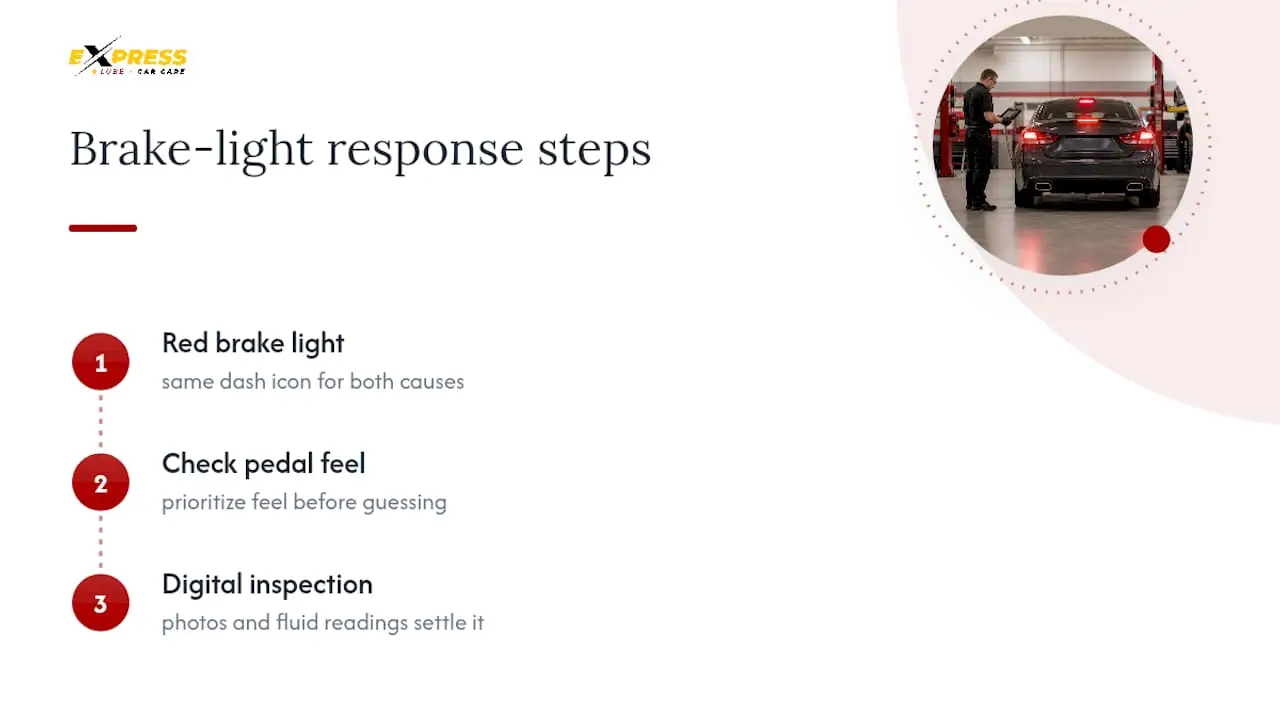
We see two patterns walk through the door with a brake light on: a parking brake that never fully released, and a fluid leak that’s already lower than the driver realized. Both trigger the exact same red light on the dash, and there’s no way to tell them apart just by looking at the icon.
That’s why pedal feel comes before anything else in our process. A driver who assumes “the brakes feel fine” can miss a slow leak that hasn’t dropped pressure yet but will. Bring the car in for a digital inspection and let the photos and fluid readings settle it, rather than guessing based on how the ride feels today.
Get Your Brake Light Checked Without the Guesswork
Express Lube & Car Care gives Richland Hills drivers a faster path to an answer than piecing together forum posts and dashboard symbols on your own. Our ASE-certified technicians run a full brake inspection with digital photos so you see exactly what’s low, worn, or leaking before you approve any repair, and every fix carries our 24-month/24,000-mile warranty.
If cost is part of what’s holding you back, check the $30 off brakes coupon or look into easy financing options before you decide to put off the visit. Walk in or schedule an appointment today, or call us directly at (817) 284-8478 and describe the pedal feel and light color so we can get you seen quickly.
FAQ
Is It Okay To Drive With the Brake Light On?
It depends on the pedal, not the light alone. A firm pedal with the red BRAKE light on may allow a cautious, short drive to a shop, but a soft or sinking pedal means you should stop and arrange a tow.
Why Is My Brake Light On but My Brakes Feel Fine?
A normal-feeling pedal doesn’t rule out a problem. Low fluid from worn pads, a parking-brake switch that didn’t reset, or an ABS sensor fault can all trigger the light without changing how the pedal feels yet.
How Urgent Is a Brake Light?
Urgency depends on color and pedal feel: a firm pedal with a single red or amber light is moderate urgency, while a soft or sinking pedal, or ABS and BRAKE lights together, is urgent and calls for stopping right away.
What Would Cause the Brake Light on the Dash To Come On?
The most common causes are an incompletely released parking brake, low brake fluid from worn pads or a leak, an ABS or wheel-speed sensor fault, or an electrical issue like a bad bulb or level sensor.
How Do I Reset the Brake Light After a Fix?
Once the parking brake is fully released, fluid is topped up, or a repair is complete, the light usually clears on its own after a short drive; if it stays lit, an ASE-certified technician can scan for stored codes and confirm the fix.