

When you're searching for "brake service near me prices," you're likely seeing a pretty wide range. Generally, a basic brake pad replacement will run you somewhere between $150 and $300 per axle. If you need the more common service of pads and new rotors, you can expect to pay anywhere from $300 to $600 per axle.
Your Quick Guide To Local Brake Service Prices
Think of it like this: a simple brake pad swap is the most straightforward job. But often, the rotors—the discs the pads squeeze against—are worn down too. Replacing both at the same time is a more involved, but often necessary, repair to get your car stopping like it should.
What your vehicle truly needs determines the final cost. At Express Lube & Car Care, we cut through the confusion. We'll show you exactly what needs attention and explain why, so you’re never caught off guard by the bill. Our job is to give Richland Hills drivers the facts they need to make a smart, safe choice.
Setting Your Budget For Brake Repairs
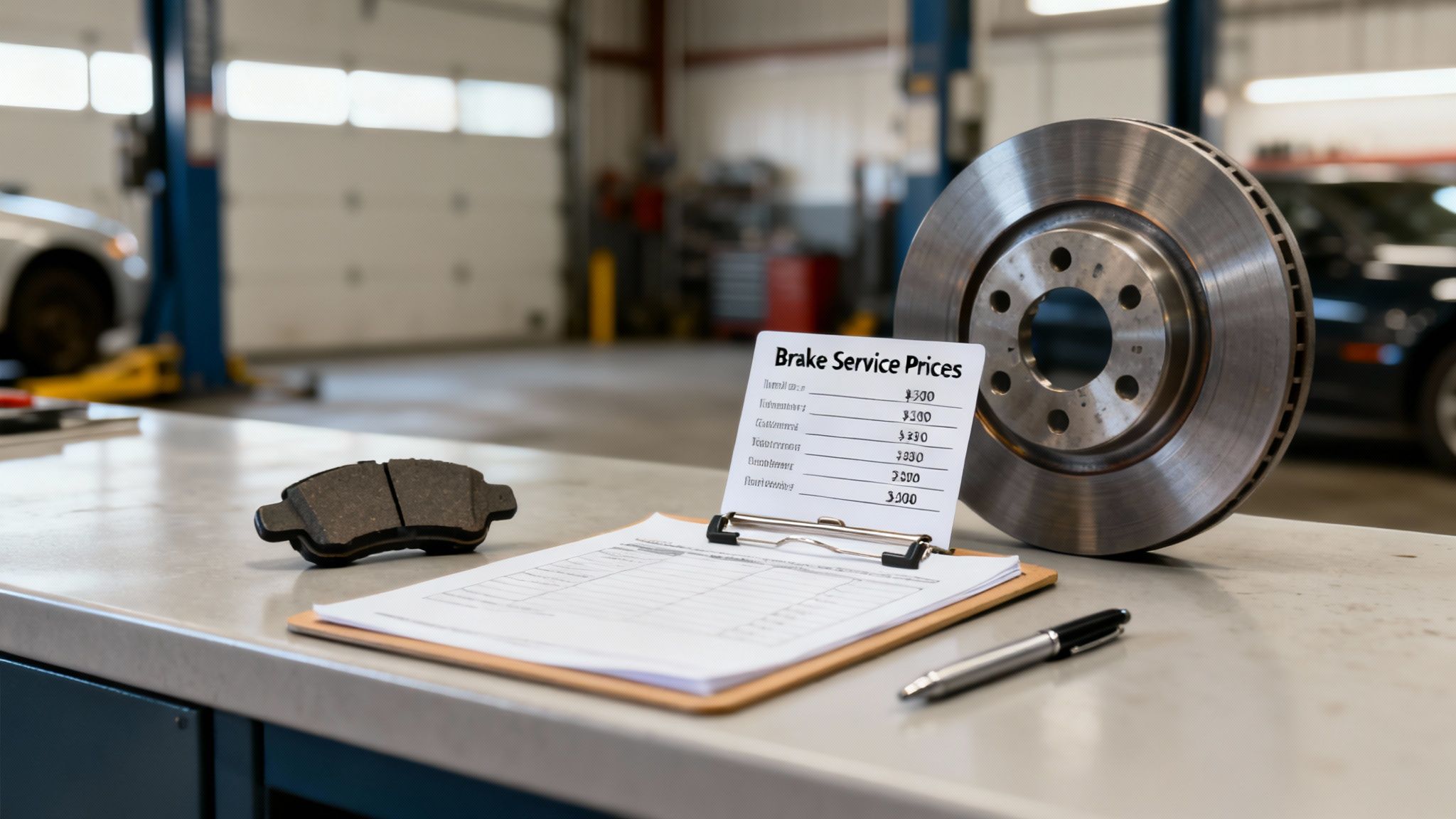
To give you a clearer picture, here’s a quick breakdown of what you can typically expect to pay for the most common brake jobs. Remember, these are estimates for one axle (either the front or rear brakes).
Estimated Brake Service Costs Per Axle
This table provides a quick overview of typical price ranges for common brake services, helping you set realistic budget expectations.
| Vehicle Type | Brake Pad Replacement | Pads & Rotors Replacement |
|---|---|---|
| Car/Sedan | $150 – $250 | $300 – $500 |
| SUV/Truck | $200 – $300 | $400 – $600 |
As you can see, costs can vary based on your vehicle type and the extent of the work required.
Here's that same information in a handy visual format:
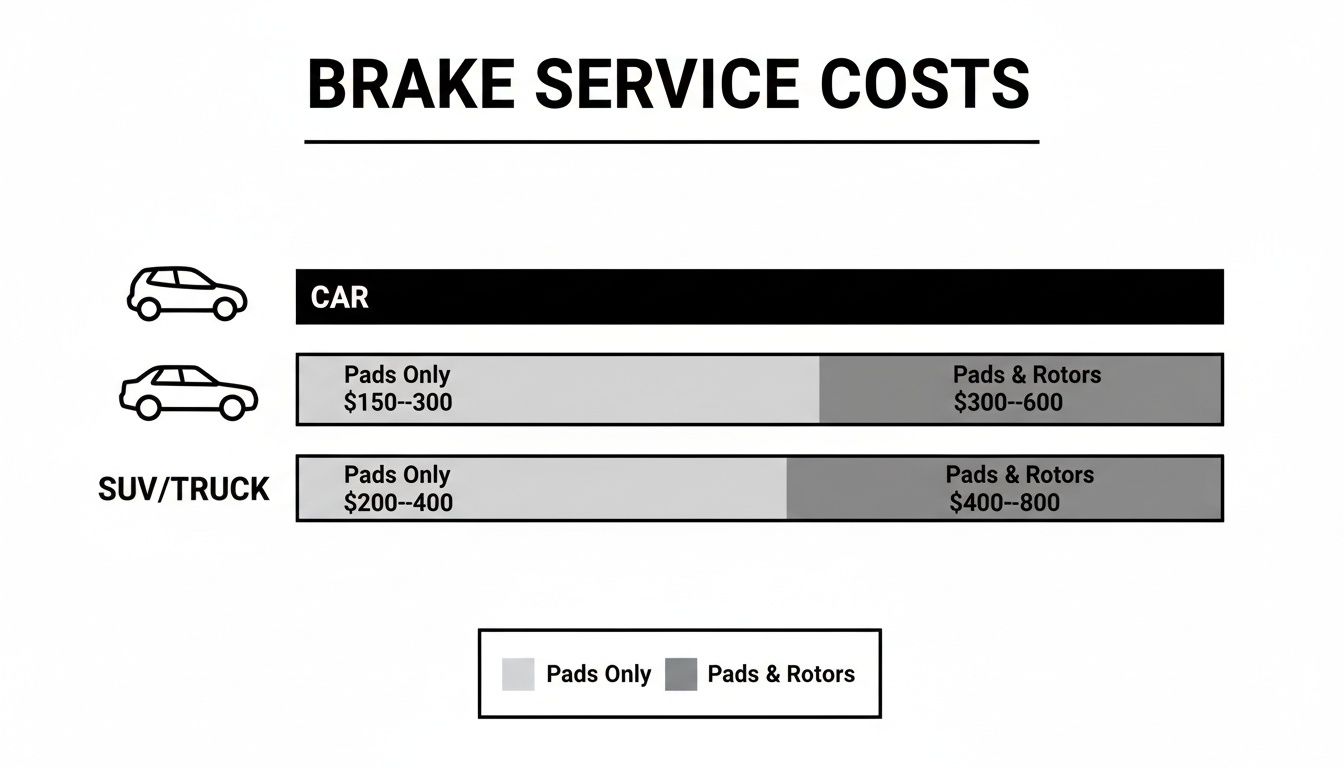
The biggest takeaway? The scope of the work is the number one factor driving the price. A pad slap is affordable, but investing in both pads and rotors is often the right call for long-term safety.
We always start with a complete brake inspection to see exactly what’s going on. From there, we’ll give you a clear, itemized estimate and walk you through our recommendations before we start any work. That way, you can budget with confidence and drive away knowing your brakes are done right.
Decoding Your Brake Repair Estimate: What Really Affects The Cost?
Ever get two different quotes for the same brake job and wonder, "Why is there such a huge difference?" You’re definitely not alone. Figuring out what goes into a brake service estimate is the first step toward finding real value and avoiding sticker shock. The final cost isn't just one number; it's a mix of a few key factors.
Think of it like buying a suit. You can grab one off the rack, or you can have one custom-tailored. Both get the job done, but the materials, the craftsmanship, and the final fit create a massive difference in both price and performance. Brake repair is a lot like that—the parts you choose, the car you drive, and the technician’s expertise all shape the final bill.
Your Vehicle Make And Model
The single biggest driver of your brake service cost is the car you drive. A common sedan like a Honda Civic uses smaller parts that are easy to find and pretty affordable. On the other hand, a big Ford F-150 needs larger, tougher pads and rotors built to handle much more weight and towing stress.
And that price gap gets even wider when you get into performance or luxury vehicles. Brands like BMW or Mercedes-Benz often come with specialized braking systems—think multi-piston calipers and high-performance pads—that carry a premium price tag.
Key Takeaway: The size, weight, and performance of your vehicle directly dictate the cost of its brake components. Heavier and faster cars simply need more stopping power, and that means more expensive parts.
The average cost for brake pad replacement can swing quite a bit depending on the vehicle. For a standard economy car, you can expect to pay somewhere between $150 and $300 per axle for parts and labor. That number jumps to $250–$450 per axle for most SUVs and trucks, which need bigger components. If you're driving a luxury or performance car, it's not uncommon to see prices in the $400–$800 per axle range.
Quality Of Brake Parts
Right after your vehicle type, the quality of the replacement parts is the next big variable. You generally have a couple of choices here:
- OEM (Original Equipment Manufacturer) Parts: These are the exact same parts your car rolled out of the factory with. They guarantee a perfect fit and perform just as the manufacturer intended, but they're also the priciest option.
- Aftermarket Parts: These are made by other companies and come in a whole range of quality levels. You can find premium aftermarket parts that meet or even beat OEM standards, but you can also find budget-friendly options that might not last as long or perform as well.
It really comes down to balancing cost with quality. For a closer look at how these choices impact your final bill, check out our guide on understanding your brake repair cost estimate. Here at Express Lube & Car Care, we help you find dependable parts that fit your budget and your driving style without ever compromising on safety.
What A Proper Brake Inspection Should Always Include
Think of a brake inspection as a complete physical for your car's most important safety feature. It’s not just a quick peek—a professional inspection tells you exactly what’s working, what’s wearing thin, and what needs to be fixed right now. This process ensures you only pay for what your car actually needs.
A deep-dive inspection catches small issues before they snowball into dangerous, expensive failures. When you’re comparing quotes for brake service, knowing what goes into a real inspection helps you tell a professional shop from one that’s just cutting corners. A certified technician won't guess; they follow a strict, hands-on process.
The Visual And Physical Checkpoints
First thing's first: a technician gets their eyes and hands on your entire brake system. This initial once-over is surprisingly important for spotting obvious wear and tear that you’d never notice from behind the wheel.
This always includes:
- Checking Brake Fluid: The technician looks at the brake fluid level and its color. If it's dark and dirty, it means moisture and contaminants have gotten in, which can ruin internal parts and make your brakes feel spongy.
- Inspecting Hoses and Lines: They'll carefully check every inch of the brake lines and hoses for cracks, leaks, or brittleness. Even a tiny leak here can lead to a total loss of braking power.
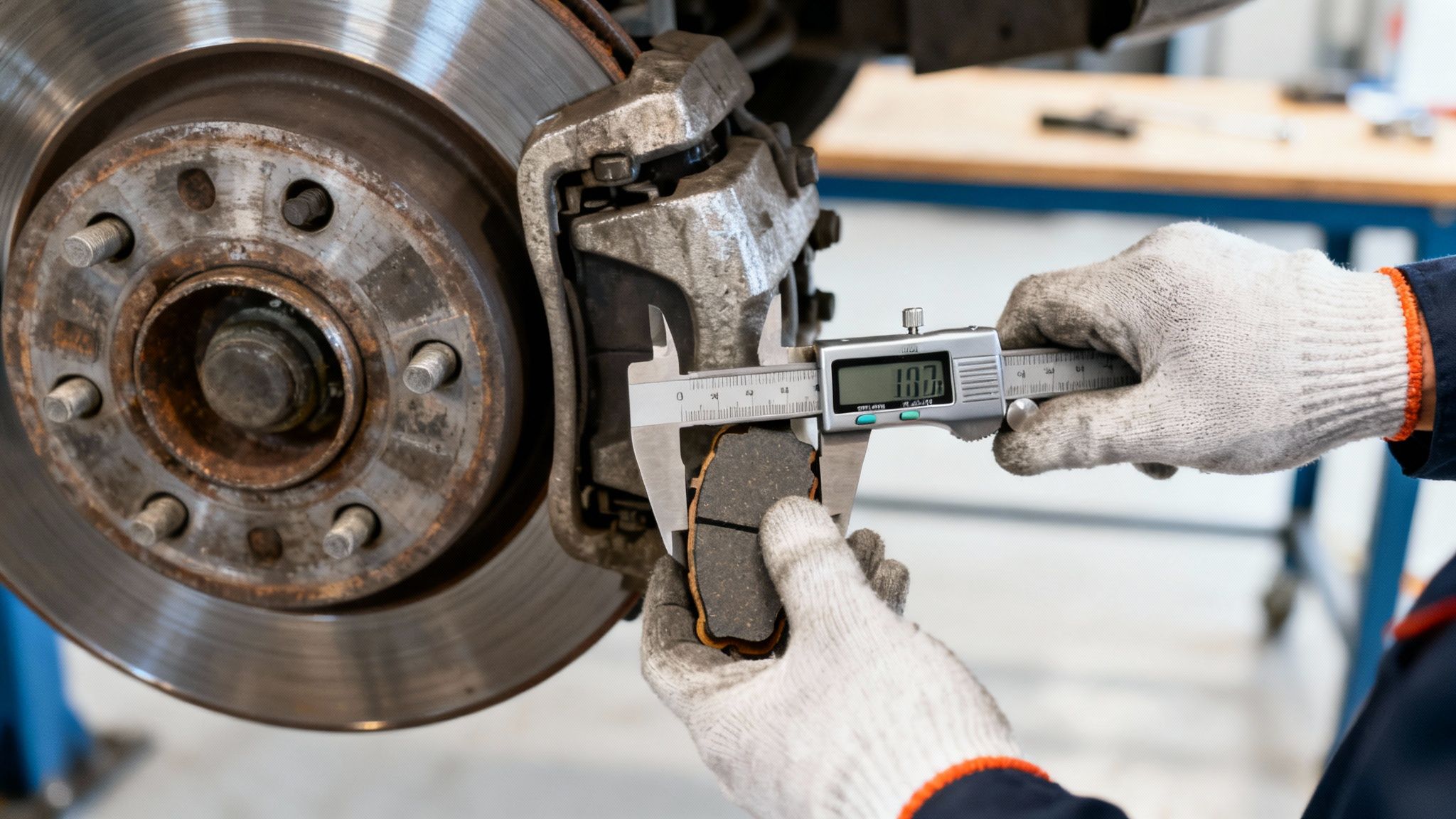
A real inspection isn’t just about looking. It’s about measuring. Technicians use precision tools like a brake pad thickness gauge and a micrometer to get exact numbers, taking all the guesswork out of the diagnosis.
Precision Measurement And Component Analysis
After the visual check, the technician grabs their tools and starts measuring the critical parts to see how much life they have left. This is where real expertise comes in, giving you a clear, data-driven picture of your brake health.
Key measurements and checks include:
- Brake Pad Thickness: Using a specialized gauge, a technician measures the friction material left on your brake pads. New pads typically measure around 10-12mm, while the absolute minimum safe thickness is 3mm.
- Rotor Condition and Thickness: Rotors are measured with a micrometer to make sure they haven't worn down past the manufacturer's minimum thickness. They're also checked for warping (or "runout"), which is what causes that shaky, vibrating steering wheel when you hit the brakes.
- Caliper Function: The technician makes sure the calipers move freely and aren't sticking or leaking fluid. A seized caliper is a classic cause of premature and uneven pad wear.
By following these steps, a technician can give you a complete and honest breakdown of your brake system's condition. This means you get a quote based on facts, not assumptions. At Express Lube & Car Care, this comprehensive inspection is always our first step, so you can drive away knowing you're safe.
Brake Pads, Rotors, And Calipers: Understanding The Core Components
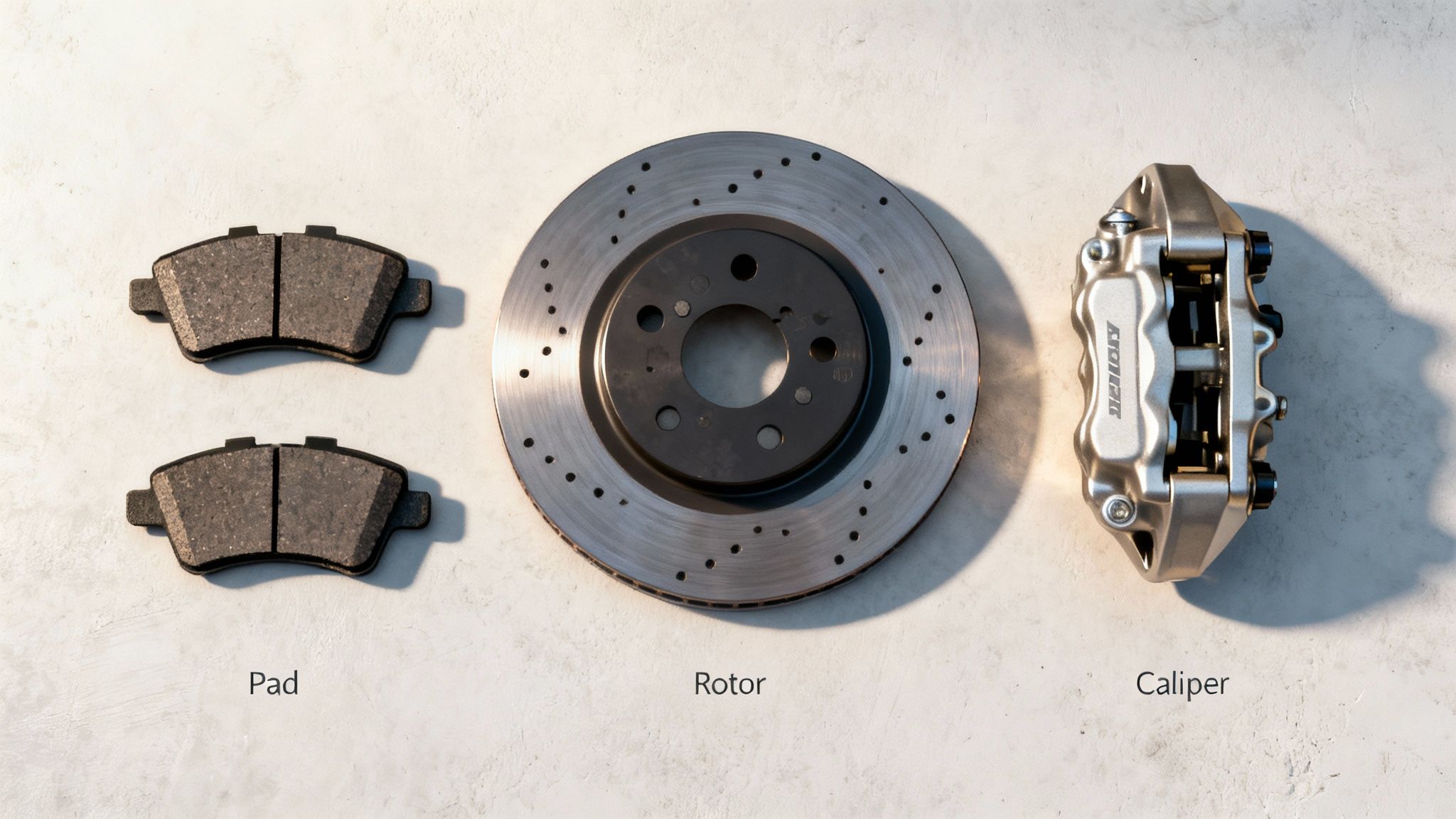
To make sense of brake service prices, you first need to know what you're actually paying for. It's less complicated than you might think. Your car's braking system is a lot like a heavy-duty version of the brakes on a bicycle, where a few key parts work together to bring thousands of pounds of metal to a safe, controlled stop.
Every time you hit the brake pedal, you're giving a command to a trio of components. The brake pads provide the friction, acting like the rubber blocks on a bike brake. They squeeze against the rotors—the big, shiny metal discs that spin with your wheels. The part doing the squeezing is the caliper, a powerful hydraulic clamp. Simple, right?
The Job Of Your Brake Pads
Your brake pads are the true workhorses of the system, and they’re the part you’ll replace most often. Their entire job is to create friction and absorb an incredible amount of heat, so they are designed to wear down over time. This makes them the #1 reason for a brake service visit.
- Lifespan: You can typically expect pads to last between 30,000 and 70,000 miles. This range is huge because it all depends on your driving style, the weight of your vehicle, and the quality of the pads themselves.
- Warning Signs: That classic high-pitched squeal when you brake is the most common red flag. Most pads have a small metal tab that makes this noise once the pad material gets too low, telling you it’s time for a replacement.
The Role Of The Rotors
If the pads are what create the friction, the rotors are the surface they grip onto. These heavy steel discs have to withstand and get rid of all the heat generated from that friction. All that intense heating and cooling eventually takes a toll, causing them to wear thin, develop deep grooves, or even warp.
Ever feel a pulsing or vibration in your brake pedal when you slow down? That's a classic sign of a warped rotor. While old-school, thicker rotors could sometimes be "resurfaced" (machined smooth again), most modern rotors are too thin for this to be a safe option. Replacement is almost always the right call.
You can learn more about how these parts work together in our guide on brake pads and rotors.
The Calipers That Do The Squeezing
The brake caliper is the hydraulic clamp that holds the brake pads. When you push the brake pedal, fluid pressure activates a piston inside the caliper, which forces the pads against the rotor. Calipers aren't a typical "wear and tear" item like pads and rotors, but they can fail over time. The seals can leak, or the piston can get stuck, or "seize."
A seized caliper is a serious problem. It means the brake pad is constantly being pushed against the rotor, causing it to wear out incredibly fast on just one wheel. Worse, the non-stop friction generates extreme heat, which can become a fire hazard.
The cost of these parts is the biggest factor in the final price of your brake service. We’re all part of a massive global industry—the automotive brake systems market was valued at $45.57 billion and is still growing. For a driver like you, that translates to average brake pad replacement costs of $150–$350 per axle, while a full job including new rotors often lands between $300–$600. You can read more about the global market for brake systems to understand how these prices are set.
How To Compare Local Brake Service Quotes Like A Pro
Getting a few quotes when you’re searching for "brake service near me prices" is a great start. But here’s something I’ve learned over the years: the lowest number on the page isn't always the best deal for your wallet or your safety.
Think of it like comparing airline tickets. You see a cheap flight, but then you get hit with extra fees for your bag, your seat, and even a bottle of water. Suddenly, that "deal" isn't so great. A slightly higher, all-inclusive price often ends up being the smarter choice. Your goal is to find that sweet spot—the perfect mix of quality parts, skilled labor, and a fair price.
Essential Questions To Ask Every Shop
To make a true apples-to-apples comparison, you need to dig a little deeper. Walk into any shop armed with these questions, and you'll quickly figure out who's giving you the real story.
- Can I get an itemized breakdown? Always ask for a written quote that clearly separates the cost of parts from the cost of labor. If all you get is one big, vague number, that's a red flag.
- What brand of parts are you using? Are they using OEM (Original Equipment Manufacturer) parts or aftermarket? If they're aftermarket, ask about the quality level—are they economy, mid-grade, or premium? The difference in performance and lifespan is huge.
- What is the warranty on parts and labor? A good shop will always stand behind their work. Get clarity on the warranty for both the components themselves and the installation.
- Is this quote based on a full inspection? A price given over the phone is just a guess. Make sure the estimate is based on a technician actually putting eyes—and hands—on your brakes.
Asking these simple questions helps you see what you’re really paying for. If you want to dive even deeper, our article on how to approach an auto repair cost comparison has some extra tips.
Spotting Red Flags In An Estimate
As you're gathering quotes, keep your eyes peeled for a few warning signs that a shop might be cutting corners or overcharging.
Pro Tip: Never let anyone pressure you into an immediate decision. A trustworthy mechanic will hand you a clear, detailed estimate and give you the space to think it over. High-pressure sales tactics are almost always a way to hide a bad deal.
Be cautious if you see:
- Vague Descriptions: Terms like "complete brake service" mean nothing without specifics. What parts are being replaced? What services are included?
- High-Pressure Tactics: If you hear "this price is only good for today," that's your cue to thank them and leave.
- Refusal to Provide a Written Quote: A verbal promise is worthless. If they won't put it in writing, they aren't willing to stand by it.
Why Richland Hills Trusts Us For Fair Brake Service Prices
Connecting honest information with dependable service is the bedrock of our business. At Express Lube & Car Care, we believe transparent pricing and quality work are non-negotiable, especially when it comes to your car's most important safety system. It's not just about a fair price; it's about providing community-focused service that gives you total peace of mind.
Our commitment starts with our team of ASE-certified technicians. Their expertise means every brake check and repair is done with precision, using dependable parts we stand behind. We never guess. We diagnose the issue first, then give you a clear, itemized estimate so you know exactly what you’re paying for before we pick up a single tool.
Service Built For Your Busy Life
We get it—life in Richland Hills moves fast. That’s why our no-appointment model is designed to fit your schedule, not the other way around. For local families and daily commuters, this means less downtime and a whole lot more convenience.
Peace of mind comes from knowing the job was done right, by professionals who care, at a price that’s fair. That's the value we deliver every single day.
On top of our everyday fair brake service near me prices, we proudly support our community with special discounts. We think it's important to give back to those who serve us all.
- Military & First Responders: We offer savings to thank you for your service.
- Healthcare Professionals: We appreciate your dedication and offer discounts as a small token of our gratitude.
- Ladies Day Specials: Our popular weekly event provides fantastic value on essential car care.
This commitment to affordability is more important than ever. The global automotive brake system market is projected to grow from $23.45 billion in 2023 to $30.10 billion by 2028. By staying efficient and offering these community-focused discounts, we help make vital safety services more accessible for everyone in our area. You can learn more about the growing automotive brake system market and how it affects local pricing.
A Few Common Questions We Hear About Brake Service
We get a lot of the same questions from drivers about brake jobs, and for good reason—it can be confusing. Here are some quick, straightforward answers to the things people ask us most often.
How Often Do My Brakes Need to Be Checked?
As a rule of thumb, it's smart to have your brakes inspected at least once a year or every 12,000 miles. This lets a technician spot worn-down pads or other issues before they turn into a real problem, which usually saves you a headache and some money down the road.
That said, your car is pretty good at telling you when something’s wrong. If you notice any of these red flags, get your brakes checked immediately, even if your last inspection wasn't long ago:
- A high-pitched squeal, a deep grinding sound, or clicking noises.
- The brake pedal feels "mushy" or sinks to the floor.
- Your car pulls to one side when you hit the brakes.
- You feel a vibration or shudder through the steering wheel when braking.
Can I Just Get New Brake Pads and Keep My Old Rotors?
Sometimes, but it's getting less common. If your rotors are still thick enough and haven't warped or developed deep grooves, a technician can sometimes resurface them. This just means they machine the surface down until it's perfectly flat and smooth for the new pads.
However, most cars today come with thinner, lighter rotors to improve fuel economy. There's often not enough metal left to safely machine them down. In that case, replacing them is the only safe option.
The only way to know for sure is to have a pro look at them. A technician will use a micrometer to measure the rotor's thickness and compare it to the minimum spec set by your car's manufacturer. It's a game of millimeters, and safety is the top priority.
Is It Cheaper to Buy My Own Parts Online?
It might look cheaper at checkout, but most professional shops won't install parts that a customer brings in. It's not because they want to make a few extra bucks on the parts—it's about liability and quality control.
A shop can't warranty a part they didn't source themselves. If that part fails, they can't stand behind the repair, and you're stuck in the middle. By using their trusted suppliers, they know they're installing quality components they can guarantee with a full warranty on both the parts and the labor. That peace of mind is worth a lot.
For a clear, honest look at your brakes and straightforward pricing, you can count on the ASE-certified team at Express Lube & Car Care. Swing by anytime—no appointment needed—or visit us online to learn more.