

So, what does it mean when a mechanic is ASE certified?
Simply put, it means they’ve passed tough, standardized tests and have proven, hands-on professional experience. Think of it like a board certification for a doctor—it's a verifiable seal of approval from the National Institute for Automotive Service Excellence (ASE), showing they’re at the top of their game.
The Real Difference an ASE Certified Mechanic Makes
When your car needs work, you're not just looking for someone who can turn a wrench. You need a trusted expert who can find the problem fast and fix it right the first time.
The gap between a hobbyist and an ASE-certified professional is huge. That little blue seal isn't just a sticker on the window; it's a promise of skill, quality, and your safety.
Imagine a tricky electrical issue is making your dashboard light up like a Christmas tree. Someone without formal training might start swapping out parts, hoping to get lucky. That’s a guessing game that costs you time and money.
An ASE-certified technician, on the other hand, approaches it systematically. They use their proven knowledge to trace the problem to its source, saving you from paying for unnecessary repairs and getting you back on the road with total confidence.
A Mark of True Expertise
The ASE credential immediately separates a technician from the pack. Since its founding back in 1972, the ASE has set the benchmark for professional excellence in the auto repair industry.
Of the more than 652,000 auto mechanics working in the U.S. today, only about 250,000—just 38%—are currently certified. That number really shows what a significant achievement it is. You can learn more about the national landscape of auto technicians on ConsumerAffairs.com.
ASE Certified vs Non-Certified Mechanic At a Glance
So what does this difference look like in practice? This table breaks down what you can expect when you choose an ASE-certified pro versus someone without the same credentials.
| Attribute | ASE Certified Mechanic | Non-Certified Mechanic |
|---|---|---|
| Qualifications | Passed multiple ASE exams & has 2+ years of verified hands-on experience. | No verified training, experience, or standardized testing required. |
| Diagnostic Skill | Follows systematic, proven methods to accurately find the root cause. | May rely on guesswork, leading to unnecessary part replacements. |
| Accountability | Adheres to a professional code of ethics and must recertify every 5 years. | No formal accountability or requirement for ongoing education. |
| Quality of Repair | High-quality, reliable repairs that are done right the first time. | Inconsistent quality; higher risk of the problem returning. |
| Customer Benefit | Peace of mind, enhanced vehicle safety, and long-term cost savings. | Potential for higher costs, repeat visits, and safety risks. |
Choosing an ASE-certified professional gives you a clear, reliable signal of their capabilities before you even hand over your keys. It’s your assurance of a higher standard.
This distinction translates directly into tangible benefits for you:
- Higher Quality Repairs: Problems get fixed correctly, which means you won't be back for the same issue next week.
- Enhanced Vehicle Safety: You can trust that critical systems like your brakes and steering are serviced by a proven expert.
- Greater Accountability: Certified technicians follow a strict code of ethics, which means you get honest and transparent service.
When you choose a shop that prioritizes ASE certification, you’re not just buying a repair. You’re investing in peace of mind, knowing your vehicle is in the hands of a dedicated, qualified professional. At Express Lube & Car Care, our commitment to staffing ASE-certified technicians is how we deliver superior, trustworthy service every single day.
The Path to Earning the ASE Blue Seal
You can’t just sign up for a weekend class and walk away with an ASE certification. Think of it less like a training course and more like earning a professional degree in automotive repair. It's a tough process that proves a technician has both real-world, hands-on experience and the deep technical knowledge to back it up.
This isn’t just about passing a test. The journey to earning the ASE Blue Seal is built on two key requirements.
The Two Pillars of Certification
The entire system is designed to be demanding, which is why the certification carries so much weight in our industry. Here’s what it takes:
- Prove Your Experience: First, a technician has to prove they’ve put in the time. They need a minimum of two years of documented, on-the-job experience. This ensures they’ve spent their days actually diagnosing and fixing cars, not just reading about them.
- Pass the Test: Once they have the experience, they have to pass one of the tough, specialized ASE certification exams. These aren’t general knowledge tests; they’re deep dives into specific vehicle systems.
It's a system that filters for true expertise. It proves a technician has the "book smarts" to understand why a part failed and the "street smarts" to fix it right the first time.
This path—from proven experience to rigorous testing—is what makes the ASE Blue Seal a credential you can actually trust.
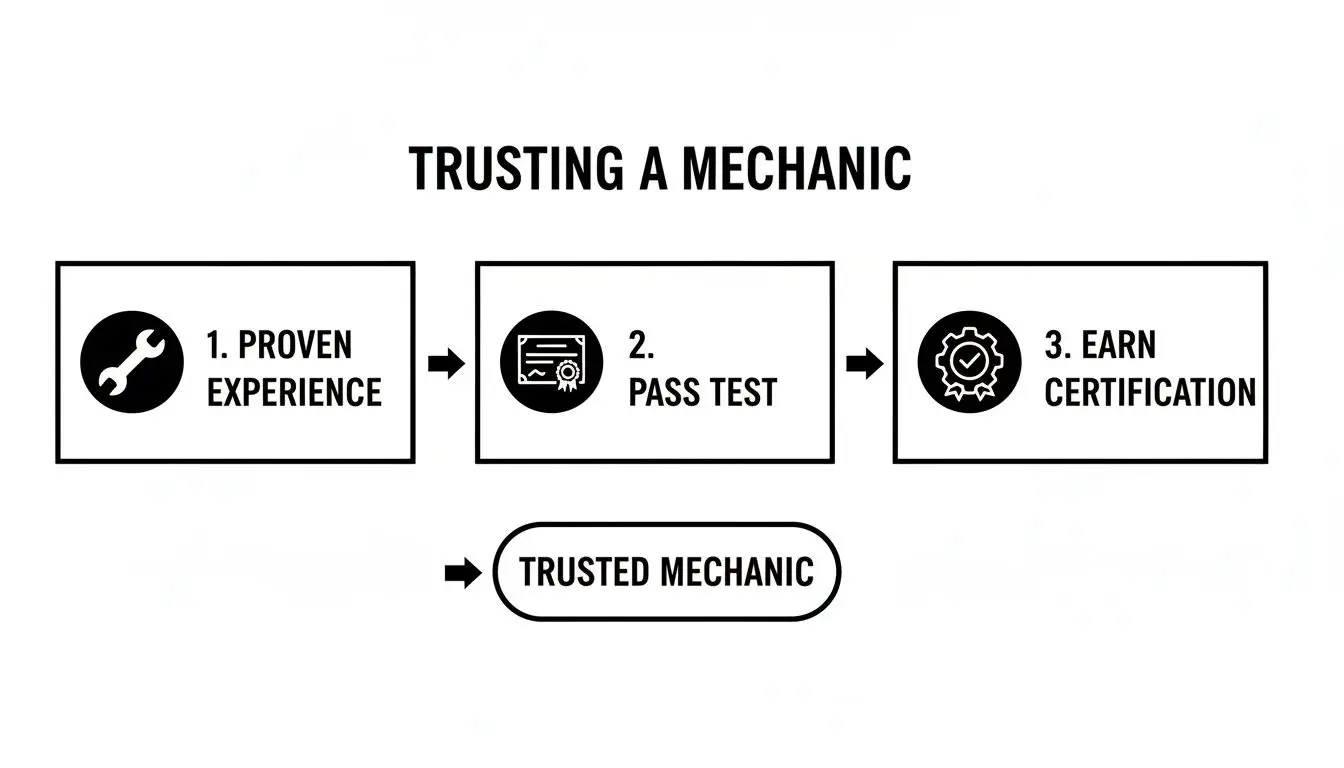
It’s this combination of knowing and doing that really separates an average mechanic from a true professional.
More Than Just One Test
There's no single, generic "mechanic test" from ASE. Instead, technicians can earn certifications in 22 distinct specialties, from A1 Engine Repair to highly advanced L1 and L2 diagnostic certifications. These tests are administered at secure computer-based testing centers.
This specialization is a huge deal for you as a customer. It means the person working on your brakes has proven they are a brake expert, and the tech diagnosing your engine is a certified engine pro.
It’s a demanding path, which is why it’s become the gold standard. Out of over 879,000 technicians in the U.S., those who commit to this process truly stand out. You can read more about how the auto repair industry is evolving on AftermarketMatters.com. This dedication is exactly what you should look for in the shop you trust with your vehicle.
Understanding the Levels of ASE Expertise
When you see that ASE logo, it’s a good sign, but it’s important to know there are different levels of certification. Think of it like a career path—there’s a huge difference in experience between someone just starting out and a seasoned veteran who has seen it all. The same is true for auto technicians.
A mechanic first becomes ASE certified by passing at least one specialty exam and having two years of proven, on-the-job experience. This certification shows they have a professional-level understanding of a specific area, like Brakes (A5) or Electrical Systems (A6). It’s a fantastic accomplishment, but it's really just the first step.
Reaching Master Technician Status
The next level—and the one that truly sets a technician apart—is becoming an ASE Master Automobile Technician. This isn’t just about adding one more credential. It's about proving comprehensive expertise across nearly every system in a modern car.
To earn this top-tier title, a mechanic has to pass a tough series of eight specific exams, known as the A1 through A8 series.
Earning Master Technician status is a major milestone. It signals that a mechanic has the breadth and depth of knowledge to diagnose and repair the most complex issues, from a complete engine rebuild to tricky electronic glitches.
This elite status is the industry’s way of identifying a true expert who can tackle just about any problem your car throws at them. It’s a standard we take seriously, which is why we’re also proud to be RepairPal certified on expressluberichlandhills.com, another mark of our commitment to quality and trust.
The A1-A8 Test Series
The road to becoming a Master Automobile Technician means mastering all of the following core areas:
- A1 – Engine Repair
- A2 – Automatic Transmission/Transaxle
- A3 – Manual Drivetrain & Axles
- A4 – Suspension & Steering
- A5 – Brakes
- A6 – Electrical/Electronic Systems
- A7 – Heating & Air Conditioning
- A8 – Engine Performance
When you work with a Master Technician, you can feel confident you’re dealing with a pro who has put in the work to prove their skills. This higher standard brings peace of mind, especially when you’re facing a strange noise or a complicated repair.
By knowing the difference between "certified" and a "Master," you can make a much better choice about who works on your vehicle.
How Certification Translates to Safer and Better Repairs
An ASE certification is more than just a piece of paper on the wall—it’s a direct promise of quality work and on-road safety. When you choose an ASE-certified mechanic, you're not just hiring someone who likes cars. You’re working with a pro who has proven they can diagnose and fix vehicles to a national standard.
That expertise translates into real-world benefits you’ll notice immediately, starting with accuracy. A certified technician has the skill to find the root cause of a problem the first time. That means no more frustrating return trips to the shop to fix the same issue over and over again.
The Check Engine Light Scenario
We’ve all been there: the dreaded check engine light flicks on. It could be anything from a loose gas cap to a critical engine misfire. Someone without proper training might start guessing, throwing parts at the problem in a costly process of elimination. That approach drains your wallet fast and still leaves you with an unreliable car.
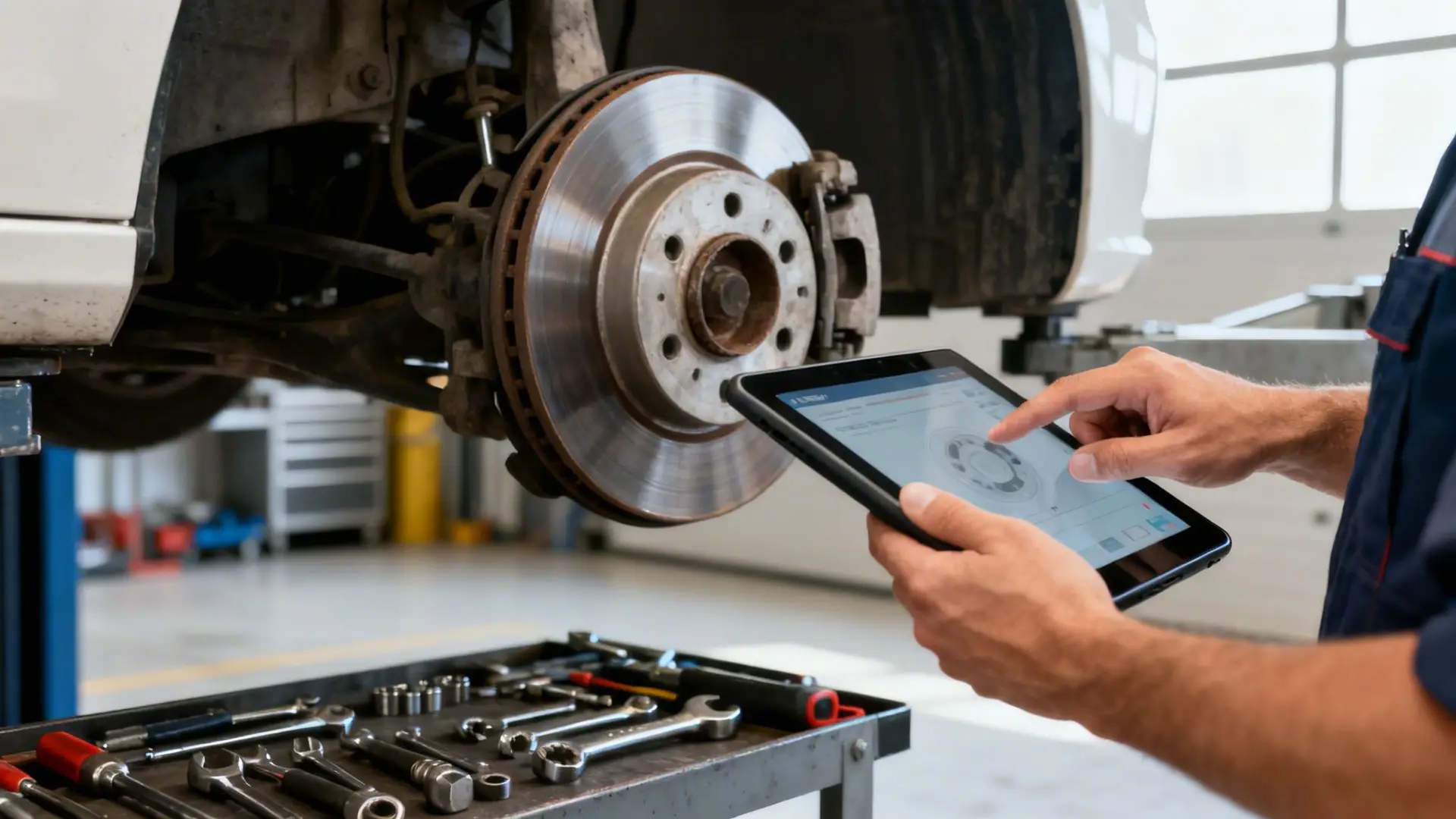
An ASE-certified professional, on the other hand, attacks the problem methodically. They use their deep knowledge of how your car works, combined with advanced diagnostic tools, to read the error codes and pinpoint the exact fault.
A certified technician doesn't just treat the symptom; they cure the disease. Their proven diagnostic process means a faster, more effective, and ultimately cheaper repair, giving you confidence that the problem is truly fixed.
A Commitment to Your Safety
Beyond just saving you money, choosing a certified technician is one of the most important investments you can make in your own safety. Your vehicle’s most critical safety systems demand an expert’s touch.
These systems include:
- Brakes: A mechanic with an A5 Brake certification has proven their skill with calipers, rotors, and hydraulic systems, ensuring your car stops safely every time.
- Steering & Suspension: An A4-certified technician understands the complex geometry that keeps your car stable and responsive, preventing dangerous handling on the road.
- Electrical Systems: With an A6 certification, a pro can properly sort out issues with everything from your headlights to your airbags, stopping catastrophic failures before they happen.
Ultimately, knowing a verified expert is working on your vehicle brings an invaluable peace of mind. That ASE Blue Seal tells you the technician is accountable, professional, and dedicated to the highest standards. It’s your guarantee that the person under your hood is committed to your car’s health and your safety.
How to Find and Verify an ASE Certified Mechanic
So you understand that an ASE-certified mechanic is the gold standard. But how do you make sure the shop you’ve chosen—or the technician working on your car—is the real deal? Becoming a savvy car owner is all about knowing what to look for, and it only takes a few quick checks.
Start with your eyes. Good shops are proud of their team’s qualifications and aren't shy about showing them off. Look for an official ASE Blue Seal of Excellence sign near the service counter or in the waiting area. This seal means the shop has made a serious commitment to having certified professionals on staff.
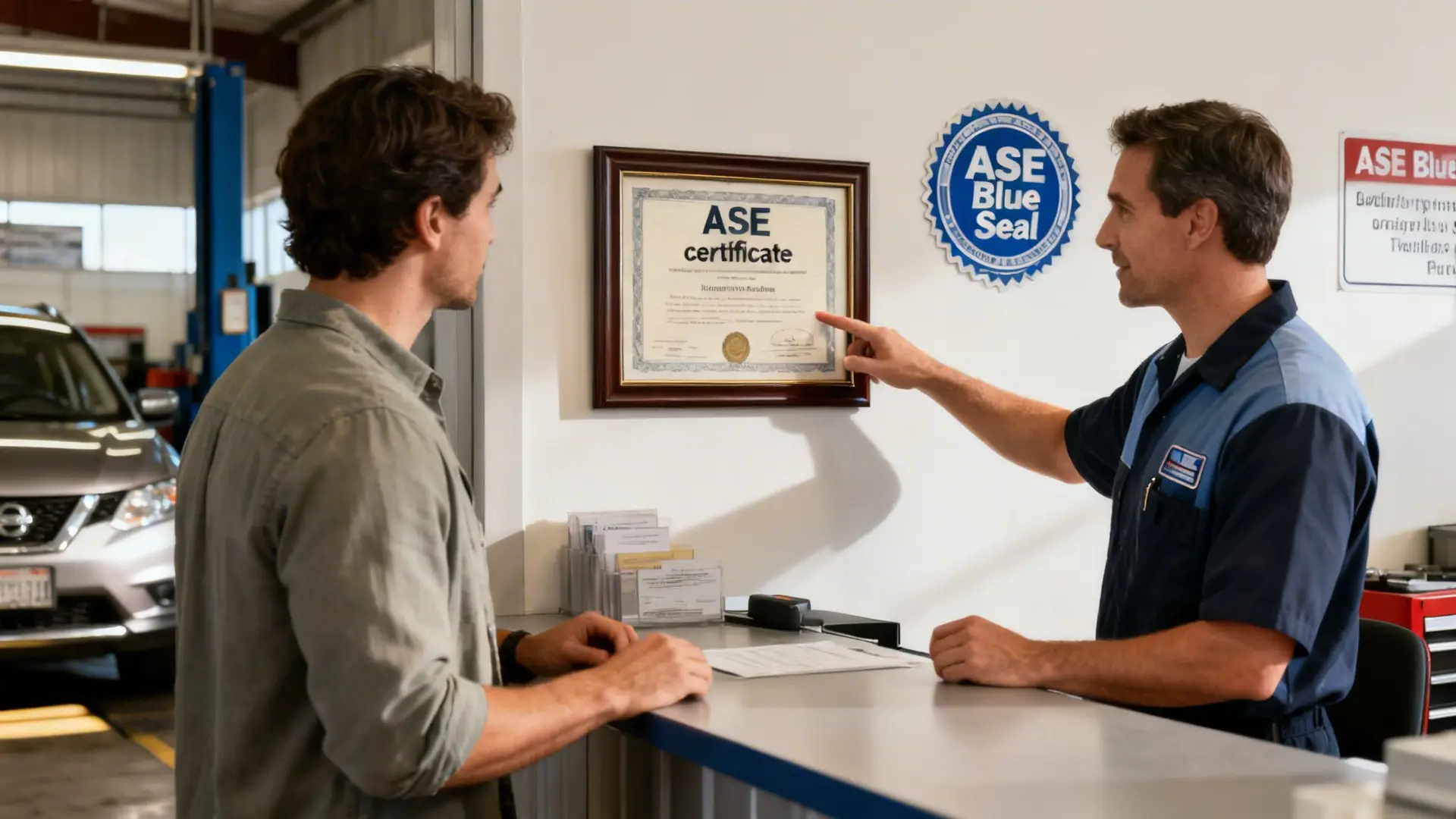
You should also see the individual technicians' certificates displayed on a wall. These will list each mechanic by name and show exactly which areas they’ve proven their expertise in.
Smart Questions to Ask Any Shop
Never hesitate to ask a few questions before you hand over the keys. Any shop worth your business will appreciate that you care about quality and will answer your questions openly. It's the fastest way to build trust.
Asking about credentials isn’t rude; it’s smart. It shows you’re an engaged car owner, and any true professional will respect that.
Here are a few key questions that will tell you everything you need to know:
- Are your technicians certified for my specific repair? A general certification is great, but a specialist is even better. If you need brake work, you'll want a technician who holds an A5 Brake certification.
- Can I see the certifications for the tech working on my car? This is a perfectly fair request. The certificate should have their name and an expiration date. Remember, all ASE credentials must be re-earned every five years.
- Is every mechanic here ASE certified, or just one or two? This is a big one. A shop can advertise "ASE Certified" even if only one person on a large team holds a single certification. Getting clarity here helps you know who is actually working on your vehicle.
Asking these questions is a key part of choosing a new auto shop. If you want more tips, check out our complete guide on how to find a good mechanic.
Finding Your Trusted Local ASE Certified Experts
It’s one thing to know what ASE certification means. It’s another to find a local shop that actually puts that standard into practice. For drivers here in Richland Hills, that search ends with us. At Express Lube & Car Care, we’ve built our shop around the promise of ASE-level expertise combined with the no-hassle convenience you need.
We simply don't believe you should have to choose between fast service and a job done right. That’s why our team is made up of dedicated, ASE-certified technicians who bring that proven expertise to every single car that rolls into our bays.
Quality and Convenience in One Place
Our reputation in the community is built on trust, and our commitment to ASE certification is a huge part of that foundation. Whether you’re stopping by for a quick oil change or need help with a complex engine diagnostic, the person working on your car is a qualified professional who meets the industry's highest bar.
This commitment is exactly what makes our no-appointment, walk-in model work. Our certified technicians have the experience to find the real problem quickly and fix it correctly the first time.
That means you get back on the road faster, with total confidence that your car is safe and the repair is solid. We bring the rigorous standards of ASE together with the friendly, transparent service you’d expect from a neighborhood shop.
Your Go-To Hub for Certified Expertise
We don’t just hire ASE-certified mechanics—we live by the principles of quality and accountability they stand for. Modern cars are incredibly complex, which is why we know ongoing training and recertification aren't just optional; they're essential. By investing in our team's skills, we’re investing in your vehicle’s health and performance for the long haul.
All of our services are performed to strict ASE standards, including:
- Routine Maintenance: From fast oil changes to fluid top-offs, we keep your car running smoothly.
- Brake Service: Our certified brake experts ensure you have reliable stopping power when it matters most.
- Engine & Transmission Work: We tackle the big, complex jobs with the skill and precision they demand.
If you want to get ahead of potential issues, our guide on creating a local car maintenance schedule is a great place to start. At Express Lube & Car Care, we’re not just here to fix cars. We’re here to build lasting relationships with our customers through dependable, expert service—one repair at a time.
Common Questions About ASE Certification
Even after understanding what makes an ASE-certified technician different, a few questions always seem to pop up. Let's tackle them head-on so you can feel completely confident the next time your car needs service.
Think of this as a quick FAQ to clear up any lingering doubts.
Do ASE Certifications Expire?
Yes, they do—and that's one of the best parts of the system. ASE certifications are only good for five years. To keep their credentials, technicians have to hit the books and pass a tough recertification exam for every single specialty they hold.
This rule forces them to stay on top of the constant changes in automotive technology. It’s your guarantee that the mechanic working on your car isn’t relying on old knowledge from a decade ago.
An ASE-certified tech is someone who is actively proving their skills are sharp enough for today's high-tech vehicles. They don't just get certified once; they have to re-earn it.
Is an ASE Certified Mechanic More Expensive?
That’s a common myth, but the answer is almost always no, especially when you look at the big picture. A shop that invests in highly skilled technicians will have competitive labor rates, but your total repair cost is often lower.
Why is that? Because an expert gets the diagnosis right the first time. That accuracy saves you a ton of money and frustration by avoiding:
- Parts-Swapping: You won’t pay for parts your car never needed in the first place.
- Comebacks: The job gets done correctly, so you aren't making frustrating return trips for the same issue.
- Wasted Labor: A fast, accurate diagnosis means fewer billable hours on your invoice.
Choosing an expert isn’t about finding the cheapest hourly rate. It’s about getting the best value and a repair that lasts.
Are All Mechanics at a Certified Shop ASE Certified?
That’s a fantastic and very important question. A shop can advertise that it employs ASE-certified technicians even if not every single person on the floor is certified. Some might be apprentices or general service techs still working their way up.
For any major repair, it's always a good idea to ask if the specific mechanic working on your vehicle is certified in that area (like brakes, transmissions, or engine performance). A good, transparent shop will have no problem answering that question.
When you need service you can count on, look no further than Express Lube & Car Care. Our team of ASE-certified technicians is ready to provide the expert, honest service your vehicle deserves. Visit us in Richland Hills today for fast, reliable car care.